The stories of people are so moving when they come from their own lips. With the power of the spoken word, the idiom, the tone and volume of their voice. You are shaken when you hear Michalis Protopsaltis, a Kythirian who found his fate far from Greece, on another continent, talking about that uprooting. «I didn't know what life would be like in Australia... Nothing. Everything was in the dream.» -What preparations did you make for the trip? «Nothing at all. I just got a jacket from my father. They were up to my ankles. I knew poverty... And I hoped I'd find something to eat and become a man...».
The stories of the people who left the wild, impoverished scenery of post-civil war Greece for a better life are the subject of the educational programme «Kythera: Stories that build bridges,» currently underway on Tsirigo, an island ravaged by migration.
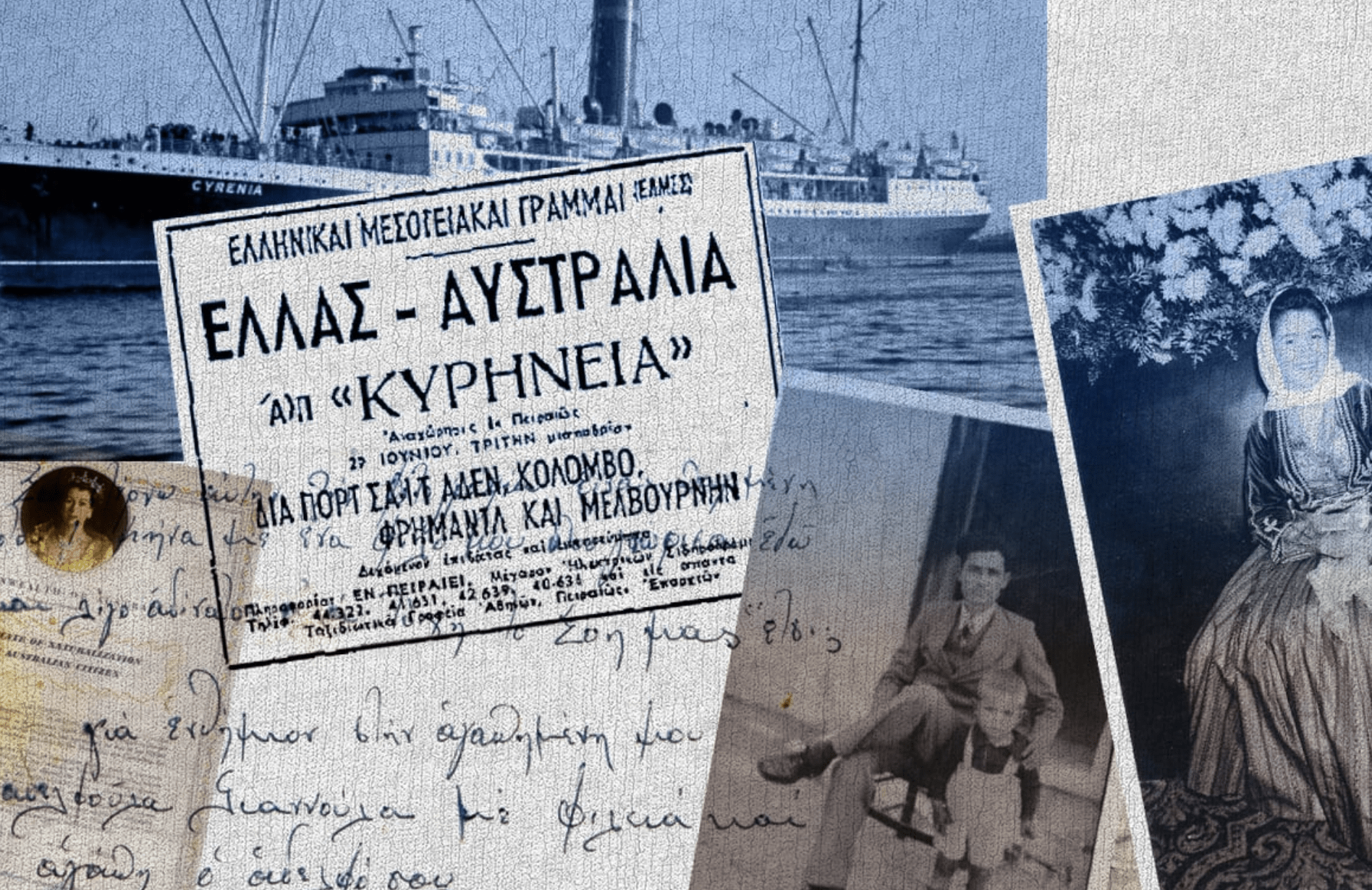
The first phase of the project was implemented by the 6th Regional Educational Design Centre of Attica in collaboration with students and teachers of Primary and Secondary Education of Piraeus, as well as with the support of the Kytheraic Association of Athens and the Nicholas Anthony Aroney Endowment.
The scientific guidance of the programme was provided by the Association of Oral History and the Postgraduate Programme «Public History» of the Hellenic Open University.
The participants attempt a biographical approach to the migration history of Kythera. They compile a memory archive, honouring those people who started from Kythera with different dreams, to take part in the difficult journey of migration to Australia.
The bet of memory
«The French historian Pierre Nora speaks of a deficit in the living transmission of memory from one generation to the next,» Archontia Mantzaridou, one of the teachers who is the «soul» of the programme, tells Protagon. «The interviews with Kytherians who emigrated are without a doubt an important historical source for the local history of the island, but also for the preservation of memory.».
He adds: «Students from schools in Kythera, Australia and New York will interview family members who still have memories and can tell their own migration story or the story of their parents or grandparents. What will emerge will be a set of stories from three continents, but with one starting point, Kythera. The stories will be studied with a view to identifying elements in them that unite them.
«The meeting of two or three stories will become the primary material for the design of a common story. The original stories will pass the baton to each other and through this synthesis and the plurality of valuable testimonies a new story will be created each time, which will have more to say through the synthesis of its parts. What will bring the stories together we do not yet know.».
The occasion can be a village, a date, a person, an object. In the end, the connected stories will form the pieces that will form the puzzle of memory for one of the most important pages of the history of Kythera and the history of migration in Greece.
«Through the educational programme, history is not an academic narrative in a textbook, but is experienced by the students, personified in a person, evolving through the narrative in which they participate, both during the course of the story, with the questions they ask the witnesses, and afterwards, through analysis, synthesis and comparison».
The programme “Kythera: Stories that build bridges” is an innovation in connecting and interacting all levels of school education. The shared stories are researched and created by each student group, which adds its own contribution to the completion of the project.
The witnesses
Late 50s - early 60s. The journey to the other continent took 27, 28, 29 days, almost a month. The narratives illuminate the ’how’, but also the «before» and «after».
Dimitris Pavlakis: «We had to accept an invitation to go to Australia. We had to be asked to go on an invitation to participate in an invitation to visit Australia. (...) We needed certificates from the police (...), from the tax office (...), health examinations at the Australian consulate in Athens. (...) It was not such a pleasant trip. 1,200 migrants on board, me in a cabin with six others».
Philip Slavos: «We didn't know anything about Australia (...) In the days we were on the ship, we children went to a room every morning. We were taught the English alphabet, we were told words. Our parents went to another room. They were told about the customs and traditions in the new country. They were told what they had to deal with...»
Photographs from the ships, the «Patris», the «Ellinis», capture the black and white yesterday of emigration. Almost 14-16 hours of work a day in the first years, and seven days a week.
Dimitris Lourantos: «The fare was 12,500 dirhams, when the daily wage was 30 dirhams (...) I happened to know a little English so I didn't go to work in the kitchen, I became a waiter (...) They gave us shelter, food. We were left with clean money, we were sent to Greece to help our family».
Vasiliki Hlenzhou wanted to leave when she was 12 years old, she saw no future on the island. When she accepted her uncle's invitation she was a teenager. But she belonged to the exceptions, she travelled by air, a month by boat was a dangerous mission for the young girl of that time. Her pity was that she had left her childhood love behind on the island... She is moved as she recounts how her uncle realized this and extended a second invitation, to him.
Young Vasiliki shines in her wedding photo. She lived well, had her nice house, her shop. Although the place was foreign and every thought wanted life there to be temporary, returning home was painful. «Two lives to live I will not cry as much as I cried when we sold the store to leave.».
Evanthia Douvris - Protopsaltis speaks with incredible sweetness about Melbourne, the city where she grew up. She was a little girl when she left the island. She remembers her mother holding their hands, she and her sister, as they boarded the ship. She remembers the steward leading them to the cabin of the «Ellinis». 1963. First stop Egypt.
Manolis Kasimatis: «27 days of travel. 1962. 12 days in the Indian Ocean, without seeing any land, no land at all. And we arrived in Perth, Australia's first port. There we saw other things. Order, cleanliness, cities, nice things (...) In Sydney we got out at 8.20 in the morning, on 29 July 1962! (...) Some people were waiting for the brides with bouquets...»
The identity of the project
In the project kits, witnesses are recorded in pairs/groups with the interviewers.
Evanthia Duvri - Protopsaltis (interviewed: Anthi Mavromati, Panagiota Semitekolo, Eleni Tzane), Athanasios Zantiotis (interviewed: Anita Hatzi and students of the Kindergarten of Potamos Kythira), Dimitrios Zantiotis (interview: Anita Hatzi and students of the Kindergarten of Potamos Kythira), Manolis Kasimatis (interview: Giorgos Lourantos and students of Kythera Gymnasium), Dimitris Lourantos (interview: Maria Lourantou), Dimitris Pavlakis (interview: George Lourantos and students of Kythera Gymnasium), Michalis Protopsaltis (interview: Stavroula Protopsaltis), Filippos Slavos (interview: Stavroula Protopsaltis), Vasiliki Hlenzou (interview: Archontia Mantzaridou).
The students of the primary and secondary education units of Kythera, based on the interviews, used teaching techniques of oral history and created the portrait of each witness through the story line of his life, They interpreted the interviews reflectively using the tools of dialogue and strategies of Project Zero of Harvard University, and adapted the oral testimonies into theatrical performances and poems.
The Educational Project Coordinators of the 6th P.E.K.E.S. of Attica who supported the project during its first phase are: Stefanos Ziovas (S.E.E. Informatics), Panagiotis Pappas (S.E.E. Physical Education), Panagiotis Pephanis (S.E.E. Science), Maria Kaskantami (S.E.E. Philology), Achilleas Mandrikas (S.E.E. Education for Sustainability), Archontia Mantzaridou (S.E.E. Education for Sustainability), Archontia Mantzaridou (S.E.E. Teachers), Eleftherios Mastoridis (S.E.E. Mathematics), Kyriaki Melliou (S.E.E. Kindergarten teachers), Anastasia Messari (S.E.E. Literature), Eleni Baliou (S.E.E. English Language), Naya Boemi (S.E.E. Theatre Education), Panagiotis Fatseas (S.E.E. Applied Arts).
Last November marked the start of the second phase of the programme.