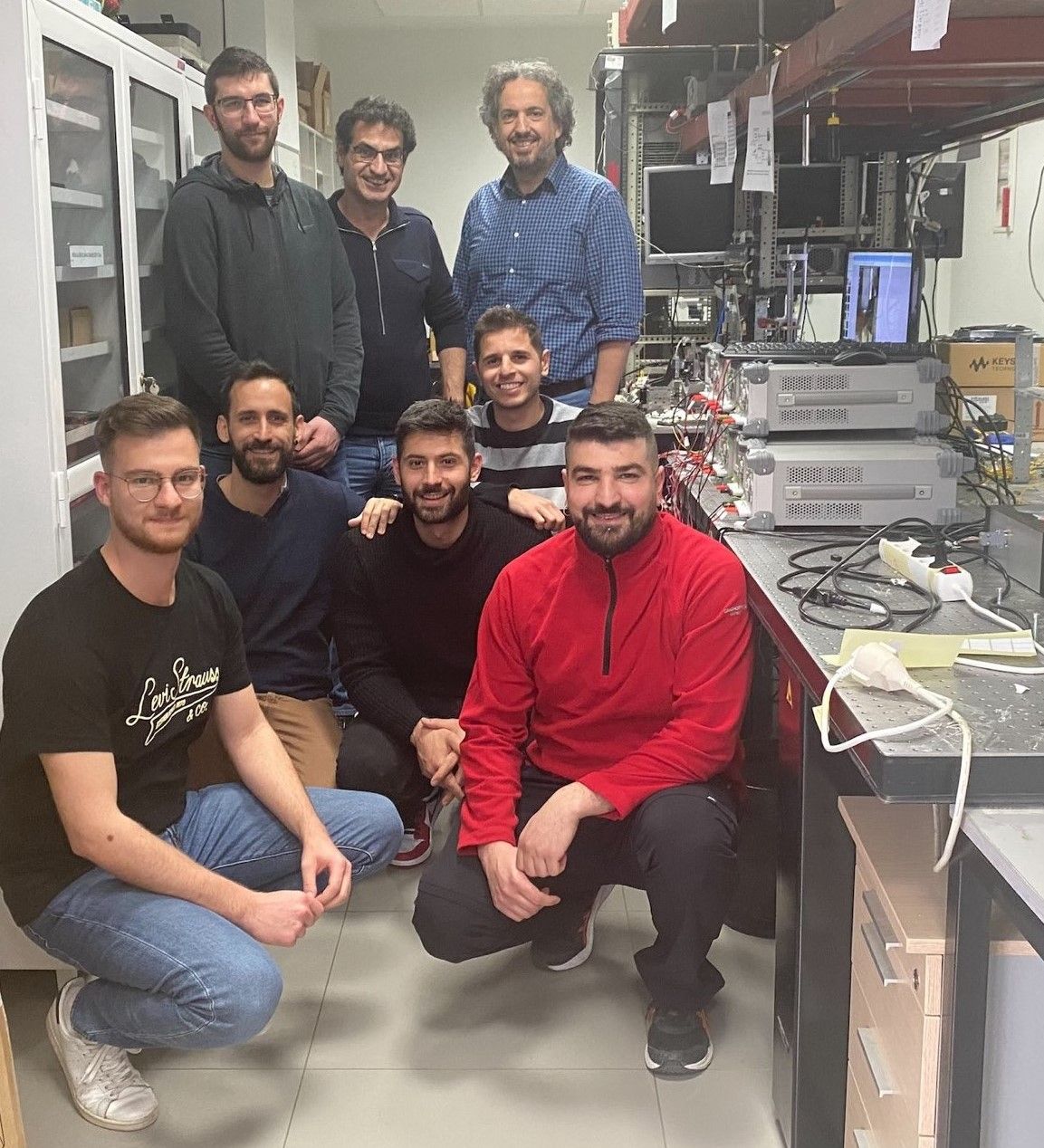
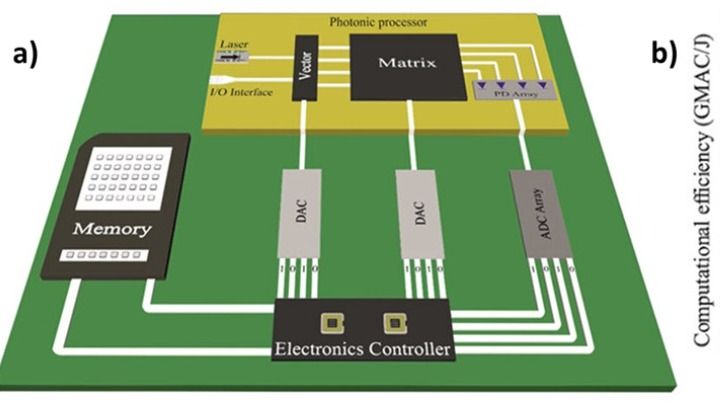
The world's fastest artificial intelligence processor, which consists of photonic neurons and operates using light instead of electricity, was created by the research team at the Department of Computer Science at Aristotle University of Thessaloniki (AUTH). According to an announcement by AUTH, the processor is based on a novel photonic neuron architecture, which enables the execution of algebraic operations at very high speeds, while simultaneously utilizing innovative neural network training techniques. This combination led to the experimental demonstration of a photonic processor operating at speeds of up to 50 GHz (>25 times faster than modern GPUs) while consuming 10 times less energy.
In remarks to the Athens-Macedonian News Agency (ANA-MPA), Miltiadis Moralis, a postdoctoral researcher in the Department of Computer Science at Aristotle University of Thessaloniki – Pegios explained that a global effort is underway to build computing systems using alternative methods, because microelectronics technologies have reached their physical limits related to the size of electronic transistors. One of the emerging technologies uses light, which, as an electromagnetic wave, is faster and does not cause interference in integrated optical circuits compared to electric current. The benefits of using light include speed as well as lower energy consumption. At this stage, according to Mr. Moralis, the effort is still in the research phase; however, steps are being taken to bring light-powered processors into production.
It should be noted that research by the Department of Computer Science at Aristotle University of Thessaloniki shows that the use of light to perform multiplication and addition operations allows processors to operate at speeds manythan today’s equivalent computing units—NVIDIA’s GPUs and Google’s TPUs. Moreover, the advantages of photonic technology in the field of information processing using neural networks are that it utilizes data in the form of light and photonic integration technologies to implement deep neural networks, which seek to «mimic» the functioning of the human brain and human neurons in the field of computing, with the goal of faster and more efficient information processing.
Last March, part of the results was presented in three scientific papers at the world’s largest Optical Fiber Communication (OFC) Conference, in San Diego, USA. The three lead researchers behind the papers were doctoral candidates in the Department of Informatics at Aristotle University of Thessaloniki: Apostolos Tsakyridis, Georgios Giamouriannis, and Christos Pappas, supervised by Professor Nikolaos Pleros of the Department of Informatics at Aristotle University of Thessaloniki. The three doctoral candidates were selected as three of the seven finalists by the Conference’s international committee, from among 350 students from around the world, for the prestigious OFC Corning Student Award. Thus, three of the seven finalists in the global competition were students from the Department of Informatics at Aristotle University of Thessaloniki.