Στις 10 Ιανουαρίου του 1944 οι Γερμανοί κατακτητές εγκαταστήσανε ένα φυλάκιο στον Αυλέμονα. Σκοπός τους η ανέλκυση σημαντικής ποσότητας ιματισμού από το καταβυθισμένο, στις 10 Δεκεμβρίου 1943, πετρελαιοκίνητο Γερμανικό πλοίο από Αγγλικά βομβαρδιστικά. Πρέπει να αναφερθεί ότι από την ημέρα της καταβύθισης του πλοίου στον Αυλέμονα όλο το ενδιαφέρον των Κυθηρίων ήταν η διαρπαγή του φορτίου από το πλοίο. Το έργο ήταν σχετικά εύκολο, μια που το πλοίο είχε βυθιστεί σε βάθος 3-4 μέτρων.
With the settlement of the Germans in the Avlemon outpost, two problems arose:
a. the existence of the prison was an obstacle to the activity of the ELAS guerrillas because it did not allow them to enter from Avlemonas (we are talking about the ELAS Laconia guerrillas) and
b. deprived the inhabitants of important items of clothing, useful for their maintenance during this difficult period of occupation.
Για τους λόγους αυτούς το Γερμανικό φυλάκιο έπρεπε να εξουδετερωθεί. Η ηγεσία του ΕΑΜ/ΕΛΑΣ Κυθήρων, αποτελούμενη κυρίως από τον Γιώργο Χλαμπέα / Γραμματέα του ΕΑΜ Κυθήρων, Σπύρο Ανδρόνικο / Γραμματέα του ΚΚΕ Κυθήρων (Έξω Δήμος), Παναγιώτη Ταμβάκη / Γραμματέα του ΕΑΜ Ποταμού, κατέστρωσε προσεκτικά το σχέδιο κατάληψης του φυλακίου. Είναι χαρακτηριστικό ότι πριν την επιχείρηση έγινε λεπτομερής αναγνώριση του χώρου, μια φορά από τους Σπύρο Ανδρόνικο και Παναγιώτη Γεροντάκο και μια δεύτερη από τους Γιώργο Χλαμπέα και Παναγιώτη Ταμβάκη.
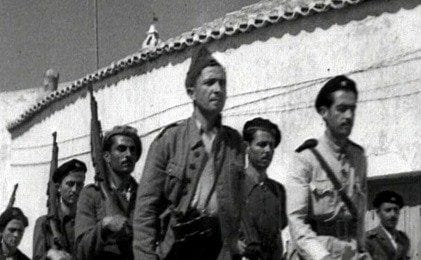
15 well-armed men, all local Kytherians, gathered at Potamos. The civilian leaders of the operation were George Chlampeas (he was in charge) and Panagiotis Tamvakis and the captain was Yannis Fardoulis - Kalogridis. At the entrance to Avlemonas the liaison informed them that the Germans had scattered to the surrounding areas and so their capture would be easy. The force of men was divided into groups. George Chlampeas and Panagiotis Tamvakis entered the village through the main entrance and headed for the place where the telephone was located. There was no one around, so they easily extracted the lever and neutralized it. Theophanis Kasimatis and Manolis Pavlakis arrested the commander of the prison while the other teams arrested the rest of the Germans and a Serbian diver, Vladimir. The Germans offered no resistance, because the well-organized operation took them by surprise.
It should be mentioned that in the port of Avlemonas there were two large Moorish boats loaded with wheat, beans, millet and other foodstuffs. The prisoners were loaded into the boats and transported across. The brisk wind helped make the transport easy. It was dusk on 17 March 1944. ELAS reservists returned to the island in the early morning hours of March 18. There were no consequences for the inhabitants of Kythera, because the Germans believed that the whole operation was carried out by Laconian guerrillas.
Notes:
α) It is a historical vindication that for the first time, after a careful search, all those who took part in the operation to eliminate the German prison of Avlemona were mentioned by name. These are: Giouzelis Ioannis, Theodorakakis Antonis (Kintis), Kalogridis Ioannis, Kasimatis Theophanis (Atzatos), Katsoulis Panagiotis, Komnenos Mitsos (Tsiglis), Pavlakis Manolis, Souris Antonis, Tamvakis Panagiotis, Faceas Theodoros, Faceas Manolis (Antriogiannis), Hatzikos Apostolos, Chlambeas George, Hlenzos Kosmas. Unfortunately the 15th is missing. Despite all my efforts I could not find his name.
b) I must thank the surviving fighters whose valuable information helped me to write this article. They are the kind and lovable Manolis Pavlakis (Potamos), the lucid and charismatic Spyros Andronikos (Potamos) and the venerable Mitsos Komninos, who now lives in Australia. Of course, the books by George Chlampeas (Kythira in the 1941-44 Quadrennium) and Ioannis P. Kasimatis (From Old and Modern Kythira Life) are always a good source of information.
c) George Chlampeas states that the arrested during the operation in Avlemonas were 7 Germans and 1 Serbian diver, while G. P. Kasimatis reports 4 Germans, 2 Italians and 1 Yugoslav diver. I think that closer to reality is the report of G. Chlambea, since he took part as the leader of the operation, while G. P. Casimatis was informed of the events.
d) The whole operation confirms that in the Outer Municipality EAM/ELAS was both massive and well organized, unlike in the Inner Municipality, where the strength of EAM/ELAS was limited, for reasons that are explained but not presently.
Michael Orphanakis