The news that the award-winning Th. Angelopoulos died senselessly on January 24 (2012), not only the fans of his art were saddened. The melancholy was also visible to ordinary Greeks, without most of them having seen any of his films, because, apart from the physical involvement in the event, the thought immediately came to mind that we were also impoverished in culture...
The following day, in the farewell texts and tributes of the State Television (in its praise), the exclusive tone was set by the director's description of himself as a «poet of images» and, somewhere, his film «Journey to Kythera». With the difference, that the filmmaker, did not start the fateful night. From his early youth he had set anchor for the island of the soul.
In the Kythera of Z. Ant. Vatto
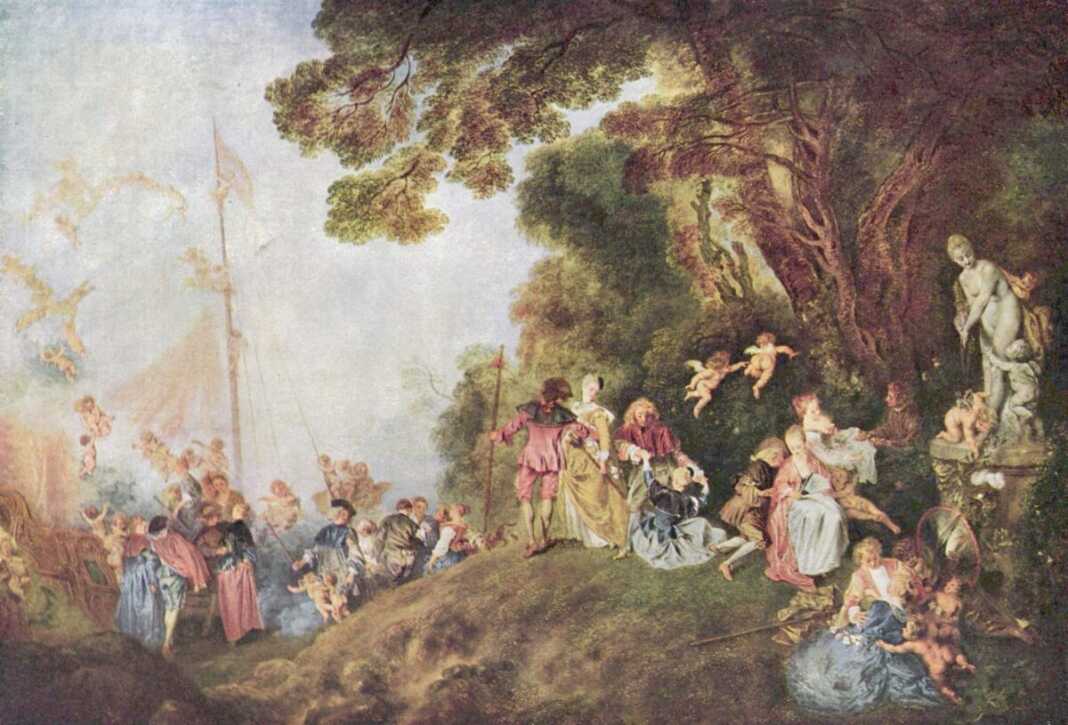
The French painter Z. Ant. Vatteau (1684 - 1721), according to the Goncourt brothers, «the great poet of the 18th century», repeatedly turned his gaze to Kythera. Finally, two paintings by the artist were imposed as masterpieces of the hundred-year-old painting: «Pilgrimage to Kythera», 1717, (Louvre Museum), in a translation of the title by Panagiotis Kanellopoulos, and for the French of Pleiades «a masterpiece of poetic tenderness»; and «Embarkation for Kythera», of 1719 or 1720, «the enchanting phantasmagoria» (Charlottenburg Museum, Berlin).
«The dreamy contemplation» by Vatto has taken the beloved island of the arts, from the Renaissance onwards, to the sky. From Vatto to Angelopoulos, «Journey to Kythera» is a timeless romantic reference point!
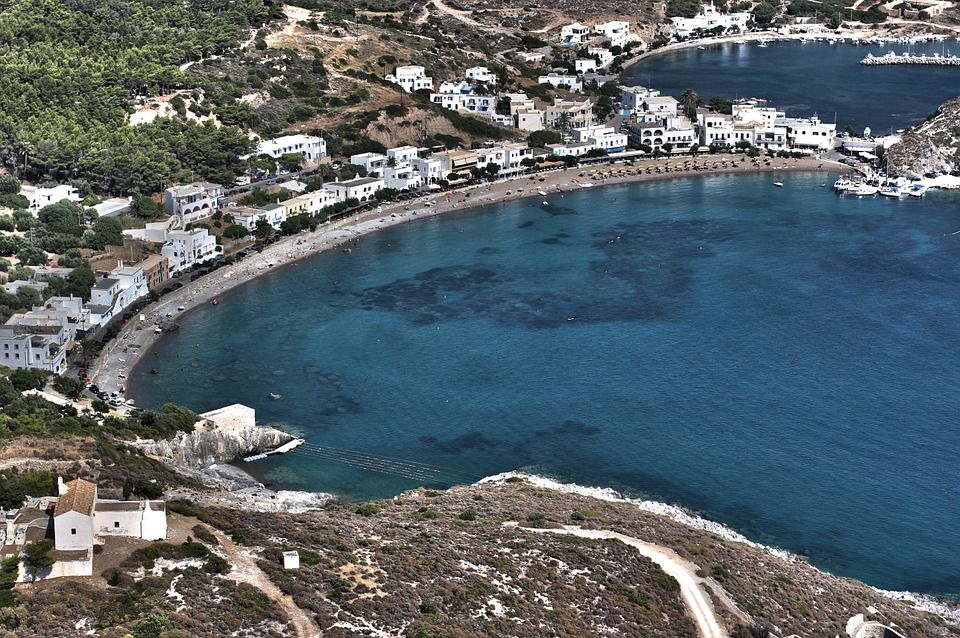
Its origins are primordial. Homer, the first, also calls Kytheria, Kytheria, the goddess of Eros. She divided her time between Cyprus and Kythera, not forgetting that the waves of Kythera's waves first formed her as a beautiful woman in the foams, before the strong winds of the region carried her away to «sea-kissed» Cyprus. Afrogenia (name and grace), Kypris, Paphis (Paphitissa), Kytheria and above all Anadymos, among many invocations, in Kythera she saw her first temple, according to the always valuable information of Pausanias: «-her sanctuary- holiest and most ancient of those in Greece» (Pausanios III, 23, 1.). There, embodied in a godlike statue, she enjoyed the adoration of multitudes of lovers at feasts of joy and inspired the Journey to Kythera: To Love, to Nature, to Freedom, with a word to the Meaning of Life! In addition to the tradition, reliefs, with representations of lovers offering gifts to their sea goddess, were taken from the place to which they were first addressed, as we read in the travel texts of the Stefanopoli Brothers and Gerard de Nerval.
Watteau's paintings depict a scene of transcendental theatre, in a lush landscape of sublime colours, with little winged Cupid, children of Zephyr, flying around the caravel on the coast and over the happy pilgrim travellers (Rococo style).
There is much critical searching, whether the paintings signify departure-travel to Kythera, the happiness of disembarkation or the sadness of farewell, the end of the erotic dream. The important thing is that the ailing Vatteau, lost in his 37th year, managed to paint, in an emblematic way, «the state of a man's soul before Life» - according to A. Chatelet - «the juxtaposition, with a wonderful love, of the so ephemeral Life with the desirable Infinity’ (Elie Four).
The work of Z. Ant. Watteau is a confession of a great soul, and therefore it blazes the trail of romanticism and inaugurates the essence of modern reality.
The Dialogue of Kythera, in the 19th century.
The first absolute heretic of Kythera and Vatto was a French writer, influenced by the «Journey of Demos and Nicolo Stephanopoli in Greece». Without travelling to the island, he presents it as a sad shadow of myth in his book «Journey to the East», in 1851, and at the same time, as a Frenchman, he seeks to denounce the barbarities of his British rulers and antiquarian exiles. The historical passions and decline of Kythera were, allegorically, linked to its perceived utopia.
Then De Nerval, V. Hugo and C. Baudelaire compose the subversive poetic dialogue. Baudelaire, in the collection «The Flowers of Evil», from the poem «A Journey to Kythera», faces a barren land, with only the memories of the land of songs: The black sea what is this sadness? We were told: / Kythera; the famous country of songs.
In V. In Hugo's poetic poems, melancholy is synonymous with the title «Cerigo», the medieval and not the ancient name of the island: Cerigo, where is Kythera? Night! Mourning only. / Gone is Eden, in its place she left a naked rock... (Trans. Nikos Stratakis).
However, much later, an expression of the dreamy Frenchman Albert Chamen is a panorama of an Ionian island, probably Kythera. In conclusion, the poet sees the unison of natural and human beauty in the divine movement of Aphrodite: And Aphrodite folds her blonde nakedness / in the smiling morning. (Trans. Michael Petrochilou).
The Greek dialogue on the Kythera Journey
Albert Chamen daydreams, but decades ago, the poet of the Idea Andreas Calvos was nostalgic. In the first ode of his «Lyre», under the title «The Philopatris», with poetic grandeur and promenade in harmonious union, he praises all that surrounds «wondrous» Zakynthos: 'The Ionian wave first / Kissed the body; / First the Ionian Zephyrs / Eschewed the breast / Of Kytheria.
In the 20th century, the Greek dialogue of Kythera, in Poetry, Music and Cinema, is divided into two: dream and scepticism. The river of the lyre, Kostis Palamas, singing the «Eptanisa», senses in the beneficial hands of Aphrodite the enalic dew: ...and always your Aphrodite rains upon you / the dew of April. (The State and Solitude. 1912).
Moreover, as it follows, the Kytherian poets sing of their hometown, inspired, as a rule, by the good fortune of enjoying the unique light of Kythera in coexistence with their poetic myth. Panos Phyllis, in 1947, with «The Journey to Kythera», ecstatic at the beauty of his place between three seas, responds to the scepticism of the difficult years.
Indeed, it would take a long time to count how many times the title «Journey to Kythera» has been written. It is rewritten, poetically attractive, by Kostas Ouranis, the pessimist of his time, in his «Nostalgia» of 1920, perhaps the most beautiful poem about the voyage, with authentic sadness, because «the beautiful ship’ did not reach the legendary Kythera. ...But the voyage was long and the winter found us / ... / and somewhere in the strange skies, the ship / was left unguided on the foaming wave / with our poor dream dead at the stern.
For our contemporary poet Dimitris Karasavvas, however, the journey has another dimension. His shipwreck was lost just before he reached the island, but he took with him, through death, Kythera and not their dead dream. ...Miltos Liapis / a forty-year-old sailor from Kos / lost in the 70s just before Kythera / with the ’Elpida« in tow / without finding his love. (»Elpida«, Navy Pamphlet, 1998).
Before Kythera, the storms of Kavo-Malias often stand up Homeric storms. The Ideal, which they symbolize -every ideal- is the Aphrodite of Milos, but according to the expression of the poet Marinos Siguros. Without hands she cannot embrace us. Yet always standing on her pedestal, she will exist beyond human as Beauty and timeless Inspiration.
TH. Angelopoulos travels to Kythera
A thinker of Time and Space, the creator of «Theasos» (1975) throughout his career co-integrated his heroes on the stage of modern Greek history, with projections from our deepest tradition. The shooting angles change, but not the poetry of the famous historical shots in his fourteen films - and here a key characteristic of his internationally acclaimed art emerges.
Migration and Nostos are the primordial and enduring companions of Greece - recalling Vatto's «Voyage». The return of the foreigner - a timeless theme of Greek literature - we witnessed it, in 1976, in Dimitris Hatzis« »Double Book", under the unacceptable, as it turned out, diversion of post-war Greece. With a romantic's flair, the immigrant Skourogiannis returns, in 1976, to a country with a new god, the illusory bliss of useless consumption, and feels the foreignness in his homeland heavier than the one in Germany, but, there, with the dream of Greek travel.
The decades-long political exile of Theodoros Angelopoulos looks like his brother Skourogiannis, only to face, in the 1984 film «Journey to Kythera», anything but the Kythera of his nostalgia. Geographically, the island is not mentioned in the script, but the decline of the solid values of the old world and its desolation.
And old Spyros - Manos Katrakis - opposes the commercialization of everything at the expense of his country, remains steadfast in the authentic reality of our homeland, and it is not long before he receives dangerous persecution from people considered to be his own.
The trip was cancelled halfway through, the Nostos did not take place. With bitter wisdom, the stranger in his own land, rejects any compromise of betrayal and chooses, keeping the ideal Kythera unscathed, to get lost in the other sea. Coincidentally, «The Other Sea» is the title of our director's unfinished film. We do not know whether, in this creation too, the Greek would have been an exile and a traveller, as Theo Angelopoulos first delivered him to us as a filmmaker. But if we recall a statement of his that the economic crisis and immigration would be set in his last film, we would have a shocking answer to our question.
The Journey to Kythera continues
It has been said by a foreign thinker that Vatto's «Journey to Kythera» is the Drama of Man. Sophia is not the Cytherian Venus, but she is always emerging. It disappears and returns. New men are always coming, with virgin desires, while others go on, determined to prove that Homer's «zathea,» the all-virgin Kythera, is real, despite the fierce Neptune of Cavo-Malias. And Th. Angelopoulos had declared that his «Journey» is like a return to Romanticism.
The Eros of the Ideal, precisely because it is considered impenetrable, resides at the heart of every high creation. Without it, man would be psychically, spiritually non-existent. No matter how many shipwrecks are recorded, woe betide us if we do not set sail for Kythera.
For us, they will surely be lost if we do not seek them out. And we must understand that we have arrived. That we live on the island of the Idea, always worshipping what it means... Ant. Vatto, when he titled his famous painting «Pilgrimage to Kythera».
ADAMANTIA TΡΙΑΡΧOI - MAKKRYGIANNIS
Bibliography:
- Panagiotis Kanellopoulos. History of the European Spirit, volume 9. Special edition for TO VIMA Library, 2010.
- Symbolic Kythera, Collective publication of the Free Open University of the Municipality of Kythera, 2003.
- Michael Petrochilos, The Polymnira Kythira. Publication of the Kythiraikos Association of Athens, 1955
- Dimitris Karasavas, Naval Pamphlet. The Tramakia Publications, Thessaloniki 1998.
- Vassilis Rafailidis, Journey to Myth - The Cinema of Theo Angelopoulos, Aigokeros Publications 2003.
- Kostas Georgousopoulos, The Ethics of Landscape. TA NEA, 4-5 February 2011.