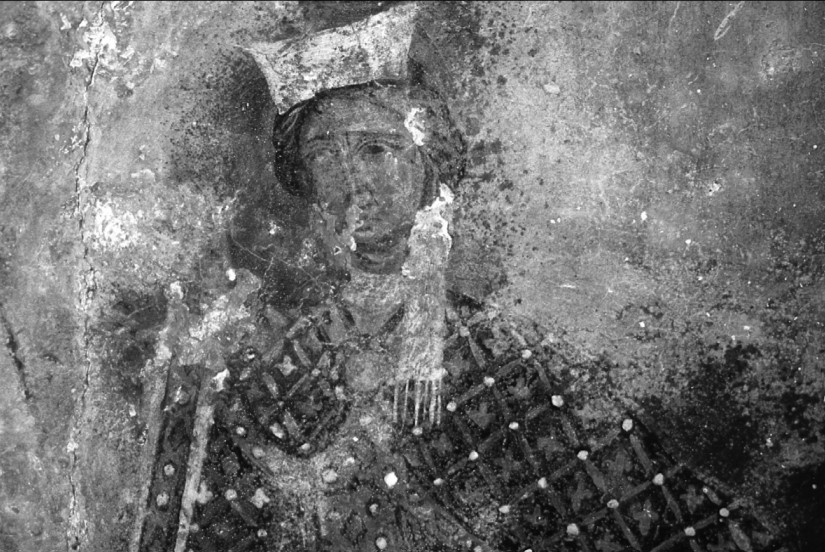
The study of Byzantine costume and the interpretations it can receive is a very interesting part of the history of Byzantine culture. Recent research has shown that clothing and the way of dressing in general are indicative of the personality or power held by the wearer, encoding political and other messages.
Few archaeological remains have survived: several luxurious fabrics and a few garments in church collections and museums, mainly in Western Europe, which were imperial or patriarchal gifts to kings and ecclesiastical and other Western officials. The most important evidence in Greece is the discovery in a burial of the dress of a noblewoman who followed Western fashion in the 15th century in Mystras.
The contribution of the sources is also important in defining clothing, although often problematic, because the type of clothing is confused with the type of fabric from which it is made, making it difficult to crystallize the form and name of the garments. Thus, we are left with the study of the visual depictions of clothing in works of art, mainly paintings and sculpture, as they are presented as intrusions of elements of everyday life or material culture in religious and devotional performances. In the religious ones, however, the rendering of costumes is characterised by timelessness and repetitions of the same patterns. On the contrary, more can be gleaned from the depiction of the devotees, which we accept that the artist, according to his ability, tries to render them as close as possible to their reality.
In the latter case fall the dedicatory representations of Kythera, which, although small in extent, with the wealth of Byzantine frescoes they possess, contribute significantly to the knowledge of Byzantine costume. In three churches, dedicators have been depicted in the fresco decoration and through these depictions we are given a brief outline of the evolution of dress habits in the region during the last three centuries of the Byzantine Empire. The two earliest cases, those of St Demetrius in Kambianika and St Polycarp in Finikia, date back to the turbulent 13th century, a time when the island alternated between Venetian and Byzantine rule, only to be fully annexed by the 14th century to the Galentine chariot. The other, in Agios Antonios in Paleochora, dates from the late 15th century, a few decades before the destruction of the castle town by Hairdin
Barbarossa in 1537.
Read below the whole study by Ioanna Bitha* which was published in the 8th International Conference (Chora of Kythera, 21-25 May 2006), Proceedings, Vol. I Archaeology - Architecture - Natural Environment, Society of Kythera Studies: Kythera - Athens 2009, pp. 270-296, 13 figs. on pp. 290-296.
Ioanna Bitha is a researcher at the Centre for Research in Byzantine and Post-Byzantine Art of the Academy of Athens. She works in the international research project of the Academy of Athens, which is under the auspices of the International Association of Academies, “Index of Byzantine Frescoes of Greece”. She is also in charge of the project “Bibliography of Byzantine and Post-Byzantine Archaeology and Art. The Greek Contribution”. Another field of research in which she is active is the study of Byzantine costume as depicted in representations of consecrated persons in frescoes and icons.
Full CV
He was born in Athens. Graduated from the University of Athens, Faculty of Philosophy, Department of History and Archaeology (1980). Postgraduate studies in Paris, University of Paris I - Panthéon-Sorbonne (1982-1984). Doctoral degree from the University of Athens, Faculty of Philosophy, Department of History and Archaeology, Department of Byzantine Archaeology (2014).
Since 1982 she has been working at the Academy of Athens: initially as a scientific assistant to the academic Manolis Hadjidakis in the publication programme of the icons of the Sinai Monastery, then as an editor at the Editorial Service of the Index of Byzantine Frescoes of Greece and since 1994 as a researcher at the then established Research Centre for Byzantine and Post-Byzantine Art of the Academy of Athens. Since 2000 she has been appointed Director of the Research Centre for Byzantine and Post-Byzantine Art of the Academy of Athens.
She worked as a scientific assistant in the recording of the relics of the Metropolis of Samos (Ministry of Culture). - Responsible for the selection, study, scientific report and publication of the icon collection of the Folklore Museum of Stemnitsa (donated by Gannis and Irini Savvopoulou). - Member of the Organizing Committee of the foundation of the Folklore Museum of Stemnitsa. - Member of the Scientific Committee of the International Conference «The Archaeological Work in the Aegean Islands» (Rhodes, 27 November-1 December 2013) - Regular member of the Local Council of Monuments of the Dodecanese 2008-2011 - Member of the Christian Archaeological Society and since 2012 elected member of the Board of Directors - Member of the Society of Kytheraic Studies and the Society of Greek Costume Studies. - Member of the Editorial Committee of the Bulletin of the Christian Archaeological Society (2012), which is published under the peer-review system.- He has edited many scientific publications. - He has taken part in 33 conferences and lectures, many of which have been published.
PUBLICATIONS
https://academyofathens.academia.edu/IoannaBITHA
THESES
Le Monastère de la Transfiguration aux Météores, dit le Grand Météoron. Son programme iconographique et sa place parmi les programmes des églises du XVIe siècle. Le naos (1552), Diplôme des études approfondies (D.E.A.), Université de Paris I - Panthéon - Sorbonne, Paris 1984 (139 p., 62 p.).
The church of St. Andrew in the «Three Churches» at Perlingianika of Kythera and the monumental painting of the 13th century in Kythera, PhD thesis, National and Kapodistrian University of Athens - School of Philosophy - Department of History and Archaeology - Byzantine Archaeology, Athens 2014 (424 p., 708 illustrations and catalogues). https://www.didaktorika.gr/eadd/handle/10442/41558
SIGNATURES
In collaboration with the academic Manolis Hadjidakis: Index of Byzantine paintings of Greece, vol. 1, Kythera, Published by the Academy of Athens - Centre for Research in Byzantine and Post-Byzantine Art, Athens 1997, 332 p., 445 illustrations in text.
In collaboration with the academic Manolis Hadjidakis: Corpus of the Byzantine Wall-Paintings of Greece. The island of Kythera, Published by the Academy of Athens - Centre for Research in Byzantine and Post-Byzantine Art, edition with improvements, Athens 2003, 332 p., 445 illustrations in text.
COMPILATION OF COMPREHENSIVE BIBLIOGRAPHIES
Bibliographie de l'Art Byzantin et Postbyzantin - La Contribution Grecque 1991-1996, in collaboration with Angeliki Katsiotis and Eleni Katsas, Published by the Academy of Athens - Centre for Research in Byzantine and Post-Byzantine Art, Athens 1996, 183 pp.
Bibliographie de l'Art Byzantin et Postbyzantin - La Contribution Grecque 1996-2000, in collaboration with Vasiliki Foskolou and Margarita Nella, Athens Academy of Athens - Centre for Research in Byzantine and Post-Byzantine Art, Athens 2001, 219 pp.
Bibliography en l‘Art Byzantium et Postbyzantine – La Contribution Grecque 2001-2005, in collaboration with Ioannis Vaxevanis and Ourania Karagiannis, Athens Academy of Athens - Centre for Research in Byzantine and Post-Byzantine Art, Athens 2006, 360 pp.
ARTICLES
«The Icons» in the Guide to the Stemnitsa Folklore Museum, Arcadia 1991, pp. 106-123, figs. 70-91 in the text.
«The Dodecanese Byzantine Paintings Index of the Academy of Athens», Archaeology, vol. 47, June 1993, pp. 29-32, statistical pl. 1 on p. 30.
«Accompaniment of Corfu villages. A small contribution to the iconography of Saint Spyridon», Bulletin of the Christian Archaeological Society, pers. D΄, vol. IH΄ (Athens 1995), pp. 151-168, 19 figs. in text.
«Observations on the iconographic cycles of St. Spyridon», Bulletin of the Christian Archaeological Society, pers. D΄, vol. IΘ΄ (Athens 1996-1997), Athens 1997, pp. 251-284, 18 illustrations in text.
«Clothing evidence in the wall paintings of medieval Rhodes (14th century - 1523). A first approach», Proceedings of the International Scientific Conference, Rhodes 2400 years. The city of Rhodes, from its foundation to its occupation by the Turks (1523), (Rhodes, 24-29 October 1993), vol. B΄, Athens 2000, pp. 429-448, drawings a-y (figs. 1-2) in text, pl. 169-174.
«Profession of the priest Nicholas Charamuntanis. Icon of a devotion from Kythera in the Byzantine Museum of Athens», Bulletin of the Christian Archaeological Society, pers. D', vol. KB (2001), pp. 229-246, 17 figs. in text.
«Costume habits in equestrian Rhodes (1309-1522)», Archaeology and Arts: Clothing in Byzantium, vol. 83, June 2002, pp. 44-50, 14 illustrations in text.
«Commentaries on an icon of Saint Charalambos, work by Constantine Adrianopoulos (1739)», Bulletin of the Christian Archaeological Society, pers. D, vol. KD (2003), pp. 333-346, 8 figs. in text.
«Byzantine Kythera through the testimonies of churches and frescoes», Sixth International Conference (Zakynthos, 23-27 September 1997), Proceedings, vol. D΄, Athens 2004, pp. 565-578, 1 map in text on p. 570.
«Costume evidence, votive offerings and Byzantine wall paintings in Kos», HARIS HAYRE. Studies in memory of Haris Kantzia, Athens 2004, vol. A', pp. 341-357, 16 illustrations and drawings on pp. 351-357.
«”Index of Byzantine Frescoes of Tilos”, a research project of the Research Centre for Byzantine and Post-Byzantine Art of the Academy of Athens», Dodecanese Chronicles τ. K΄ (Rhodes 2005), pp. 119-140, 12 illustrations on pp. 135-140.
«Comments on the inscription of the church of St. George Pachymachiotis in Lindos, Rhodes (1394/5)», Bulletin of the Christian Archaeological Society, pers. D΄, vol. L΄ (2009).
«Costume evidence in Byzantine Kythera», H International Conference (Chora Kythera, 21-25 May 2006), Proceedings, vol. I. Archaeology - Architecture - Natural Environment, Society of Kytherian Studies: Kythira - Athens 2009, pp. 270-296, 13 figs. on pp. 290-296.
«Women's clothing of the Frankish period», M. PANAGIOTIDI-KESISOGLOU (ed.), Woman in Byzantium. Cult and art (Christian Archaeological Society. Special issue of the 26th Symposium on Byzantine and Post-Byzantine Archaeology and Art, Athens, 12-14 May 2006), Christian Archaeological Society - Piraeus Bank Group Cultural Foundation: Athens 2012, pp. 181-202, 208-209, 212, 31 figs. in text. Summary: Female clothing during Frankish rule.
«The presence of the Apostle Andrew in the iconographic programme of the Byzantine temples of Kythera (13th century)», E. Γ. Saranti, D. D. Triantafylopoulos (eds.), Proceedings of the International Conference «The Apostle Andrew in history and art» (Patras, 17-19 November 2006), Patras 2013, pp. 173-192, figs. on pp. 193-200.Summary: The Depiction of Apostle Andrew in the Iconographic Programs of the Byzantine Churches of Kythera (13th Century).
«Kythira», N. Gioles, G. Pallis (ed.), Atlas of the Christian monuments of the Aegean. From the early Christian times to the Fall of Constantinople, General Secretariat for Aegean and Island Policy, Athens 2014 / «Cythera», N. Gkioles, G. Pallis (eds.), Atlas of the Christian Monuments of the Aegean. From the Early Christian Years to the Fall of Constantinople, General Secretariat of the Aegean and Island Policy, Athens 2014, pp. 228-231, map no. 8.
In collaboration with Brigitte Pitarakis: «Double-sided icon of the Virgin Hodegetria (front) and St. Theodore Teron (back) with integral frame», Br. Pitarakis (ed.), Life Is Short, Art Long. The Art of Healing in Byzantium, Pera Museum, Istanbul 10 February-26 April 2015 (bilingual exhibition catalogue in Turkish and English), Istanbul 2015, catalogue no. 44 p. 269-273.
«Performances of the Second Coming in Rhodes (13th century - c. 1500)», B. V. (ed.), Tribute to the academic Panagiotis L. Vokotopoulos, Kapon Publications, Athens 2015, pp. 441-456, 11 illustrations in text. Summary: Representations of the Last Judgement in the island of Rhodes, Greece (13th c. - ca. 1500).
LEMS
«Dafni», entry in The Dictionary of Art - Grove, vol. 8, London 1996, pp. 446-447.
«Kythera» article in The Dictionary of Art - Grove, vol. 18, London 1996, pp. 570-571.
«Meteora» article in The Dictionary of Art - Grove, vol. 21, London 1996, pp. 343-345, fig. 1 on p. 343.
«Ionian Islands. Kythera», entry in the Great Orthodox Christian Encyclopedia (GOCE), vol. 9, Athens 2013, pp. 41-44.
EPHYLLISTS
«Kythera. Place and Monuments, The wall paintings of Kythera. Archaeology and art in the Byzantine and post-Byzantine monuments of the island», Kathimerini - Seven days, Athens 5 July 1998, pp. 9-12, 7 illustrations in text.
«Tilos. The island of Herina, »The Byzantine churches", in collaboration with Eleni Papavassiliou and Angeliki Katsiotis, Kathimerini - Seven days, Athens 19 August 2001, pp. 13-19, 9 illustrations in text.