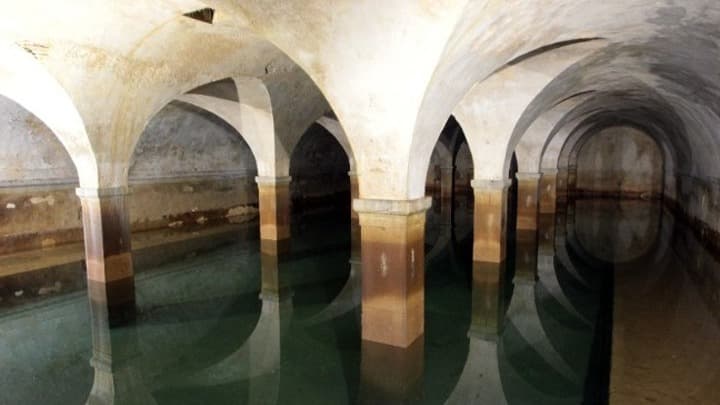
Step by step, the design of the municipality of Halandri is being implemented for the integration of the ancient aqueduct into the daily life of the citizens and thus become a «living» element of the city. The Hadrianic Aqueduct was constructed in the 2nd century AD by the Roman Emperor Hadrian, with the aim of supplying Athens with water from the rainwater of the Penteli and Parnitha rivers. In Chalandri, its reopening 19 centuries later, started as a vision and ended up becoming a reality, in the framework of the European project CULTURAL H.ID.RA.N.T.
Now it is preparing to operate again, through an irrigation network, but also a major redevelopment, which will accompany the hydraulic installation and will connect the monument with a pedestrian walkway, with the Rematia Halandri and the city centre. This ambitious and bold project, which was first presented by APPE-MPA last February, also includes the creation of an irrigation network within the urban area, as two pumping stations will be organized in order to make the aqueduct productive and its non-potable water accessible to residents. The two intake points will also fill the aqueducts that will carry water to more remote neighbourhoods of the city, which de facto will not have direct access.
«The idea was not to showcase the Hadrianic Aqueduct as just a monument, but to make it productive and involved in the city. So, it became even more interesting, it was a much more interesting approach,» Deputy Mayor of Planning and Electronic Governance Costas Gerolymatos told APE-MPA.
Already the first steps have been taken and apart from everything else, a multimodal and interactive festival on water and the city was launched in September, while the municipality is collecting and digitizing cultural material and archives related to the Adrianio Aqueduct.
Now it is the turn for the construction of the first network in the country exclusively of non-potable water, which is now being carried out by EYDAP in cooperation with the municipality of Halandri and the route to be followed has already been finalized, so that the water that flows through the Adrianio Aqueduct becomes accessible again for the residents and for their irrigation and other needs. A fact that will also contribute to the economy of drinking water, since there will no longer be a need to consume and waste it for non-potable uses.
In essence, the network reuses the untapped quantities of water that used to flow into the abandoned Roman aqueduct. This water, which is produced by hydro-mastering, is reused in a circular economy logic, helping to save valuable drinking water and energy.
The project consists of two separate parts and has a total length of 4 km. Starting from the 102 well of the Adrianium and the reservoir in El Alamein Street, it unfolds on one side along the Rimatia and on the other side up to the Rizario School.
The second part of the network, starting from the 85th shaft of Adrianio, runs along the National Resistance Street until the park of Agia Varvara. Both sections have branches and are part of a general plan to extend the non-potable water network in Halandri, but also along the entire length of the Adrianaios Aqueduct.
This means that residents living close to the underground network and wishing to connect will be able to directly obtain non-potable water for various needs, such as watering. For residents who do not live nearby, the municipality will take care of the distribution of non-potable water by water trucks.
«We are now creating a direct relationship between the Adrian Aqueduct and the citizens and not just a mausoleum or a museum», Mr. Gerolymatos explains to the Athens-Macedonian News Agency. «As long as there was water, we wanted to take it and distribute it to the inhabitants. This will be done in two ways. The first for those who are directly connected to the network and the second with water trucks so that we can take the water to areas that are not nearby. So we are planning these two networks.’.
The deputy mayor of Halandri mentions an additional parameter: «We will ask the residents who will participate and take water to manage it after the project is over. The management, expansion and maintenance will be their own affair, under the supervision of EYDAP of course and under the auspices of the municipality. This is something you often see abroad, but for Greece it is a first.
On difficulties that may have arisen, Mr Gerolymatos says: «All the attempts we made at the beginning of the year and all our efforts were difficult to make and because of the pandemic. I think that now the conditions are much better to go ahead and find the response from the people.».
Finally, schools are also involved in the development of the project in various roles, either by designing the spaces that will be recreated around their school and watered by the Adrianio Aqueduct, or through participatory design workshops. Already students from the 12th Primary School have designed their reservoir, making sure to add a lot of greenery around it.
«It's part of the project the students of our city and the participation of the schools. The kids designed the visible part of the network for their school. Soon it will be put out to tender,» concludes the deputy mayor of Halandri.
Dem. Vassilopoulos