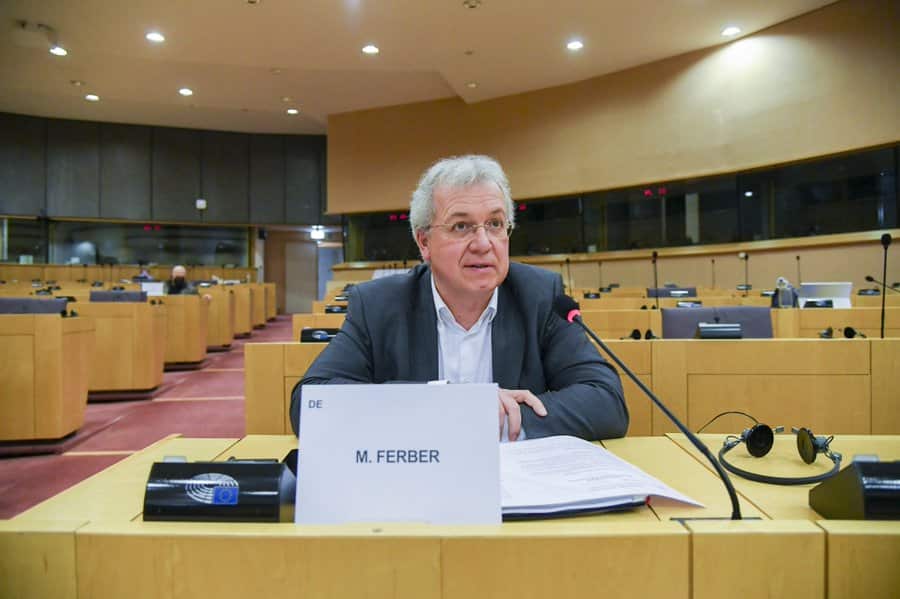
To end the accession negotiations with Turkey, proposes the Marcus Ferber (Markus Ferber), MEP from the European People's Party and president of the foundation Hanns Seidel, in an interview with the Athens-Macedonian News Agency and calls on the Germany to take a position on the matter.
He stresses that Turkey “has moved from the role of a reliable partner to that of a competitor of the EU in many areas” and notes that the termination of the accession negotiations, which have been “inactive for a long time”, may “be able to restore the relationship and readjust the expectations of both sides so that we can return to a more realistic relationship”.
Mr Ferber, who will participate in the Delphi Forum starting on Monday, underlines that Greece has dealt with the pandemic “quite effectively” and that the big bet is to use the European funds of the Recovery Fund to the fullest. He says that Greece's recovery plan includes “an ambitious combination of reforms and productive investments that could really make a difference in the long run”.
It points out that, due to pandemic, debt levels in many Member States have reached unsustainable levels in the long term and stresses that a responsible path to more sustainable debt levels “can only be achieved by through a combination of economic growth and the right degree of fiscal discipline“.
Finally, on the refugee/migration issue, he stresses that Greece has “done a very good job” in protecting the European borders “despite the difficult circumstances”, while recalling that “migratory flows will not disappear if we do not solve the underlying problem, which is the political instability in our immediate geographical neighbourhood”.
Below is the full text of the interview of the MEP and President of the Hanns Seidel Foundation Marcus Ferber with the journalist Nektaria Stamoulis.
Q: How do you judge the way Greece has dealt with the pandemic? What do you think is the key to recovery after the pandemic?;
AS: Greece has dealt with the pandemic quite effectively. Of course, the impact on the Greek economy was heavy, as Greece is heavily dependent on the tourism and hospitality sector. From now on, I think Greece should make the most of the money from the EU Recovery Fund to modernise the economy. From what I have seen of the recovery plan so far, Greece has come up with an ambitious combination of reforms and productive investments that could really make a difference in the long term. Ultimately, good execution of this ambitious programme will be crucial.
Q: In the last EU Councils, as well as in the upcoming Summit in June, Turkey was among the main issues discussed. What do you think about the EU's attitude towards Turkey and what role should Germany play?;
AS: Over the years, Turkey has taken an increasingly aggressive stance on many issues, which is very disappointing. It has moved from the role of a reliable partner to that of a competitor of the EU in many areas. In my experience, we have to be honest with Turkey that the kind of aggression we have seen in recent years cannot continue. A logical first step would be to end the accession negotiations with Turkey, which have been inactive for a long time. Perhaps such a move could reset the relationship and realign the expectations of both sides so that we can return to a more realistic relationship. Undoubtedly, as the largest Member State, Germany must take a stand on this issue.
Q: Do you think the Greek government has done a good job in managing the migration flows? Do you think there will be new pressure?;
AS: Greece is clearly at the forefront of protecting our borders and has done a very good job, despite the difficult circumstances. Unfortunately, migration flows will not disappear unless we solve the underlying problem, which is political instability in our immediate geographical neighbourhood. If people do not feel safe in their countries of origin and have no economic prospects, it will be very difficult to stop this type of migration.
Q: What is at stake in the upcoming German elections? What is Germany's role in the EU in the post-pandemic period?;
AS: The upcoming elections in Germany are crucial as they will determine the course of Germany in the post-Angela Merkel era. While all the major political parties that will have a chance to govern are generally pro-European, the details matter. I would like Germany to be the centre of political and economic stability in Europe. That would also be in the interest of the EU. To achieve this, the next government should be led by the CDU and CSU.
Q: B. V. Do you see that as we come out of the pandemic period, there will be tighter fiscal discipline?;
AS: Because of the pandemic, debt levels in many member states have reached a level that is unsustainable in the long term. A few years ago, Greece has experienced what can happen if debt levels get out of control. We must avoid a repeat of such a sovereign debt crisis. Therefore, we need to set a responsible path to more sustainable debt levels. I believe that this can only be achieved through a combination of economic growth and the right degree of fiscal discipline.
Q: The Hanns Seidel Foundation has published reports on the geopolitics of the pandemic. How did the coronavirus affect international relations and the global balance of power?;
AS: First of all, the pandemic changed the way international relations were conducted and diplomacy was seriously hampered by the fact that we were not able to meet in person. So far, we have not seen a clear shift in the global balance of power, but the long-term political and economic implications have yet to materialize. Many countries will emerge from the pandemic saddled with debt that will constrain growth and resources, increase inequalities and could lead to social unrest, something the IMF has already warned about.
This could also limit the ability of Western governments, faced with growing domestic problems, to respond to global challenges and defend the rules-based international order, resulting in greater instability. With the Nagorno-Karabakh conflict and the clashes on the China-India border, we have seen how some states may feel empowered by their aggressive behaviour.
However, we should not assume that everything that happened during the pandemic that affected the international order was due to the pandemic. The pandemic mainly accelerated trends in international relations that had already begun in the past, such as the perceived failure of multilateral institutions and alliances, inequality between developing and industrialized countries, and growing nationalism. The world remains in constant motion and we are in transition from the «unipolar moment» to a new world order where the «rules of the game» continue to emerge. So while the pandemic has not changed the global balance of power, it may have helped shape these new rules.