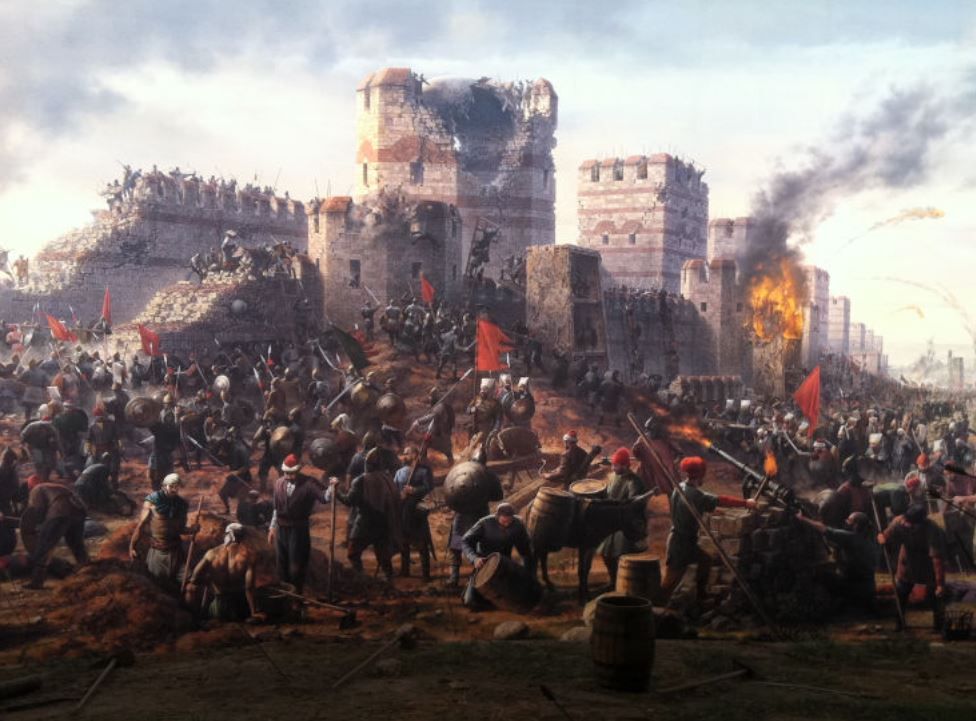
On May 29, 1453 Constantinople fell to the Ottomans after nearly 50 days of siege.
The once-mighty Byzantine Empire had already been weakened by religious strife, civil wars, and the emergence of many dangerous enemies on its borders. The The Fall of Constantinople It was a natural consequence of the Ottoman Empire's continuous expansion throughout the wider region.
From early 1453, Mehmed had been preparing to capture Constantinople. Based in Adrianople, he assembled an army of 150,000 men and a navy of 400 ships. His artillery stood out as the most modern of its time, particularly the enormous siege cannon crafted by Saxon artisans. On April 7, the sultan set up his tent in front of the Gate of Saint Romanus and officially declared the siege of Constantinople.
The battle was an uneven one for the Byzantines, who, as reported by sansimera, had only 7,000 men to field, 2,000 of whom were mercenaries, mainly Venetians and Genoese, while approximately 50,000 residents remained in Constantinople, facing food shortages.
The Ottomans launched their final assault on the morning of May 29, 1453. Thousands of Mehmed’s soldiers stormed the virtually defenseless city and captured it within a few hours.
Constantine Palaiologos, who had earlier proudly rejected Muhammad’s offers of a truce, fell heroically in battle.
The Factors That Led to the Decline of the Byzantine Empire
The decline of the Byzantine Empire, as noted in *Byzantium* by N. H. Baynes and H. Moss, occurred in many ways and for many reasons. To begin with, societies, like individuals, grow old. Byzantine shipowners, merchants, and industrialists—likely clinging passively to outdated methods of work—were unable to compete with their younger Italian rivals. On the other hand, the Byzantine economic system was state-run and, consequently, bureaucratic. Bureaucracies are overtaken by decline even more quickly than ’communities.’.
From the 11th century onward, the Byzantine administration was no longer able to protect small landowners, and taxation, which was lenient (to an ever-increasing degree) toward monasteries and the ruling class, became, out of necessity, increasingly oppressive for the common people.
However, all these causes of decline were less significant than the political misfortunes, which (with some periods of respite, particularly during the reign of the three great Komnenos emperors) continued to plague the empire after the death of Basil II.
This was followed by the first three Crusades, which, among other unfortunate consequences, led to the shift of Syrian trade from Constantinople to Italy.
The capture of Constantinople by the Crusaders and the fragmentation of the empire sealed the long series of misfortunes.
The latest disaster dealt a fatal blow to the empire from an economic standpoint.
As long as Constantinople remained intact, there was always the possibility of renewal, similar to the renewal observed after the great Arab and Bulgarian invasions that took place during the early Middle Ages. Constantinople was the heart of the state’s economic life. Here was concentrated the greater part of the movable wealth and the main branches of industry and commerce. Hundreds of thousands of working people lived within its walls. Of all this, after a few days of looting, slaughter, and arson, almost nothing remained.