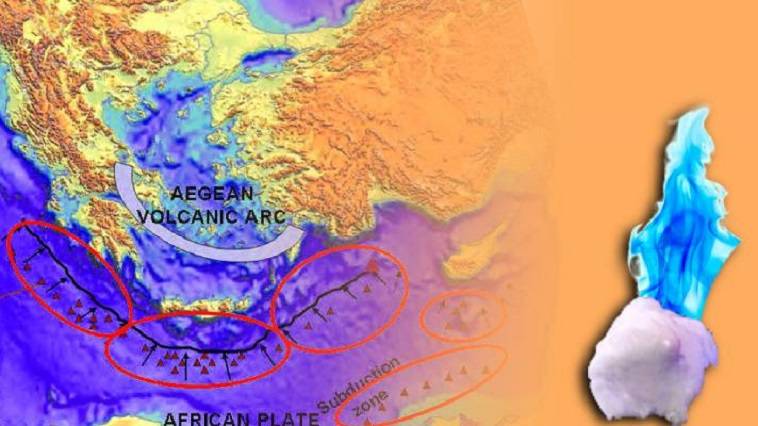
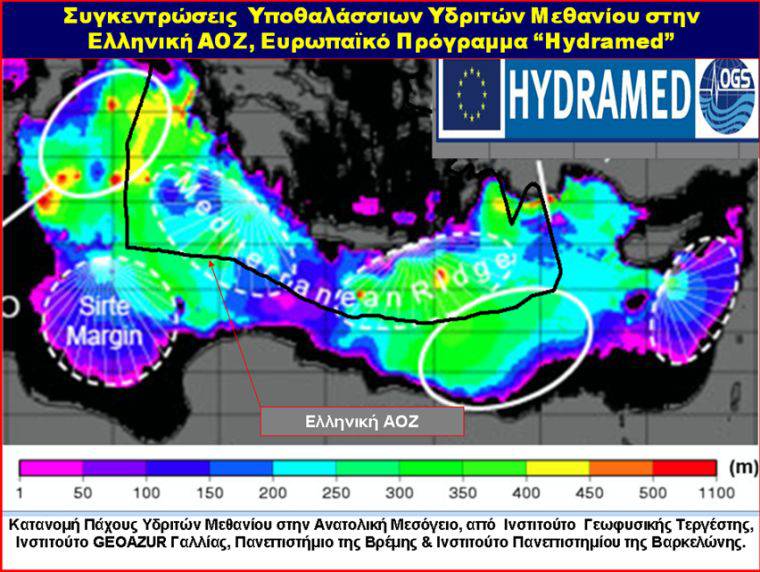
Methan hydrates are in the form of ice and are found in the geological formations under the seabed in thicknesses of up to 1 km.According to the European project Hydramed the Greek continental shelf-EEZ (Figure 7) contains the largest methane (CH4) hydrate reserves in Europe. Note that methane hydrate is a kind of methane gas solution in the ice crystal vacancies. One litre of methane hydride can yield 169 times its volume in methane (CH4) at atmospheric pressure.
The reserves of “unconventional hydrocarbon deposits” are expected to be a major source of methane production in the future, but at the same time threaten the planet with further ecological disaster in case the methane (CH4) they contain is released due to global warming of the seas. from global warming.
It should be noted that as far as global warming is concerned, methane (CH4) is 25 times more toxic than carbon dioxide (CO2). It is therefore obvious that a massive emergence of methane hydrates in Greece could lead to the production of clean energy through “blue hydrogen”, which will be derived from the steam reforming of methane hydrates, thus becoming a highly beneficial case for the formation of a better energy mix in our country.
Methane hydrates in Greece
According to an earlier survey, in our country within the 80,000 km2 of the Greek continental shelf extending offshore from Lefkada to the offshore southern Crete shows that there are significant concentrations of methane hydrates. With their current exploitation technology they could (with a 50% probability and a 30-year horizon) yield at least 10 trillion m3 of methane in our country. It should be noted that west of the islands of Lefkada and Kefallonia there are mapped areas with methane hydrate thicknesses of more than one km.
In addition, off the coast of Aktion, south of Corfu, we know that there are reserves of hydrates, where if technology advances in their exploitation, Greece could live 100-200 years with only the Ionian reserves, as hydrate is pure methane.
In similar areas, Greece could grant rights to test methane deposits in very favourable and highly incentivised areas. In other words, the relevant concession contract would allow a consortium to perfect the technology for the exploitation of methane hydrates and then the consortium of the contractor company together with the Greek State could sell this technology on the international market.
Greece has a reasonable chance of finding and producing significant quantities of natural gas that could reach 5 trillion m3 within a 35-year horizon. These, apart from completely replacing the natural gas imported into Greece, would also make Greece a producer of “blue hydrogen”. It should be noted that methane hydrates have been described as the “fuel of the future”.