By Stelios Zervos
One thing we’ll certainly remember from the year that’s coming to an end is the «chills» we all felt when we heard church bells across Greece tolling in mourning on July 24, 2020. It was the day when, after 86 years, the Hagia Sophia It became a mosque again…
That is why Harvard’s films, which reveal the mosaics of Hagia Sophia in the 1930s, are so striking.
The history of Hagia Sophia is intertwined with the history of the City
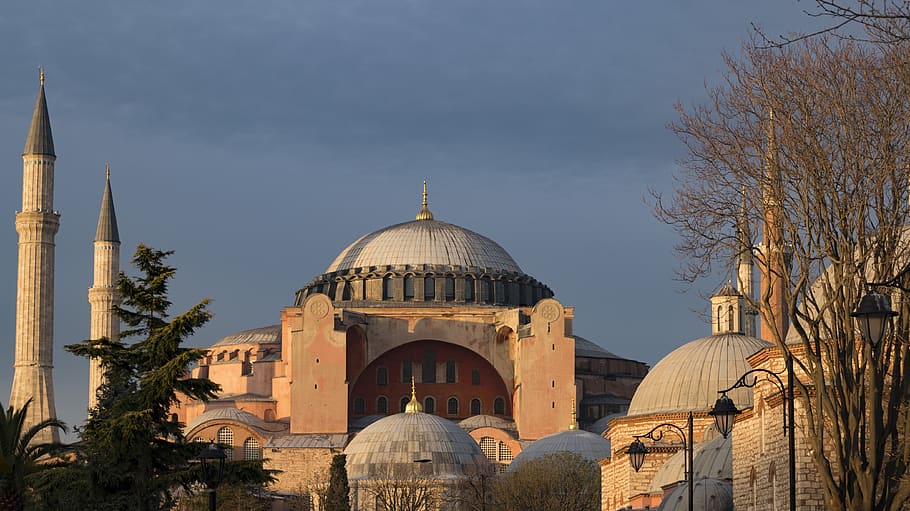
Hagia Sophia is a Byzantine church that once dominated the skyline of Istanbul and throughout its history.
It has become a major tourist attraction. Visitors admire not only its architecture, but also the layers of history embedded in every corner of it.
Constantinople was founded in 330 A.D. by the Roman emperor Constantine I. It is situated in a fantastic, strategic location overlooking the Bosphorus and the Black Sea. In the «New Rome», he built an imperial capital that surpassed «Old» Rome.
Hagia Sophia was rebuilt as a wooden-roofed basilica by the emperor Theodosius II‘…and the dedication took place on January 11, 415, by the patriarch" Attica. However, the temple would be set on fire again in 532, during the Nika's Stance.
So, the emperor Justinian I‘He decided to rebuild the church from scratch, on the same site, but on a much grander scale, so that it would tower over the Capital.".
The foundation stone of this magnificent temple was laid on February 23, 532, forty days after the suppression of the uprising, based on plans drawn up by the Anthemius of Tralles and Isidore of Miletus.
To complete this colossal project, 10,000 craftsmen worked tirelessly for six years. The inauguration took place on December 27, 537, and was presided over by Justinian himself. .
For about a thousand years, Hagia Sophia was the center of political, ecclesiastical, and intellectual life in the Byzantine Empire. There, the people would celebrate triumphs, mourn misfortunes, and hail new emperors.
For nearly 1,000 years, Hagia Sophia was the tallest and largest building in the world.
Decorated with contrasting colored marbles from all over the Mediterranean, the entire interior of Hagia Sophia shone with gold and silver mosaics that reflected the light flooding in through its many windows.
Toward the end of the ninth century, iconic mosaics were added: the Virgin Mary with the Christ Child, flanked on both sides by the archangels Michael and Gabriel. Later, emperors were honored with beautiful portraits made of gold mosaic and Christian icons.
The large church served as the model.
When the Arabs They poured out of the deserts to proclaim the faith of Islam, and built their first mosques modeled after the Christian domes first constructed by the Byzantines.
So, when the Turkish sultan Muhammad the Conqueror After breaching the triple walls and capturing Constantinople in May 1453, he decided that the city’s symbol, Hagia Sophia, into a mosque rather than destroying it.
In accordance with Islamic law, the mosaics were removed or covered up.
In 1931, Greece was trying to get back on its feet after the ill-fated adventure of the “Great Idea,” the bloody Asia Minor Catastrophe, and the population exchange.
That same year, in neighboring Turkey, the Kemal In a handwritten note posted at the main gate, he announced the closure of Hagia Sophia: «The museum is closed for repairs.».
This was preceded by peace talks with the Eleftherios Venizelos.
Kemal sought to open Turkey up to the West.
He was laying the foundation for a New Turkey, distinct from its Ottoman past. The conversion of Hagia Sophia into a museum would be the hallmark of his new secular state.
To make this happen and raise funds for the restoration of Hagia Sophia, the American scholar and archaeologist took action Thomas Whitmore, its founder Institute of Byzantine Studies in America.
Thomas Whitmore had strong connections in American society, primarily with figures from the worlds of politics and business.
Whitmore also maintained excellent personal relations with Mustafa Kemal, and it is speculated that he was the one who persuaded him to convert Hagia Sophia into a museum.
In June 1931, he received permission to remove the Ottoman plaster, and in December of that same year, he was tasked with uncovering the Christian mosaics that had previouslycovered.
The work of archaeologists and conservators is being filmed.
The mosaics impressed even Mustafa Kemal.
The documentary films we are presenting today show scenes from the uncovering and restoration of the mosaics.
They come from the Harvard archives and have no sound.
Watch Harvard’s stunning footage here, showing the discovery of the mosaics at Hagia Sophia in the 1930s and 1940s.
1st/VIDEO HERE
This film documents the conservation and restoration work carried out by the Byzantine Institute at the Kariye Mosque in Istanbul, Turkey. It shows the exterior of the Kariye Mosque – Chora Monastery , the interior of the outer portico, and its recently uncovered mosaics. It also focuses on the farmers and the Thomas Whittemore the cleaning and restoration of both the mosaics and the structure. It was filmed around 1949 on 16 mm KodaChrome safety film.
2nd / VIDEO HERE
This film documents the conservation and restoration work carried out by the Byzantine Institute at Hagia Sophia in Istanbul, Turkey. It shows a close-up view of the mosaic in the apse depicting the Virgin Mary and Christ, as well as the workers examining the mosaics under the supervision of Thomas Whittemore. It also includes a view of the tools on site used during conservation and restoration. It was filmed in 1936 on 16 mm KodaChrome safety film.
3rd/VIDEO HERE
This film documents the conservation and restoration work carried out by the Byzantine Institute at Hagia Sophia in Istanbul, Turkey. It depicts the following scenes or motifs in the South Gallery: close-up details of Constantine IX and Zoe with Christ. John and Irene with the Virgin Mary, enthroned with the Christ Child and Alexios, and the Desis. It was filmed in May 1936 on 16 mm KodaChrome safety film.