How easy is it for our country to attract them ΈGreek doctors from abroad, using the capability provided by the new law from the Ministry of Health to also take on private work at the same time?;
How much The increases are high which gives the Article 54 of the new law, so that salaries will be brought in line with those of public-sector doctors in the Germany, the United Kingdom, or the Netherlands;
The Minister of Health Thanasis Plevris and the Deputy Minister of Health Mina Gaga, seem almost certain that at least the Greek doctors working in European countries will return.
«In all advanced healthcare systems, there are no restrictions for any doctor, and everyone can provide services in both the private and public sectors. Greek doctors, who have been leaving the country in recent years, are also taking advantage of such opportunities. »We want our doctors to stay in the country; we want to create conditions for them that give them a sense of professional security,” explains Deputy Minister of Health Mina Gkaga regarding the underlying philosophy behind the changes in the health sector.
The statements by Health Minister Thanasis Plevris are along the same lines; in a recent radio interview, he said that «Right now, if there is a Greek doctor in Germany who is thinking of returning, isn’t it more likely that upon his return he will join the National Health System, since he will know that he can also practice privately?».
From which countries do doctors immigrate to Greece?;
However, as can be seen from the file of the Athens Medical Association (ISA), the overwhelming majority of doctors who come to work in our country earn salaries that are significantly lower than those in Greece.
Specifically, out of the total 26,924 doctors who work at the Athens and are members of the ISA, namely 26,312 are Greek and only the 107 Cypriots.
Beyond that, the list includes doctors who have immigrated from Romania, Albania, Iran, Palestine, Ukraine, Lebanon, Sudan, Ethiopia, Pakistan, and others.
Nationalities of doctors working in Greece
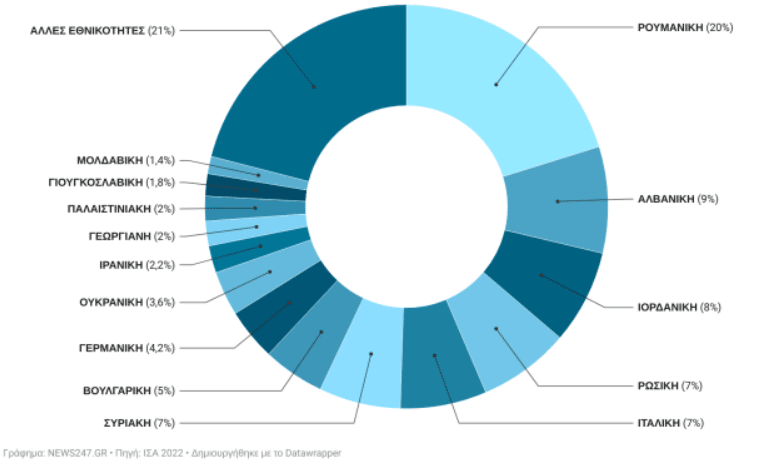
In addition, there are very few doctors from countries with higher salaries—specifically, just 2 doctors of British origin, 2 from Denmark, and 3 from the U.S.
Of course, since the ISA includes not only doctors from the National Health System but also private practitioners, doctors from countries such as the United Kingdom and the United States may also work as executives at private medical centers.
The average salary of a doctor in three public health care systems
In Greece, the annual salary of a manager «with 32 years of service, a marriage allowance, and two children is 29,520 euros.», as he explains in NEWS on July 27, o Panagiotis Papanikolaou, Secretary General of the Federation of Greek Hospital Physicians' Associations (OENGE).
In Germany, according to SalaryExpert, a doctor's salary during the first three years of their career is 75.334 euro.
In Netherlands, where the highest-paid doctors in the European Union (EU) earn as much as 115.624 euro.
Of course, the cost of living is much higher in these countries, but incomes are high enough to more than make up for that difference.
Will pay raises and jobs in the private sector «save» the situation?;
According to Article 54 of the Ministry of Health Act, the salaries of hospital physicians are increasing by 5%, with the increase averaging 10%, if the hospital employment allowance is also included.
«With these raises the government is granting, it is in fact pulling a fast one to circumvent the decisions of the Council of State (CoS), so that salaries do not return to 2012 levels, which would be higher. In fact, the decision is final and binding, and the leadership of the Ministry of Health has found a way to reformulate the pay scale, change the name of the law that has been ruled unconstitutional, and provide even less money,» Mr. Papanikolaou argues.
«His announcements Prime Minister Kyriakos Mitsotakis at the Thessaloniki International Trade Fair for increase 10% regarding the salaries of hospital doctors turned out to be false. For example, for a second-level attending physician, a 10% increase on top of the base salary (1,484 euros according to the 2017 pay scale) would amount to 1,632 euros gross. Under the new regulations, the base salary (gross) is set at 1,558. Similarly, for the remaining ranks, increases in the base salary range from 59 euros per month for trainees to 90 euros for coordinating directors and directors,’ OENGE states in its announcement.
For a Greek doctor to return from Germany and receive his salary from the National Health System, he must be able to earn at least an additional amount from his private practice 30,000 per year.
Something that is utopian to even think about, since the right to visit a private clinic will be limited to once or twice a week (pending the ministerial decision that will specify exactly how many days).
If the doctor ends up seeing patients twice a week, he would need to earn 310 euros per day during the few hours he has left after his work in the National Health System. If it’s one day a week, he would need to earn about 620 euros.
Of course, this applies to those doctors who are able to work in the private sector, as there are several specialties—particularly laboratory specialties—where it is not so easy to hold a second job for obvious reasons.
In addition, our country does not have a well-developed research program, so even if financial and professional incentives are offered, there will still be many scientists who will not return.
«Doctors from abroad trust Greek healthcare systems and choose them. However, we must invest in the country’s highly skilled scientific workforce, which is emigrating just to make ends meet. If we do not ensure that our doctors can practice their profession with dignity, they will emigrate, and our country will be forced to attract low-cost medical personnel from other countries, with a lower level of expertise. And ultimately, the highly specialized Greek doctors who were trained in our country, will continue to serve in the health care systems of other countries», he explains to NEWS on July 27, George Patoulis, president of the ISA.
This means that the incentives cited by Mr. Plevris and Ms. Gkaga to encourage Greek doctors to return from countries such as Germany are insufficient. And the problems patients face on a daily basis in the beleaguered National Health System are expected to increase.