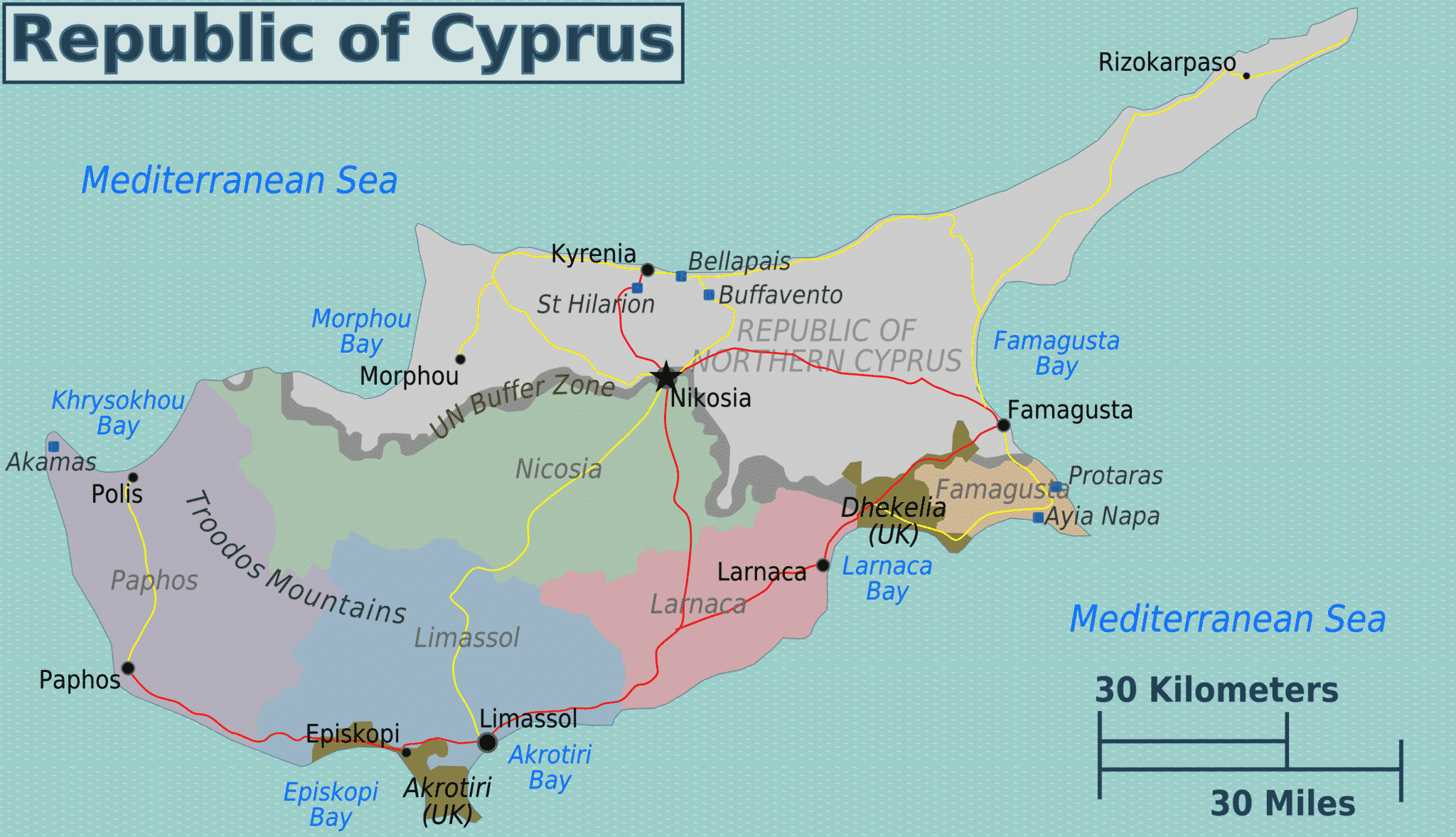
It has often been pointed out that Cyprus is of immense geopolitical importance and can provide strategic oversight capabilities to anyone wishing to exercise such oversight, with a focus on the MiddleMiddle East and the Suez Canal.
This obviously applies to all the Great Powers that wish to project power in the region, such as the United Kingdom or the United States, but it takes on unimaginable proportions in the case of Turkey.
For Ankara, control of Cyprus is a matter of survival, since this is not merely a—highly significant but simple—episode in the global competition between powers whose metropolitan areas are located on opposite sides of the globe.
It is a large island located in its soft underbelly, which, as part of the Greek arc, confines Turkey to its mainland and, ultimately, cuts it off from its broader maximalist ambitions.
The one we all know by now Ahmet Davutoğlu, whose directives are followed to the letter despite his removal from Recep Tayyip Erdoğan's inner circle, He pointed out as early as 20 years ago that «even if there weren’t a single Muslim Turk there, Turkey was obliged to keep the Cyprus issue alive.».
In this way, he made it clear that, caught in the grip of interstate power struggles and faced with the urgent need for national survival, Turkey is obliged, with regard to Cyprus (and, in his view, was right to do so), to invent a minority, to invade, to violate every fundamental principle of international law, trample on every human right, settle the area, threaten, and legitimize its presence there by any means necessary in the international fora.
And all of the above is because Cyprus is located at the crossroads of three continents and, «along with Crete, lies at the intersection of major waterways.».
Consequently, as he states, «a country that neglects Cyprus cannot play a decisive role in global and regional politics,» and Turkey has precisely that ambition.
It has expressed its intention to exercise regional hegemony, because it continues to be guided by a neo-Ottoman framework for policy-making and interpreting the international environment, which finds the appropriate opportunity to unfold amid a sufficient —in Ankara’s assessment— a redistribution of power within the regional system and a shift in priorities within the global order.
Consequently, Turkey has hegemonic ambitions, and the more these intensify due to the escalation of the aforementioned conditions, the more sensitive it becomes to the strategic costs.
In other words, Ankara is prepared for an ever-greater and more active involvement throughout Cyprus, while it intensifies and consolidates its display of power across multiple geographic zones in the wider region.
After all, according to Davutoğlu, Cyprus is linked to mtwo dimensions of geostrategic competition: the local, which concerns Greek-Turkish relations and Turkey's treatment of Greece and the regional/global, which corresponds to «strategic considerations in the Middle East, the Eastern Mediterranean, the Aegean, the Suez Canal, the Red Sea, and the Persian Gulf».
At the same time, It sets an excellent precedent for Turkish foreign policy, as Ankara has managed to gain a foothold in an area where, until recently, it had absolutely no legitimacy so that it could enter. It became a guarantor power and managed to play a disproportionately prominent role in the affairs of the Republic of Cyprus.
To that end, the invasion and occupation of Cyprus are the result of a policy that is considered a «model» or «a role model» for the way in which the Turkey could provide a pretext for interventions centered on Turkish interests or (skillfully exploited) Muslim minorities in the Balkans, the Middle East, and beyond.
The points mentioned above are obviously not being raised by chance. We are on the verge of the start of a a new round of exploratory talks and it has now become clear that Turkey is posing an indirect and immediate threat with division, but this is a remote possibility, because in reality No one wants that.
Obviously, Greece and the Greek Cypriots do not want this, but Turkey doesn't want that either – despite its bluffing threats to impose its version of a bizonal federation – as it would dash any hope she has of gaining full control of the island.
Moreover, Cyprus’s geopolitical importance has been strengthened by the discovery of hydrocarbons south of the island, while total control would allow Turkey to gain a means of exerting pressure from within the European Union, turning a diplomatic victory for Greece (such as Cyprus’s accession to the EU in 2004) into its own advantage for exerting pressure on Western European or even transatlantic supranational actors.
By Dr. Markos Troulis, International Relations Specialist