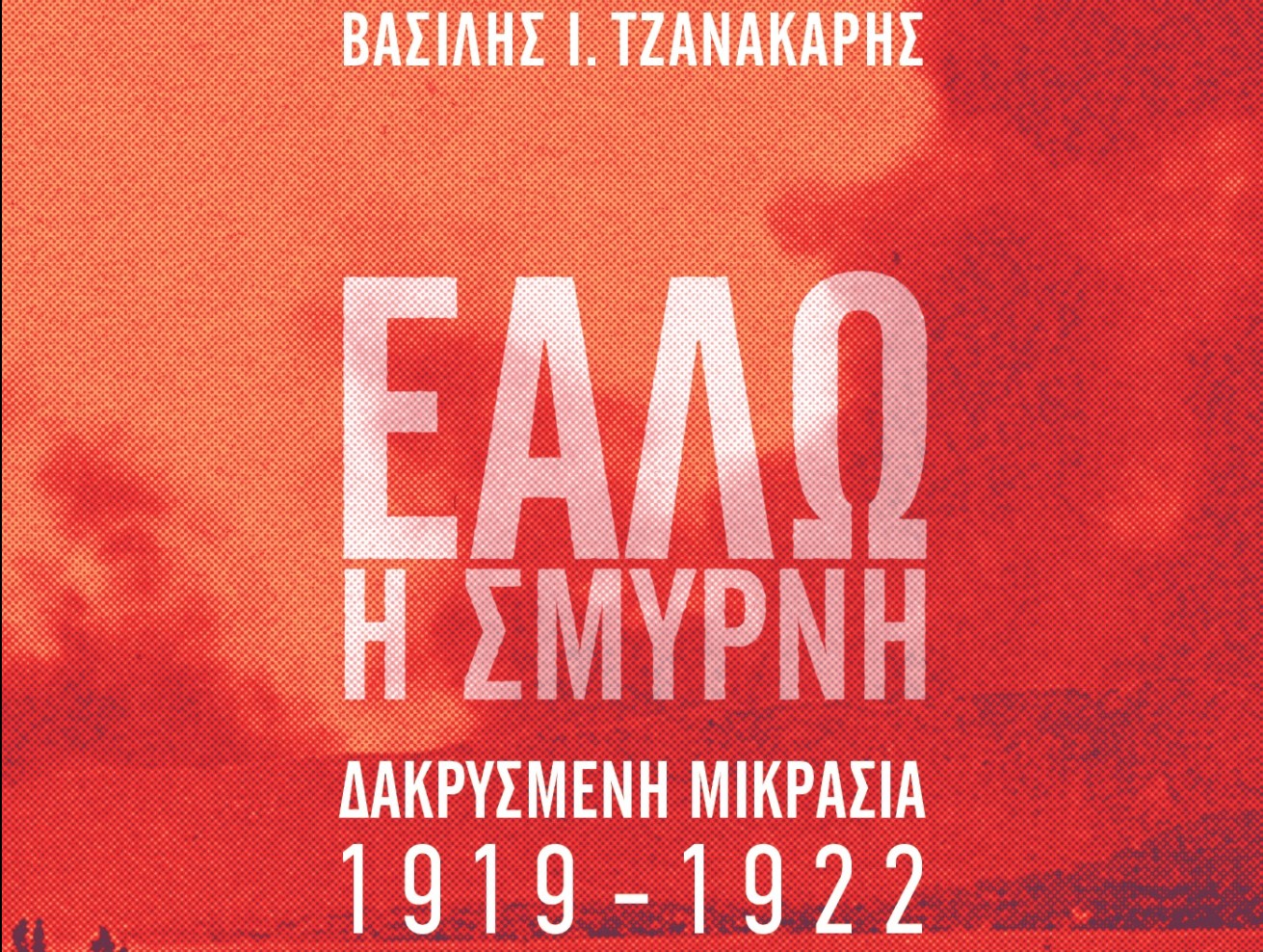
Ο Vassilis I. Tzanacaris, author of the book «Here is Smyrna. Teary Asia Minor 1919 - 1922» (Metaixmio Publications) summarizes the Asia Minor Catastrophe in a single sentence.
Having studied the Asia Minor question exhaustively -this revised, enriched edition is his fourth book on the subject-, delivers with sobriety and emotion, in a dense, charming but unembellished narrative, the events that led to the Asia Minor Catastrophe, starting from 1919 in Paris when, after the First World War, the great «peacemakers» were dividing the world.
From the 900 pages of the book that was awarded the 2008 State Prize for Testimony - Chronicle, all the protagonists - Venizelos, Alexandros, Konstantinos, Gounaris, Protopapadakis, Baltazis, Theotokis, Stratos, Hatzanestis, Paraskevopoulos, Plastiras, Chrysostomos, Aristides Stergiadis - are passed through, while the underground routes and the networks of relations between states and individuals are illuminated, helping the reader to understand the national tragedy.
Against the background of the 100th anniversary of the Asia Minor Catastrophe, Vassilis Tzanakaris answers the questions of HuffPost for the Big Idea, the Smyrna and the Istanbul, the «dark» aspects of the Catastrophe and the great lesson, noting that in his estimation «the fall and total destruction of Smyrna (which entailed not only the loss of ancient Greek territories but also the extermination of more than 1.5 million unredeemed Greeks) was more tragic than Constantinople».
-The Great Idea was born during the Revolution of 1821, although its «father» is considered to be Prime Minister Ioannis Kolettis, while it took flesh and blood with Eleftherios Venizelos. How did Greece believe that it could manage with its small forces and spread its wings as far as Asia Minor?;
The Greek people, or rather most of the Greeks, were for hundreds of years manified by what later Kolettis made more specific and we used to call the «Great Idea», which was none other than a series of «fancy ideas» for the creation of a Greater Greece, on the model of the Byzantine Empire, a Greece of two continents and five seas. This... Idea the Greek people, who are particularly fond of fiction, were quick to accompany it with a series of myths such as: the red apple tree, the... fried fish in Baloukli, the marble emperor who would... be resurrected! etc.
As far as its realisation is concerned, I am very sceptical about it. The fact that in Greece at that time, which numbered only 5 million people, there were only 5 million people. inhabitants, half of whom (due to the policy of National Schism followed by their leaders) wanted to... exterminate the other half, I don't think that there was any room for such a... I don't think that there was any room for such a bold idea, but it was the touchstone for what Greece pursued at the end of the First World War, despite the fact that it continued to have a devastated economy, an acute refugee problem and, most importantly, as I mentioned, polarized political forces. Nonetheless, the grand and flamboyant ideas that Venizelos and his cohorts believed it was time to be realized prevailed as a vision...
-How do you assess the decision of the Great Powers «to send a Greek army to Smyrna under the pretext of preventing any massacres of Christians by the Turks» in the spring of 1919?;
The «possible massacres» of Christians by the Turks that Venizelos put on the negotiating table was a pretext and a minor reason for the decision of the Great Powers to send a Greek army to Smyrna. After all, until then massacres, persecutions and the creation of refugees by the Turks had been a frequent occurrence, culminating in the Armenian genocide. What really interested the Allies was the threat of occupation of Asia Minor and Smyrna by Italy, which had been promised by the Treaty of Moria and had already begun to land troops in Antalya. That was what was actually «burning» them and that was what made them send the Greek army there quickly.
-If the fillet of the Great Idea was Asia Minor, you are referring to the alternative claim to Constantinople. When, at what time and by whom did Constantinople come on the table?;
In April 1919 two English experts, Arnold Toynbee and Harold Nicholson, had proposed a radical solution, with Greece taking Constantinople and the European coast of the Straits (Eastern Thrace) instead of Smyrna, which infuriated Venizelos. Venizelos believed that Smyrna was a huge rising economic power that would sooner or later gain a head start in the race for an expansionist capitalism, unlike Constantinople, which at the time was «overwhelmed» by thousands of uncaring Russian emigres and in decline.
-What are the three darkest «areas», aspects, moments of the Asia Minor Catastrophe - diplomatically, politically and militarily - that we either ignore or almost silence?;
I consider the uncontrolled bloody events on the waterfront that turned relations with some of our Allies and public opinion upside down, the defeat of Venizelos in the 1920 elections and what many of our soldiers did during the campaign and on their return from the front to be a «dark» aspect.
-When did the Greeks realize that the Asia Minor campaign was turning into a Waterloo?;
The Greek rulers realized this in the last, particularly revealing days, when Stratos and Theotokis visited Smyrna and the staff there, but generally the Greeks and even the inhabitants of Smyrna much later, not to say, only at the last moment...
-The 100th anniversary gives us the opportunity to look at people and events from the distance of time. In your opinion, what is the great lesson from the Asia Minor Catastrophe?;
That we are neither an abominable nation nor a high-souled one, and therefore we must not be carried away by unattainable visions and grand fanciful ideas.
-Why did you choose the title «Ealo Izmir», using a word that is absolutely identified with the Fall of Constantinople?;
I believe that the Asia Minor Catastrophe was greater than that of the Byzantine Empire and the fall and total destruction of Smyrna (which entailed not only the loss of ancient Greek territories but also the extermination of more than 1.5 million unredeemed Greeks) was more tragic than that of Constantinople. For me, the «fall» of Smyrna marked the definitive end of Hellenism in the East. And that was the worst thing of all.
«At dawn on December 4, 1923, a Greek steamship, the Archipelagos, entered the harbour of the destroyed Smyrna with the blue and white flag waving on the mast. It was a frosty morning, and the waterfront of the once beautiful city was crowded with people, especially foreigners. The “Archipelagos” was coming to receive another “batch” of prisoners, among those who had been included in the exchange agreement for some months. Only this time the captain's decision was explicit: “I'm not entering the port without the Greek flag!”.
Until then, the Turks, by decision of the military command, did not allow the Greek flag on the steamships that received the prisoners. They had to enter and leave the port of Smyrna after they had been flagged. This time, however, the captain was insistent. It had been more than a year since the blue and white had flown in Smyrna, since that gloomy afternoon of August 26 when it came down from its mast at the hitherto Greek command post. And here was a Greek ship entering the harbour of the erstwhile “Giaur Ismir”, proudly flying the flag at the top of its highest mast. It seems that the Turks, too, after the signing of the Treaty of Lausanne and the decisions to exchange populations, prisoners and hostages, had put water in their wine. He therefore allowed the fortress commander of Smyrna, Sureya Beis, to enter, and even hastened to greet the Greek captain cordially, and to convey to them the greetings of the Turkish prefect. The exchange committee, consisting of Jaquith, director of the Nair East Reliff, and other Americans, went up, talked with the representatives of the Greek government, arrangements were made as to how many and whom, and the receipt of them from the “Archipelagos” was commenced.
Along the whole length of the quay, the legendary And, and behind it, Smyrna lay in ruins...» (Quote).
♪ Ireni Orphanidou, huffingtonpost.gr ♪