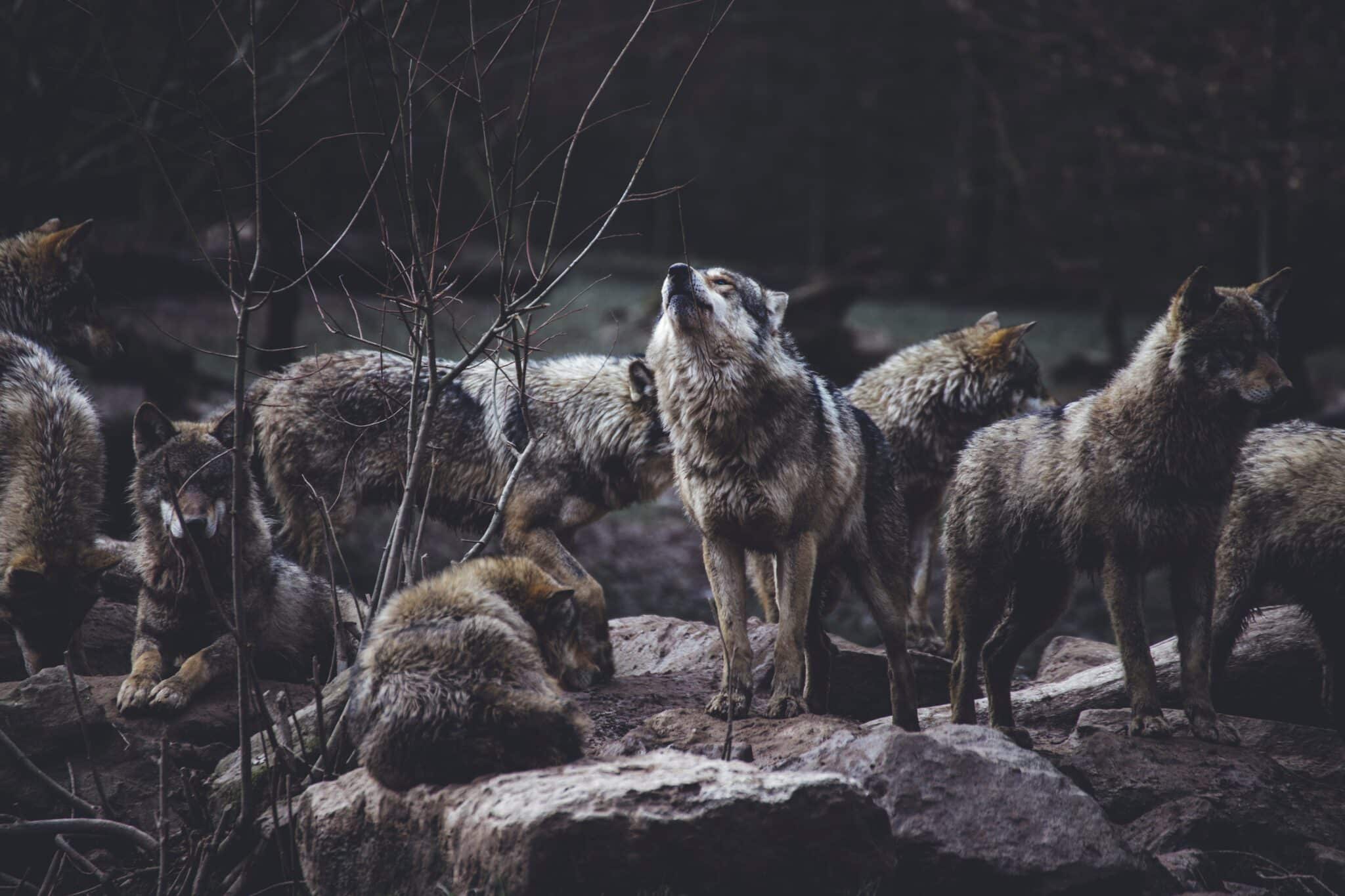
In fact, in recent decades, following a period when their numbers had dwindled to a minimum, it appears that wolves have returned to Greek territory, forming significant packs, with a total population of around 1,000 individuals. These 1,000 wolves in Greece are estimated to be distributed across 180 packs and are found from the country’s northeastern border in Evros all the way to Corinth, while it is estimated that approximately 25 wolves currently live in Parnitha.
This phenomenon—the increase in the wolf population—is, in fact, being observed throughout Europe, and in Germany and France—where until recently there were no wolves—populations of approximately 500 individuals are now recorded in each country.
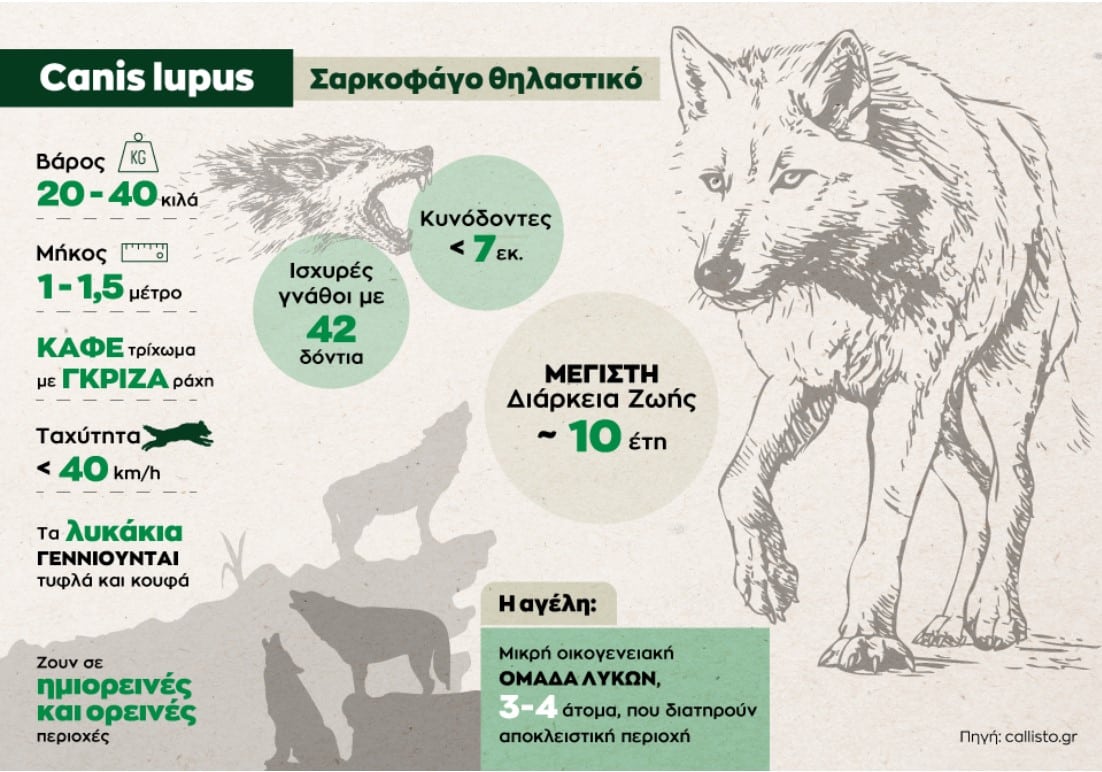
The scientific name for the wolf is Canis lupus; it is a carnivorous mammal and the largest member of the dog family (Canidae). Scientists estimate that it took on its current form about one million years ago, and today two species survive worldwide: the gray wolf (Canis lupus) and the red wolf (Canis rufus), along with approximately 30 subspecies, which inhabit specific regions across the globe.
A characteristic of wolves is that they live in packs, which actually communicate with one another. This is a form of social organization, consisting of smaller or larger groups of individuals, with a core: the dominant breeding pair, which may remain together for the entire lives of its members. Wolves communicate with one another through a variety of sounds, but they primarily reveal their moods and intentions through facial expressions and specific body postures.
The wolf has a large head and powerful jaws (with a bite twice as strong as that of a dog), a narrow chest, long legs, and a light frame (adapted for covering long distances over long periods), and moves—running or walking quickly— for eight to ten hours a day, covering several kilometers.
In addition, wolves use all their senses (especially hearing and smell) to locate and track their prey, as they can detect prey from very long distances and have good night vision.