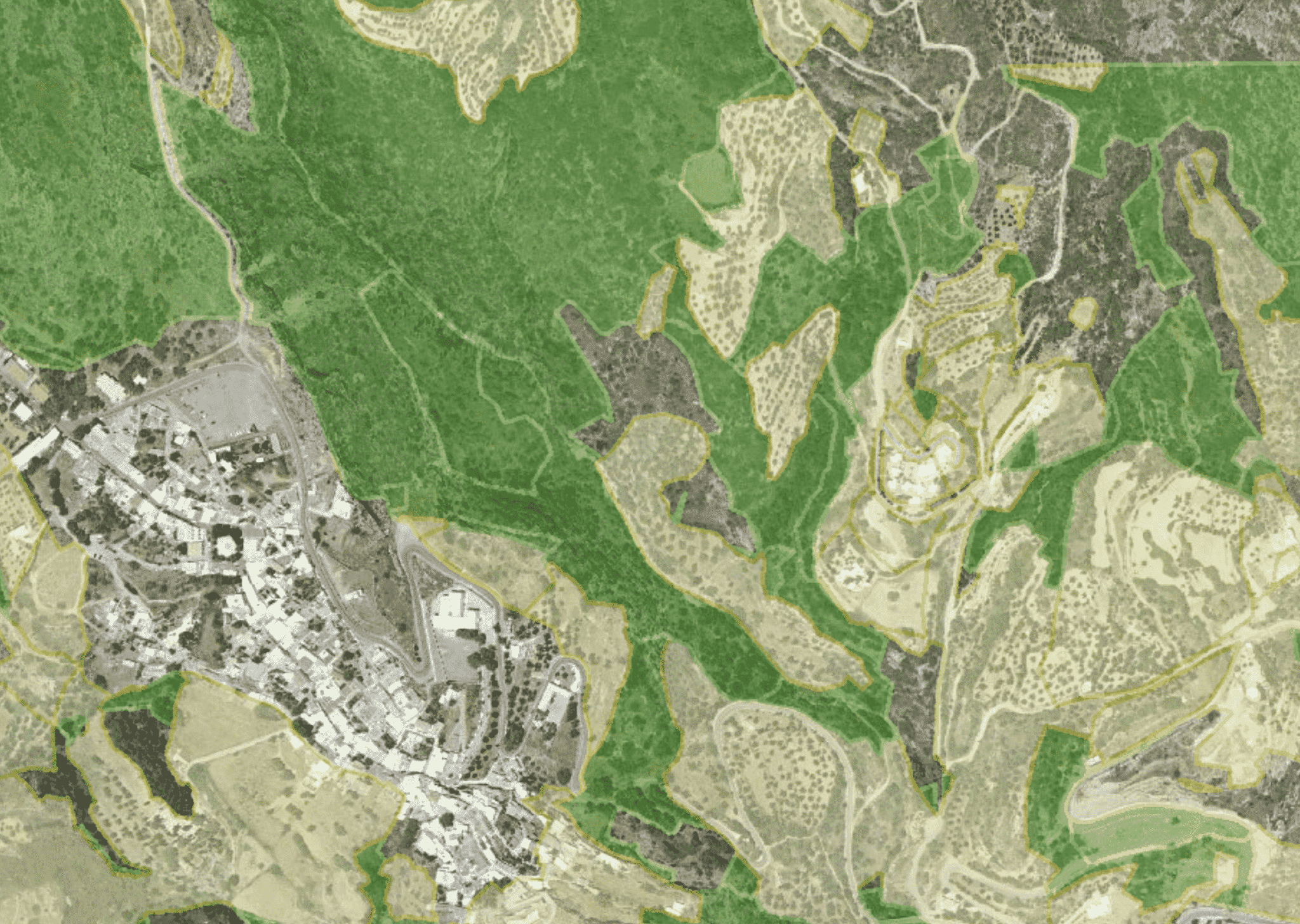
The decision by the Deputy Minister of Environment and Energy (YPEΝ), Mr. Giorgos Amiras for the scrub and them asphodel and the protests have snowballed.
The goal was to resolve the issue of land that was once agricultural but has become forested over the years and is now classified as forest, and to quell the storm of public outcry that had erupted mainly in the Crete and in the Dodecanese.
However, instead of calm, it brought …storms to the scientific community, with foresters preparing to appeal to the Council of State (CoS). Indeed, A member of the Technical Forestry Council withdrew his signature from the opinion on which the Amira decision was based. According to this, areas covered with scrub and asphodel do not meet the criteria to be classified as forest when Forest Maps are drawn up.
As the Dr. Georgios Karetsos, Director of Research at the Institute of Mediterranean Forest Ecosystems «I realized my mistake and withdrew my signature regarding the section on phryganic ecosystems, because, moreover, as I subsequently discovered, this opinion even calls into question the constitutional mandate and the relevant legislation; it was a serious misstep on my part.».
For his part, the vice president of the Panhellenic Union of Public-Sector Foresters (PEDDY) and member of the Geotechnical Chamber (GEOTEE), Mr. Nikos Bokaris, speaking to the «Economic Courier,», describes Amyrás's decision as scientifically «arbitrary» and unconstitutional and notes that «we are examining all the factors involved in filing an appeal with the Council of State.» He even refers to a «semantic shift» in the restriction of species classified as wild woody vegetation (which are protected by the Constitution), excluding the asphodel.
The data and scientific criteria required to classify an area as forest, woodland, grassland, or rocky terrain are defined by Presidential Decree (Presidential Decree) following a proposal by the Minister of the Environment, and for this reason Presidential Decree 32/2016 was issued, which It can be amended only by a presidential decree and not by a ministerial decision, «so that it can undergo the Council of State’s scrutiny regarding its constitutionality,» as stated by PEDDY President Dr. Nikitas Fragiskakis,
As he himself notes, «We’re already hearing concerns from Northern Greece and other regions, which ask us: Since the aspalathos trees were removed to benefit Crete and the islands, why not remove the holm oaks as well?» And he points out that if the changes are not made on a solid foundation—both scientific and institutional—the whole affair will end up being a bottomless pit.
In any case, it is noteworthy that a decision similar to that of Mr. Amyrás was signed in 2019 by the then-Deputy Minister, Mr. Socrates Famellos, accepting a corresponding opinion regarding the phryganic areas, although it was not taken into account in the preparation of the Aegean forest maps.
There is also a counterargument
However, even within the field of forestry, there are two … schools of thought.
Thus, for his part, the former Director General of Forests and the Forest Environment, Mr. Konstantinos Dimopoulos It states, among other things, that the new decision does not «eliminate» or «remove» the asphodel from the list of forest species. On the contrary, it clarifies that agricultural lands, on which, due to the abandonment of agricultural activity, only the asphodel species has become established over time, cannot constitute a forest biocoenosis or a forest-like environment, and therefore cannot meet the requirement of organic unity as mandated by Article 24(1) of the Constitution and Presidential Decree 32/2016. According to him, the same applies to grasslands and rocky areas when only phrygana and aspalathos grow there.
As he notes, «the Constitution explicitly protects forests and forested areas, and not other types of land with different characteristics. How, then, can the mere presence of asphodel on former agricultural land, based on purely scientific criteria, be considered sufficient to satisfy the above condition, which pertains to constitutionally protected forests and forested areas»?;
Referring specifically to the islands, Mr. Dimopoulos considers the approach of his colleagues—who believe that designating phryganic ecosystems as forest areas will halt the wave of construction in the Aegean—to be misguided. According to him, an issue that is purely one of spatial planning and relates to specific land uses cannot be resolved «using purely forestry-based criteria, and in an extremely broad manner.».
Private land and cleared land
In any case, the publication of the Forest Maps throughout the country has revealed hundreds of problems, which, as Mr. Amiras from Lefkada and Meganisi noted yesterday, «the public administration will meticulously revise the forest maps on a case-by-case basis, taking into account measurable data and strictly adhering to the provisions of the Constitution.«.
In particular, solutions regarding property ownership are being promoted. First of all, in the Cyclades, Crete, the Ionian Islands, Lesbos, Samos, Chios, Kythera, Antikythera and Mani, The presumption of ownership in favor of the State does not apply (that is, the burden of proving ownership falls equally on the private individual and the State). On the contrary, in the Dodecanese (as in the rest of the country), the law applies such that forest land on these islands is, by definition, public property, unless a private individual can prove otherwise. And given that in the Dodecanese, more than 50% of the land is designated as forest land on the published maps, the public outcry is enormous.
In fact, on some islands, such as Symi, Agathonisi, Patmos, Kasos, and Karpathos, the forest coverage percentages shown on the maps range from 73% to 88%. The solution currently under consideration is to add the Dodecanese to the list of regions where the presumption of state ownership does not apply. After all, Mani was also included in 2014, through a provision amending the famous Article 62 of Law 998/1979.
With regard to grasslands, rocky, and stony areas located in regions where the presumption of state ownership does not apply, the current procedure for establishing ownership—and consequently their exemption from the provisions of forestry legislation and the possibility of utilizing them—is defined as follows: the existence of securities dating from before February 1946. According to reports, the proposal by the legislative committee is changing the date to a later one, so that citizens who do not possess old title deeds are spared years of legal battles to prove their ownership.
Regarding the Gordian knot of illegally deforested areas (estimated at more than two million stremmata nationwide), the ministry’s legislative drafting team is scrapping and rewriting regulations, as all proposals have weaknesses that could lead, once again, to a case before the Council of State (CoS).
In addition, the Ministry of Environment and Energy’s staff must also examine other inconsistencies that have arisen regarding the nature of the land, such as issues related to monastic and church property.