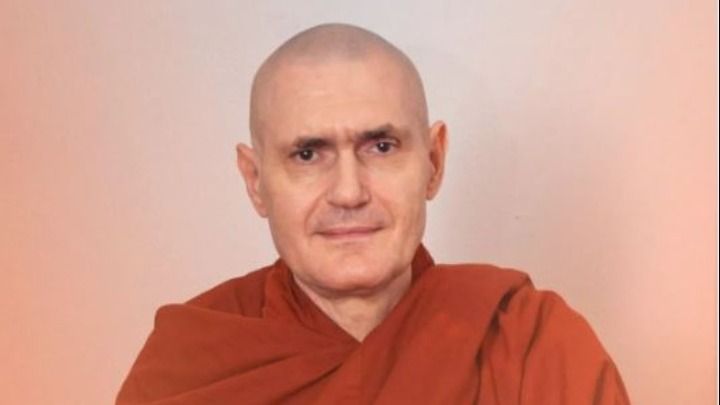
Since the time of Alexander the Great and his successors, Hellenism and Buddhism have intersected in Asia, exerting a mutual influence on one another. Following in the footsteps of this tradition is a modern Greek who, after an unusual life journey, is now, at the age of 64, a prominent Buddhist monk and scholar with numerous books to his credit, international acclaim, and deep experience in meditation.
The Athens and Macedonian News Agency spoke with him and presents the unique story of Bande (Venerable) Naniantasana, who was born in 1959 as Ioannis Tselios in Serres. No other contemporary Greek—at least as far as is known—has had such a long career in traditional Buddhist monasticism, spanning over 40 years, a fact he himself confirms.
As a teenager in Thessaloniki, he was an outstanding student with a knack for physics and mathematics, especially atomic and nuclear physics; He «devoured» books on the subject and dreamed of working for the National Aeronautics and Space Administration (NASA). But along the way—influenced in part by the books of Erich Fromm—he discovered psychology and then sociology. So he studied sociology at Goethe University in Frankfurt for two years, but did not complete his studies, which generally disappointed him.
At the same time, he declared himself an atheist. «How is it possible,» he wondered, «for the all-good and all-powerful God to allow the evil that is so common in the world? How can something so pure give rise to something so evil?» It was the late ’70s and early ’80s, and Tselios, with long hair and a beard, lived like many other restless young people in Europe, read voraciously (including, among others, the complete works of Kazantzakis), traveled adventurously through several European countries, and searched for the meaning of life.
As he says, «Theoretical knowledge wasn’t enough for me; I wanted to see the world, so I took many trips on my own to European countries and Morocco, even reaching the Sahara. My friends were afraid; they didn’t dare to travel on their own. But even back when I was a high school student, I had gone on my own to Mount Athos with just a sleeping bag for 15 days.’.
Until a trip to India in 1981 changed his life. «I arrived in New Delhi carrying nothing but a bag of books and a sleeping bag. I found it repulsive that everyone, even the gurus, smoked hashish. I didn’t find anything meaningful there, anything spiritual,» he says. For many months, he traveled alone from the Himalayas in the north to the south, often on the roofs of trains, among Western hippies and devout local believers.
Eventually, after becoming disillusioned with «India’s theomania and religious fanaticism,» at the age of 22 he had, in that vast Hindu country—the cradle of Buddhism— his first encounter with Buddhism—specifically with the Theravada tradition (the Teaching of the Elders), which is older and more authentic than later traditions such as Mahayana, Zen, and Tibetan Tantric Buddhism. A tourist brochure, in which he happened to read a quote from the Buddha («This is my final birth; I have crossed the ocean of existence»), which shook him to the core, marked the beginning of a new journey.
«I couldn’t believe my eyes,» he says. «Who would dare say something like that? For half an hour, my mind kept returning to those words. I decided I had to learn about the Buddha.» ‘That’s when I began, under the guidance of an Indian Buddhist monk, director of the Buddhist museum in Kushinara (where the Buddha had died), to practice meditation systematically and read Buddhist books.
«The first thing the monk told me surprised me: ’In Buddhism, there is no god; focus all your attention on your breathing.» As an atheist, I felt such freedom. Within five minutes, I achieved such deep concentration that I felt as if I’d been reborn. I got closer to myself, and that was a life-changing experience for me. I stayed there for a month, then went to Nepal, visited Kathmandu and Lumbini, where the Buddha was born, and returned to India for another month. When I learned that there were Buddhist countries, I chose to go to the closest one, Sri Lanka. But first, I visited Tibetan Buddhists living in Darjeeling in northern India. I stayed at a Tibetan monastery for seven days, but I was disappointed by their rituals and deities, which strongly resembled a conventional religion, and I also sensed corruption related to money. “That’s why I sought out authentic Buddhism in Sri Lanka.”.
Knowledge and Insight
In Sri Lanka (Ceylon), an ancient Buddhist stronghold, he stayed at Buddhist centers and quickly made the momentous decision to become a forest monk: first as a novice (samanera) in 1982 and, after this preparatory period, as a full-fledged monk (bhikkhu) in 1986.
«At one point,» he says, «I had bought a return ticket to Greece to find a quiet place to meditate. But in the end, I burned the ticket and decided to stay in Sri Lanka and become a monk. No one influenced me to become a monk. In Buddhism, you have to knock on its door, and then they’ll give you information. They don’t come to you and say, ‘You must become a Buddhist.’ I’ve never encountered proselytizing among Buddhists. Even my teachers told me how to learn to meditate, not how to become a Buddhist. My ordination ceremony, where I put on the robe and became a novice, took place at the Polgastuva hermitage on an island.».
There, at the age of 23, he was ordained by the state-recognized scholar, the Most Venerable Kaḑavedduve Shrī Jinavaṃsa Mahāthera. For the next four years, he trained at the Nissaraṇa Vanaya monastery in the Mitirigala region, under the guidance of the Venerable Mātara Ñāṇārāma Mahāthera, another state-recognized scholar and renowned meditation teacher.
In 1986, Nanyantasana (whose monastic name means «knowledge and vision») received full ordination and subsequently studied the ancient Indian language Pali, the Three Baskets of Sacred Buddhist Texts (Tipiṭaka), and their subsequent commentaries, under the guidance of erudite teachers at the Gnānārāma Dharmāyatanaya monastery, where he remained for 16 years. In 1997, after passing written and oral examinations, he received the title of Vinayācariya (Professor of Monastic Education), which is equivalent to a university degree but may not be used by monks to earn a living.
The Life of Nyanadassana (Nyanadassana) was marked by an ever-deepening immersion in and devotion to Buddhism, both theoretically—through extensive study of the Buddha’s discourses (suttas) and Buddhist psychology (Abhidhamma), as well as practically through all-day meditation sessions. He lived in various monasteries in Sri Lanka, at times in seclusion in huts, cottages, and caves in the jungles and rainforests. «Meditation,» he emphasizes, «is not an easy task, which is why most people avoid it.’.
His most recent stay was at a secluded hermitage in the vast Na Uyana Aranya, the largest Buddhist meditation center in the country, which comprises six monasteries, covers a forested area of over 50,000 stremmata, and is home to 150 monks, 50 of whom are foreigners. The cottage where he lives, at an elevation of 400 meters, was built specifically for him by a layperson who wanted to perform a good deed—a tradition in Sri Lanka.
«The Sri Lankans feel a great sense of pride when a foreigner expresses an interest in becoming a Buddhist monk in their country. They appreciate it very much. There are currently about 100 foreign Buddhist monks in Sri Lanka. As far as I know from relevant records and other sources, ’there has been no other Greek Buddhist monk before me in Sri Lanka, Myanmar, Thailand, or any other country with Theravada Buddhism,» he says.
Now known internationally as «the Greek Nanyantasana,» he has acquired a deep understanding of the Buddhist scriptures, thanks in part to his mastery of both the local language (Sinhala) and the ancient Indian Buddhist language Pali, which is related to Sanskrit. At a certain point, having by then become a Mahāthera, he himself taught locals and foreigners who came to the monasteries, gained students, and along the way wrote and translated ten books—all of which have been made available free of charge—into various languages (English, German, and Sinhala). Some have had a wider impact on the Buddhist world internationally, particularly one of his books on the dawn (exactly when the day begins for monks), which required five years of research equivalent to a doctoral dissertation and «shook up» many Buddhist communities.
He has also been repeatedly invited to travel to various Asian countries (Indonesia, Singapore, Malaysia, Taiwan, Thailand, etc.) to give talks and teach meditation. Between 2003 and 2007, he lived and practiced meditation at the renowned Pa-Auk Tawya Buddhist meditation center in Myanmar (Burma).
In Athens
In April 2019, he returned to Greece at the invitation of Michael Xynou, president of the Greek Teravada Center and honorary consul of Sri Lanka in Greece. He originally planned to stay for six months, but his stay has been extended considerably. To date, he has been staying primarily in Agia Paraskevi, in the building that houses both the Sri Lankan Cultural Association (which serves the needs of the approximately 850 Sri Lankans in Greece) and the Theravada Center.
During his four years in Athens, he has taught a series of courses on Buddhist psychology, philosophy, and meditation—both in person and online via Zoom and Facebook (due in part to the pandemic), so that Greeks could learn about Buddhism firsthand and from a reliable source.
At the same time, he worked tirelessly on the publication of various books in Greek. In fact, the book *What the Buddha Taught*, an international bestseller (since 1959) by the learned Buddhist monk Walpola Rahula, has just been published by the Teravada Center Press in his own new translation. Two of his own books are also being prepared for publication: a detailed guide to Buddhist meditation and a book on the life and teachings of the historical Buddha.
«When I came to Greece, I didn’t know what I would find,» he says. «I did see, however, that there was interest in Buddhism and meditation. The Greeks had always spoken of ‘know thyself,’ but they didn’t know a method for achieving it. Greek philosophers, such as Socrates and Heraclitus, had explored such topics, so Buddhism—which teaches how to analyze yourself, transcend your emotions, and focus your mind—is not something foreign. What Buddhism can offer a modern Greek is self-awareness, an understanding of how the mind works, and the ability to turn inward rather than outward. The goal of Buddhism is to understand our passions, impulses, fantasies, and delusions—and how much we suffer because of them, how much of our pain is self-inflicted. The Buddha provides guidance for a journey inward.’.
«Buddhism is not theocentric but anthropocentric,» he adds. «It’s not life, politicians, the will of God or Satan, or anything outside of us that is to blame. The source of our suffering and our happiness lies within us; we just need to purify our minds. If someone is unhappy, they are the cause of their own unhappiness due to their ignorance. Bliss can be found only within us. Everyone can avoid attachments, cultivate altruistic tendencies and generosity, and eliminate greed and anger. The world’s problems stem from our own minds. Buddhism seeks to purify the mind, because mental defilements bring all kinds of suffering into life.».
Paul Drakopoulos