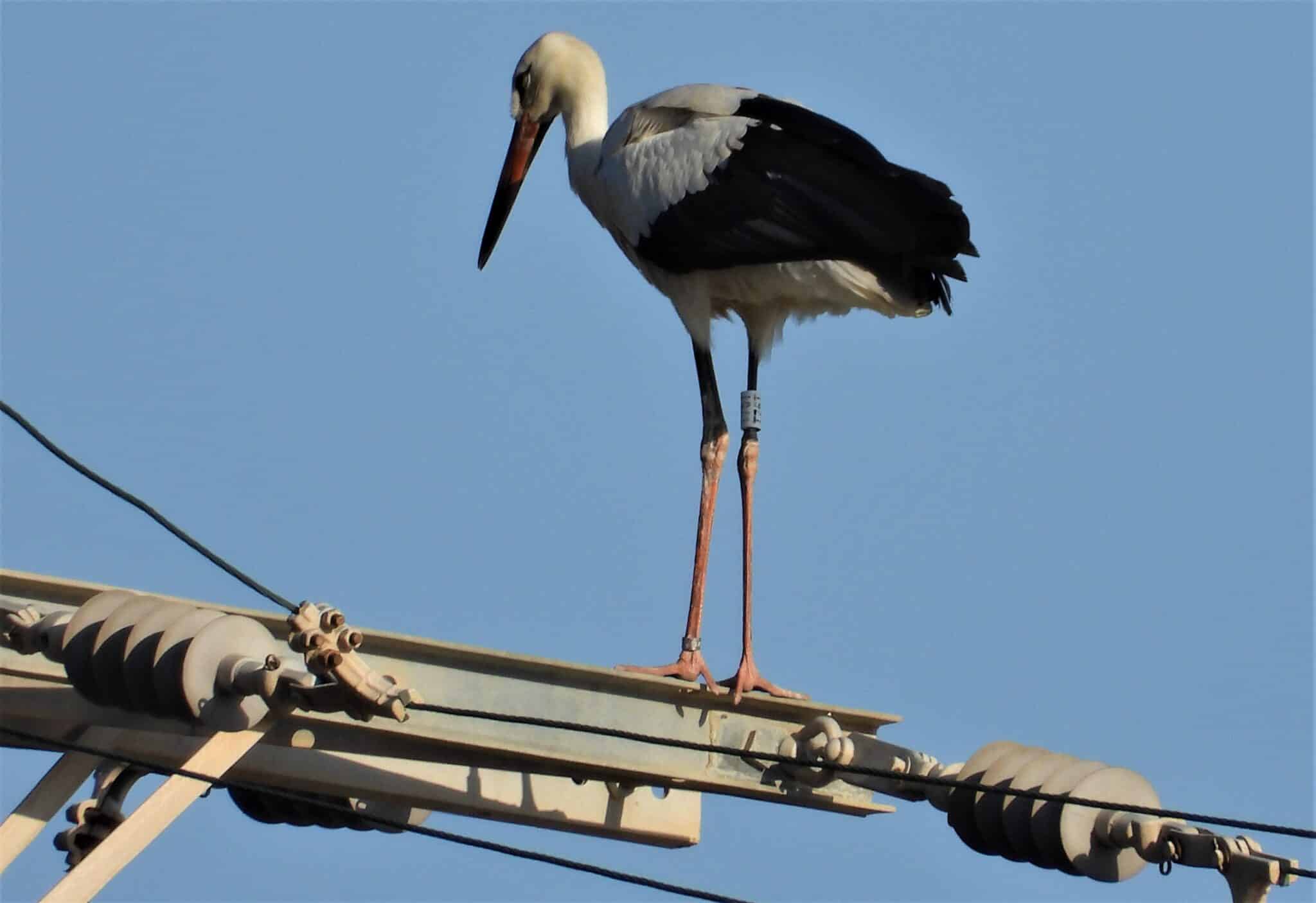
Nine storks passed through Kapsali on Kythira, where they spent the night on Wednesday, September 8.
The storks arrived in Kythira at dusk on Wednesday as part of their migration to warmer climates, where they will spend the winter.
Kythera.News obtained photographs showing two “rings” on the legs of a stork. One, the smaller one, is at the base of the left leg, and the other, larger one, is on the upper part of the right leg. In fact, according to the person who sent the photos, the code T75T (in Latin) is inscribed on the larger “ring,” which indicates that the birds have been registered and are being monitored.
Storks do not build nests on Kythira; they use the island as a stopover during their migration. They usually stay here for 2 to 3 days to rest before continuing their long and difficult journey. The latest report indicates that the birds left Kapsali today and are heading toward the Feloti area.
The People-Loving Storks
The stork (Ciconia ciconia), the «leleki» of the Greek plains, is a truly people-friendly bird that nests near settlements, in areas adjacent to wetlands, meadows, and farmland.
The word «stork» is a compound of the words «pelos» (black) and ’argos” (white), and perfectly describes this bird’s black-and-white coloration. It is over one meter long, has a wingspan of two meters, and weighs about four kilograms. It prefers to feed in shallow, still waters—lakes, lagoons, ponds, and streams. It is very quiet, which is why people initially believed it to be mute. In rare cases, however, it emits a guttural cry or a whistle.
In the late 1950s, it is estimated that approximately 10,000 pairs of storks nested in Greece. Ten years later, only about 2,500 remained. Starting in the mid-1970s, the Hellenic Society for the Protection of Nature launched an effort to conduct a stork census by sending questionnaires to municipalities, communities, schools, and other organizations. Although it was ultimately not possible to determine the total population with precision, the species’ geographic distribution in Greece was fully documented. Today, the southernmost extent of the regular range of storks nesting in Greece is Messolonghi. According to the most recent population estimate (Tucker and Heath 1994), there are an estimated 2,000–2,500 breeding pairs in Greece; however, this number may be overestimated.
It is certain, however, that in Greece—unlike in most Central European countries—storks continue to nest in several cities (Kastoria, Trikala, Karditsa, Lamia, Ioannina, Arta, Filippiada, Messolonghi, Aitoliko, etc.). There are also populations that nest on islands, specifically on Lesbos and Lemnos, while until a few years ago they nested on Kos and in Northern Euboea.
Storks are monogamous birds. Once they mate, the male and female remain bonded for a very long time. The female lays her eggs in April, usually 2–3, but sometimes as many as 6. Both parents take turns incubating the eggs for about 30 days. And even after the chicks hatch, one of the parents always stays close to protect them from predators, rain, cold, or heat.
Long-haul flights
Storks are migratory birds that spend their lives divided between the countries where they nest and those where they spend the winter. Storks make this long journey not by flying, but by gliding. They form small groups that begin to circle and climb higher and higher, often exceeding 700 meters. Then, suddenly, they all leave the warm updraft together and head in the direction of migration at speeds exceeding 70 km/h. Their long, broad wings facilitate their long-distance flights, as they allow the birds to fly with minimal flapping, taking advantage of the warm updrafts.
Usually, instead of crossing the Mediterranean, storks bypass the open sea by flying through the straits of Gibraltar and the Bosphorus. An exception is a portion of the stork population in Central Greece, which likely flies over the Aegean Sea or Crete.
Stork nests are always built in high places—on the roofs of houses, on chimneys, on pillars, in large trees, on cliffs, in ruins, on churches, and on bell towers. The male stork is usually the first to arrive and takes charge of maintaining or even building the nest from scratch. Although nest construction can be completed in a few days, storks prefer not to build a new nest every year, but rather to repair and reuse the old one. They lay 3–5 eggs, and incubation lasts about a month. Both parents take turns incubating the eggs. The chicks make their first flight after nine to ten weeks.
The storks’ diet consists largely of insects, worms, reptiles (snakes, lizards), and amphibians. They also feed on small mammals (mice, rats, etc.). Their dexterity and speed in catching their prey are remarkable, especially when food is plentiful. It has been observed, for example, that they can catch 25–30 grasshoppers in just one minute!
Storks, as population regulators of many other organisms (insects, rodents, etc.), play a very important role in agricultural ecosystems. They serve as indicators of environmental balance and, at the same time, symbolize the harmonious coexistence of humans with the natural countryside.
Stories of Storks
According to tradition, when elderly storks grow weak and begin to lose their feathers, their offspring provide for them and cover them with their own feathers. This story has its roots in the ancient belief, also mentioned by Aristophanes in *The Birds*, that young storks care for their parents in their old age. It is worth noting that in antiquity, the law requiring children to care for their parents when they grew up was called «Pelargikos,» and the reciprocation of this care by children toward their parents was called «antipelargia» or «antipelargesis.» In his work *Stories About Animals*, Aristotle notes that the Thessalians recognized the role of storks in controlling the snakes in their region. For this very reason, they strictly protected storks and strictly prohibited hunting them. They considered the killing of these birds to be just as criminal as murder.
The great ecological importance of storks is also vividly described by the journalist Konstantinos Maroudis in his book «On the Usefulness of Birds,» written in 1879 and still relevant today. Finally, Stefanos Granitsas, in his book «The Wild and the Tame of the Mountain and the Valley,» describes spring plowing with the following words: «In front, the plowman; behind, the oxen; further back, the woman with the hoes, the pot, and the baskets; and above them, the Lelekia, a white cloud in the azure mist of dawn.’.
So, setting aside any utilitarian perspective, storks have always been associated with the changing of the seasons, as their departure and arrival signaled the beginning of a new season for people. Storks leave at the end of summer, and shortly thereafter, swallows depart in early fall. The following folk couplet serves as a calendar reminder of the departure of these migratory birds:
«The Savior’s drops, the Cross’s swallows…»