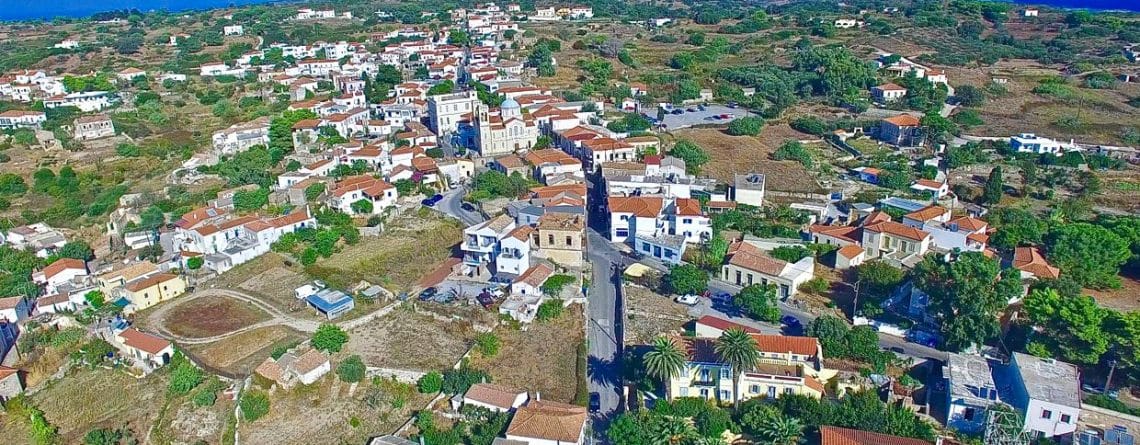
With program agreement between the Municipality and of Network of Municipalities of the Attica Islands, and with funding of €35,000.00 from the Deposit and Loan Fund, the Finance Committee voted to approve the study and maturation of the River's regeneration. The project will have a 9-month timeframe, with the ultimate goal of identifying a funding program for its implementation before the end of 2021.
In a related Press Release issued by the Municipality of Kythira, the total cost of the study is set forth in detail, while the belief is expressed that the route of direct award is «the quickest and most cost-effective procedure, compared to the time-consuming and protracted process of architectural competitions.».
The municipality then launches an attack on the recent Objections raised by Andreas Mariatos, describing his statement regarding the architect’s fee as «utterly false,» while regarding the preference Mr. Mariatos expressed in the architectural competition, he points to earlier instances where the Municipality directly commissioned him to carry out redevelopment studies, «without Mr. Mariatos having requested a nationwide architectural competition for those projects at the time,» as he pointedly notes.
The following is the press release of the Municipality of Kythera:
Studies on the River's Revitalization Begin
By decision of the Finance Committee, chaired by the Mayor of Kythira, Mr. Efstratios Charhalakis, The conclusion and terms of the Program Agreement between the Municipality of Kythira and the Network of Attica Island Municipalities were approved for the implementation of the project «Preparation of Studies for the Redevelopment of the Potamos Settlement in Kythira,» which is funded in the amount of €35,000.00 by the Deposits and Loans Fund. The decision was made by a majority, with only the five members of the Municipal Authority voting in favor. The Attica Islands Network will serve as Technical Advisor to finalize the river restoration studies, with the Technical Support Department for Island Municipalities of the Attica Region bearing ultimate responsibility for their drafting. This process, provided for in Article 100 of Law 3852/2010 in conjunction with the provisions of Laws 4412/2016 and 4674/2020, constitutes the quickest and most cost-effective process for a municipality to fully develop a project, spending much less money and in a much shorter time compared to the time-consuming and protracted process of architectural competitions. The amount specified in the Program Agreement will be spent as follows:
| PROJECT: «REVITALIZATION OF THE POTAMOS SETTLEMENT IN THE MUNICIPALITY OF KYTHIRA» | |
| CONSULTING AND TECHNICAL SUPPORT | EXPENSE |
| SURVEY STUDY | 2.500,00 € |
| ARCHITECTURAL DESIGN | 20.000,00 € |
| ELECTROMECHANICAL DESIGN STUDY | 3.000,00 € |
| TENDER DOCUMENTS | 1.000,00 € |
| OHSAS – FAY Study | 400,00 € |
| SUM 1 | 26.900,00 € |
| Operating expenses for the implementation of 6% (Article 100, paragraph 4, of Law 3852/2010) | 1.614,00 € |
| SUM 2 | 28.514,00 € |
| VAT 24% | 6.843,36 € |
| TOTAL FEES FOR STUDIES | 35.357,36 € |
For the first time in decades, the Potamos River revitalization project is entering a phase of planning and full development with a clear timeline of 9 months. The goal is to have the studies fully completed by the end of 2021, so that funding for the project can be sought from a current funding program and it is not once again relegated to an uncertain and indefinite future..
With regard to the allegations made by architect Mr. Andreas Mariatos, we would like to clarify the following:
- The settlement of Potamos has not been designated by the Government Gazette as a traditional or special historical site and, therefore, does not fall under the «notable engineering works» described in the relevant Ministerial Decision regarding the obligation to hold a nationwide architectural competition.
- The architect's fee, according to the table above, is the by no means insignificant amount of 20.000,00€, therefore Mr. Mariatos's statement that «The architect who will do almost all the work will earn no more than 6,900 euros—which is exactly what the building permit for a small 60-square-meter house costs.» It is, at the very least, completely false, and it would be best if he retracted it. An amount of approximately €20,000.00 for the architectural design of the redevelopment of the main streets in the town of Potamos (and obviously not the entire residential complex, which would be unfeasible in terms of time, procedure, and cost), is more than reasonable, especially given the current circumstances.
- A selection process for engineers and architects will be held public announcement to all media outlets in Kythira (therefore, Mr. Mariatos may also participate if he wishes) while Before the finalization of the studies—and especially the basic architectural proposal—there will be a presentation and consultation with the entire local community of Potamos (Community, organizations, residents) as expressly provided for in Article 8 of the Programming Agreement.
- Opting for an architectural competition puts the project on the back burner. It takes years to complete a nationwide architectural competition. Furthermore, an architectural competition requires a budget many times greater than €35,000.00, as it is conducted based on estimated design fees, which are very high. Moreover, no one can rule out the possibility that the final contractor for an architectural design might be, for example, from Thessaloniki or Cyprus, who would have no connection to the local architecture of Potamos and Kythira in general—with all that this implies for the project’s final aesthetic. In contrast, under the selected procedure, the call for expressions of interest will be directed primarily at the local community.
- To provide a point of comparison, we will mention only the following: The design studies for the completion of the River Theater, with a budget of 40,000€, were put out to bid through a simplified competitive bidding process on January 24, 2020—that is, 14 months ago. Only one consultant participated in the tender. To date—that is, 14 months after the tender was concluded— we have still not signed the contract with the contractor due to the labyrinthine bureaucracy that plagues all public tenders, even the simplest ones! So when it takes nearly two years to sign the agreement for such a simple contract, anyone can imagine how many years it would take to complete a nationwide architectural competition—which, we reiterate, is a potential rather than a mandatory option in the case of the River..
- Through the process of technical development carried out by a technical consultant (such as, for example, a Network of Municipalities), much larger regeneration projects than this one have been and are being carried out—including projects within designated traditional settlements and historic sites such as Pylos, Leonidio, Kosmas in Kynouria, and the city of Sparta etc. Projects funded by the NSRF and having obtained all the necessary legal approvals—including those from the Central Archaeological Council—were brought to fruition through «Parnonas S.A.» (the corresponding Network of Municipalities of the Eastern Peloponnese), which entered into an identical Program Agreement with the relevant municipalities. The relevant list of major redevelopment projects implemented through Program Agreements under Law No. 3852/2010 rather than through an architectural competition, is inexhaustible. A recent example is the studies for the Vitzamanio School in Chora, Kythira, which we completed in a very short time (in just 8 months) with the technical assistance of the Attica Islands Network, will be submitted in the coming days to the «TRITSIS» program for funding. The studies were unanimously approved by the competent body, the Architecture Council (where the Technical Chamber of Greece is also represented), without the issue of an architectural competition even being raised, even though the Vitzamanios School is located at the heart of Chora’s traditional settlement and is itself a protected monument (the first educational institution in Kythira during British rule).. This is also the most substantive response to the criticisms regarding the alleged illegality of the procedure, since the Architectural Council is the body with the greatest authority to approve procedures and the quality of architectural designs.
- The quality of the Study obviously cannot be questioned in advance, as it will be reviewed and approved by the competent authorities as required by law (Technical Services Department of the Islands Regional Unit, Architectural Council, etc.). Specifically, the Approval by the Architecture Council is of crucial importance for such projects, something that Mr. Mariatos is well aware of this, having previously served on that body, which has issued dozens of approvals for similar studies without holding a nationwide architectural competition.
- Finally, we consider it appropriate to mention that During the period 2005–2008, Mr. A. Mariatos was commissioned by the Municipality of Kythira (rightly so, in our opinion) to prepare nine urban renewal studies (e.g., Mitata, Fratsia, Belvedere, Melissou Square in Aroniadika, Kato Chora Square in Mylopotamos, Kamari-Platanos, Toichio Ag. Pelagia, Livadi, and Chora Central Square) through direct award—and, of course, without Mr. Mariatos having called for a nationwide architectural competition for these designs at the time (!), some of which concerned designated traditional settlements, which are strictly regulated and protected, such as Chora, Aroniadika, and Mylopotamos.
For the first time, the studies on the river’s restoration are being put on a sound and clear path toward implementation by our municipal government. We are consciously choosing the quickest and most cost-effective procedure provided for by law because we want to see results soon, rather than discussing the issue in abstract terms for years, as has been the case until now with far too many projects. The studies will be subject to public consultation with the local community, and the final outcome will fully vindicate our choice.
The above, however, raises the following question: Are the objections to the architectural competition and the related arguments intended to help bring the project to fruition, or to shelve it indefinitely?;