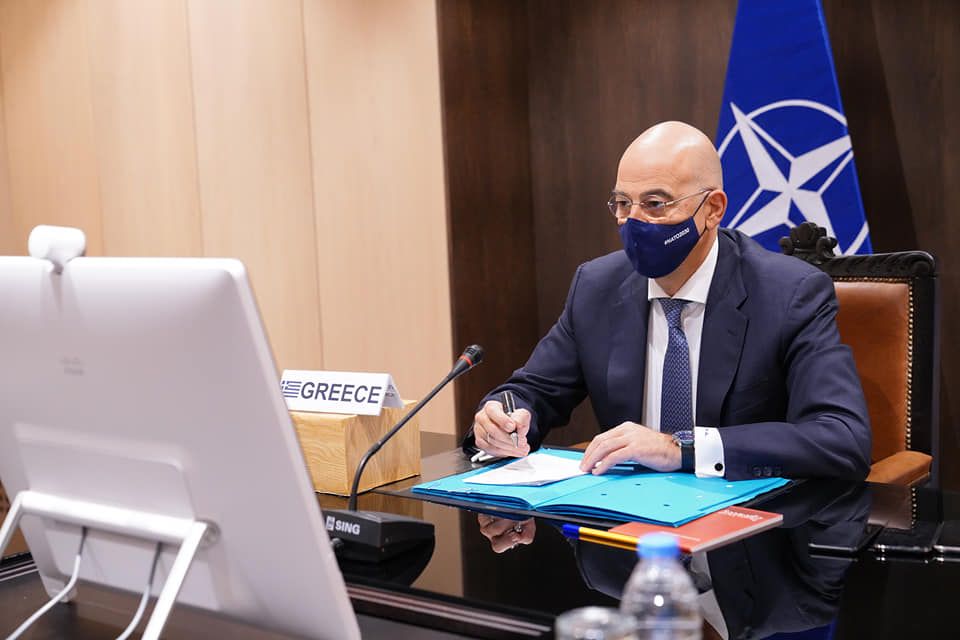
«The reality is that we would have liked to see better results from the summit,» notes Foreign Minister Nikos Dendias in an interview with the newspaper “To Vima tis Kyriakis.” «On the other hand, given the Council Presidency and its stance, one could not realistically expect more,» he adds.
The foreign minister believes that the German political system and German society recognize Turkish aggression and irrationality on certain issues. However, «there is a major issue with the current German government regarding immigration. The events of 2015 have left a lasting trauma,» he explains, adding that «any risk associated with this is greatly exaggerated in their eyes.».
He also believes «that they are operating on the basis of stereotypes such as “Erdoğan won’t be there forever.” ‘So, let’s put up with what’s happening today in anticipation of a better future that is bound to come.»”.
As Mr. Dendias points out, «We Europeans ourselves have not reached a firm decision on the direction we want Euro-Turkish relations to take.» He points out that Greece’s decision in the 1990s to seek a resolution of disputes through the accession process was a bold one. Today, however, Turkey is straying from that path, and this historic endeavor is failing.
«If we were to speak in terms of probabilities, the 90% leads to the conclusion that Turkey will continue to diverge, while the 10% suggests it will converge again. I wouldn’t rule out this 10%. And we must realize that choosing the 90% carries a risk: a special relationship. »This could grant Turkey access to the European market without imposing on it the obligations regarding the rule of law and human rights, which are essential for us,” he emphasizes.
«We are almost historically obligated to seek a shift in Turkish society toward Europe. Otherwise, we will have to adopt a »Fortress Europe’ approach. That would not be a pleasant prospect.”.
As he notes, Athens is waiting for a date from Ankara, but the latter apparently wants to be sure it won’t face a rejection. There will be no refusal, Mr. Dendias makes clear, ‘as long as the climate is right, the Oruc Reis isn’t «cruising around,“ and we have stability, not tactical maneuvers.”.
By repeatedly invoking the demand for the demilitarization of the islands, Ankara appears to be seeking to broaden the agenda from the outset. ‘This will not be accepted,« Mr. Dendias emphatically states, stressing that no third country, including Germany, has raised such an issue.
«I think everyone understands—even though deep down they may think otherwise—that once this Pandora’s box is opened, it will never close again,» he says.
Nikos Dendias also believes that the recent announcement of U.S. sanctions against Turkey will affect the current balance of power. He also believes that with the amendment to the annex of the Greek-U.S. defense agreement in 2019, «Greece provided the U.S. with a basis for taking such a step, as it offered the luxury of breaking free from Turkey’s geopolitical stranglehold.».
He also emphasizes the significance of the remarks made by his American counterpart, Mike Pompeo, at the most recent meeting of NATO foreign ministers, who «effectively refuted Turkey’s main argument that it is the “touchstone” of the Alliance’s presence in our region.».
As he explains, Athens is already in talks to revise the core of the defense agreement, with an expansion of the U.S. military presence, but «we need to see what the new U.S. administration’s ambitions are.» Greece is seeking an expanded role in the Balkans, both for geostrategic reasons and for the development of the Greek economy. «Our geopolitical bargaining chip is stability and security,» he emphasizes.
«In the Libyan Sea, we didn’t have many options when we came to power,» he notes. «Our first priority was to ensure that the Libyan coastline opposite Crete would be controlled by friendly forces, whether on the ground or by third parties. In the discussion the following day, there were two main objectives: preventing the establishment of a Turkish base and overturning decisions made by the Sarraj government, such as the Turkish-Libyan Memorandum,» he concludes.