This mantra is constantly shouting, the last 3 years more intensely, that “globalisation is over” and “whatever you used to parrot about it, forget it”. And that we are now heading towards (at least) a bipolar world with zones and infrastructure supporting non-communicating monetary systems of the same up and down philosophy (but which continue to ignore the internet and its potential).
Everything that has been done since June 19 is an act of demarcation of these zones to control the “passages” of commercial or energy roads or to bypass the “checkpoints” of the adversary. Such as the Suez Canal or Panama Canal, for example, which emerged as such mainly during the previous Cold War.
But today new passages are being created, which require “watch dogs” like Israel and Egypt. One such is the four-country Nordic grid and Alaska to control the new sea lanes in the Arctic Circle, which are emerging from the melting of the ice.
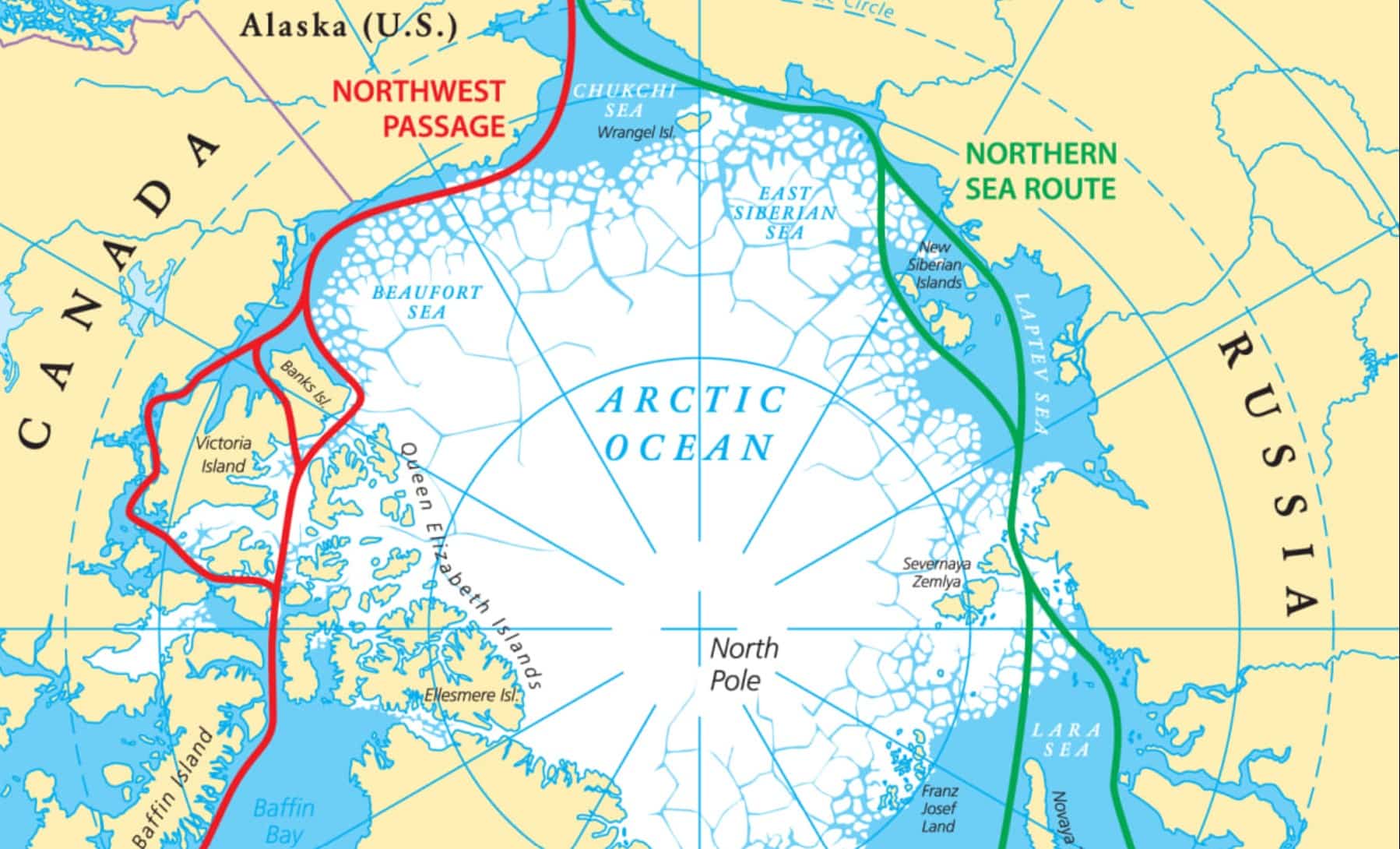
Due to its strategic position and natural resources on these new routes, China has been early to develop a “polar silk road” to play a leading role in the Arctic region, attempting to develop joint projects with local actors, particularly the Russian Federation, opening a new transit route for its goods.
The Polar Silk Road refers to the Arctic Sea waterways connecting three major economic centres, North America, East Asia and Western Europe, via the Arctic Circle. As the melting of sea ice makes it possible to open up the region to shipping, creating significantly shortened sea routes such as the North Sea Passage, thus promoting overall economic growth in the regional north, which will lead to significant changes in global business and shipping patterns.
Due to its geographical location, the People's Republic of China has been designated as a «Near Arctic State» at the recent (2021) meeting of the Arctic Circle countries in Reykjavik, Iceland. Beijing became a vital stakeholder in this region and in 2018 China published its first white paper stating its desire and strategy to engage in the exploration and exploitation of oil, gas, minerals and other non-living resources , using these resources legally and rationally. Beijing also added that it would be necessary to understand the Arctic region, develop the fisheries and tourism sectors along with other biological resources, protect the ecological environment, jointly address climate change and participate in Arctic governance under the Belt and Road Initiative. In July 2018, China completed the first delivery of LNG from the Arctic.
The Arctic has a unique geographical location and includes land and sea area north of the Arctic Circle with an area of about 21 million square kilometres. In international law, the Arctic includes the northernmost land-locked coastal countries of Europe, Asia and North America, adjacent to the Arctic Ocean and its associated islands. It includes maritime areas under national jurisdiction, the high seas and the Arctic Ocean region. At present there is no single comprehensive treaty for all Arctic affairs and, obviously, no effective system of collective security, both military and environmental.
According to the Chinese White Paper published in 2018, Beijing's initiative offers stakeholders the opportunity to build a “polar silk road” facilitating connectivity and sustainable economic and social development in the Arctic. During his tenure as President of Iceland and Chair of the Arctic Circle, Olaf Ragnar Grimsson stressed that China, like every nation beyond the polar region, should have been engaged in the Arctic dynamic. Stating that «It is a wrong scenario to think that this will only affect those people living in the Arctic. It will concern every nation,» the Danish-led Grimson practically called on Beijing to expand its interests in the region five years before the People's Republic of China develops its strategy in the region.
The possible cooperation between Russia and China in the Arctic region
Russia is interested in the Arctic region because of its proximity and direct involvement. Indeed, the Russian Federation has expanded its military and commercial capabilities in the region and has partnered with China on liquefied natural gas (LNG) projects since global demand has grown rapidly and will remain at these levels at least until 2050. For example, Beijing and Moscow have partnered on the Yamal LNG project located on Russia's Arctic coast near Sabetta on the Yamal Peninsula.
The $27 billion integrated LNG project includes the development of the giant South Tambey (Tambeyskoye) gas field, a 17.4 million metric ton per annum LNG plant consisting of four processing lines and shipping facilities at the purpose-built port of Sabetta, to supply LNG to the Asia-Pacific and European gas markets via the Arctic Circle.
The Power of Siberia is the second China-Russia cooperation pipeline and is expected to come into operation towards the end of 2022 to mitigate China's current energy shortage. It is to this pipeline that gas volumes are now being directed that are, in one way or another, excluded from Western European markets.
In August 2021, China Communications Construction Company won the contract to build an LNG terminal on the Kamchatka Peninsula, Russia, further expanding Russian LNG shipments to Asia.
Much of the initial Polar Silk Road project will focus on crossing the North Sea, thus reducing the time and cost of shipping goods between Europe and Asia by 35% bypassing Suez and 15% to the Western Hemisphere, bypassing Panama. For this reason, after declaring the Russian Arctic as a completely free trade zone in 2020, and Russia encouraged companies and individuals to set up there, such as in Murmansk . The local government of Murmansk has stated that it will turn the city into the «Arctic capital» through tax benefits similar to those offered by the City of London to the “Paradisiac” tax islands.
As a result, Russia is carrying out new upgrades of railways, ports and airports, often with Chinese and even Indian investment, to ensure the security and curatorship of supply chains across the region, which are combined with other infrastructure projects to transport energy and goods to/from India via Iran and the Caspian Sea. It is therefore a priority for Moscow to exploit this huge and complex North Sea Route project, because the Arctic encapsulates its vital state interests: economic, defence, geopolitical, scientific and environmental, which depend on the operation of the Northern Sea Route (NSR), which is also linked to the economic development needs of the Russian Federation's far north.
In this region, it is now possible to exploit coastal and offshore deposits of metals, oil and gas in the Timan-Pechora province, frozen hydrate in the Ob'e Yenisei river basins, gas condensate fields in the Kara and Barents seas, the Yamal field and others.
The NSR, therefore, has enormous geo-economic potential if the Kremlin succeeds in attracting domestic and foreign investment, particularly Chinese and Indian, which in turn will be realised on the basis of improved icebreaker fleet capacity, tax and customs policies and credit limits under a neo-reserve currency, subject to a guarantee of safe navigation of goods.
China is gradually increasing its interest in Arctic projects, making it the leading foreign partner in the Russian Arctic territory. The oil and gas company CNPC (20%) and the Chinese Silk Road Fund (9.9%) are among the shareholders.
Thus, shortly before the outbreak of the Ukrainian crisis, President Vladimir Putin and President Xi Jinping agreed to accelerate the implementation of the Silk Road projects together with the Russian land route to India as one cannot be achieved without the support of the other. The joint projects could then become a major opportunity for geo-economic expansion in a highly strategic region, Eurasia.
For many analysts, the sabotage of the Minsk agreements (which could have prevented the current crisis and the invasion of Ukraine) was deliberately provoked by the (allegedly) “Collective West” precisely to accelerate developments at the expense of others, launched from the 18th, also related to the Arctic Circle. The bipolar world is in the interest of both former great superpowers of the previous Cold War equally!
Thus, Eurasia could become a transcontinental maritime corridor if Russia and China succeed in their joint projects, although the Russian Federation may face internal economic problems due to the conflict in Ukraine and Western sanctions. In this context, Moscow may face the potential fear of depending on Chinese investment and financial support for project development.
Given the various projects and strategic projects of interest to the region, the Arctic zone will become a test for all the nations directly involved through phases of cooperation-competition, from the political-commercial to the financial sector and international law, and even the military-technological one, precisely because of the vastness of its territory and its enormous energy resources, which will be contested between the various players in the Arctic chess game.
Of course these are all logical conclusions if the logical assumption that “there is no other way to prolong the life of neoliberalism than to divide the world in two” is true.
Today in Brazil, the truth or otherwise of this case is largely being judged. And, as has been known in mathematics since ancient times, from a false hypothesis any conclusion can be anything. Like these recent ones of some under an umbrella, for example, and under their false further assumption that energy sufficiency is only possible from renewables.
Therefore, any conclusion under such assumptions is also completely useless.
What don't you understand?
By Yannis Hadjichristou