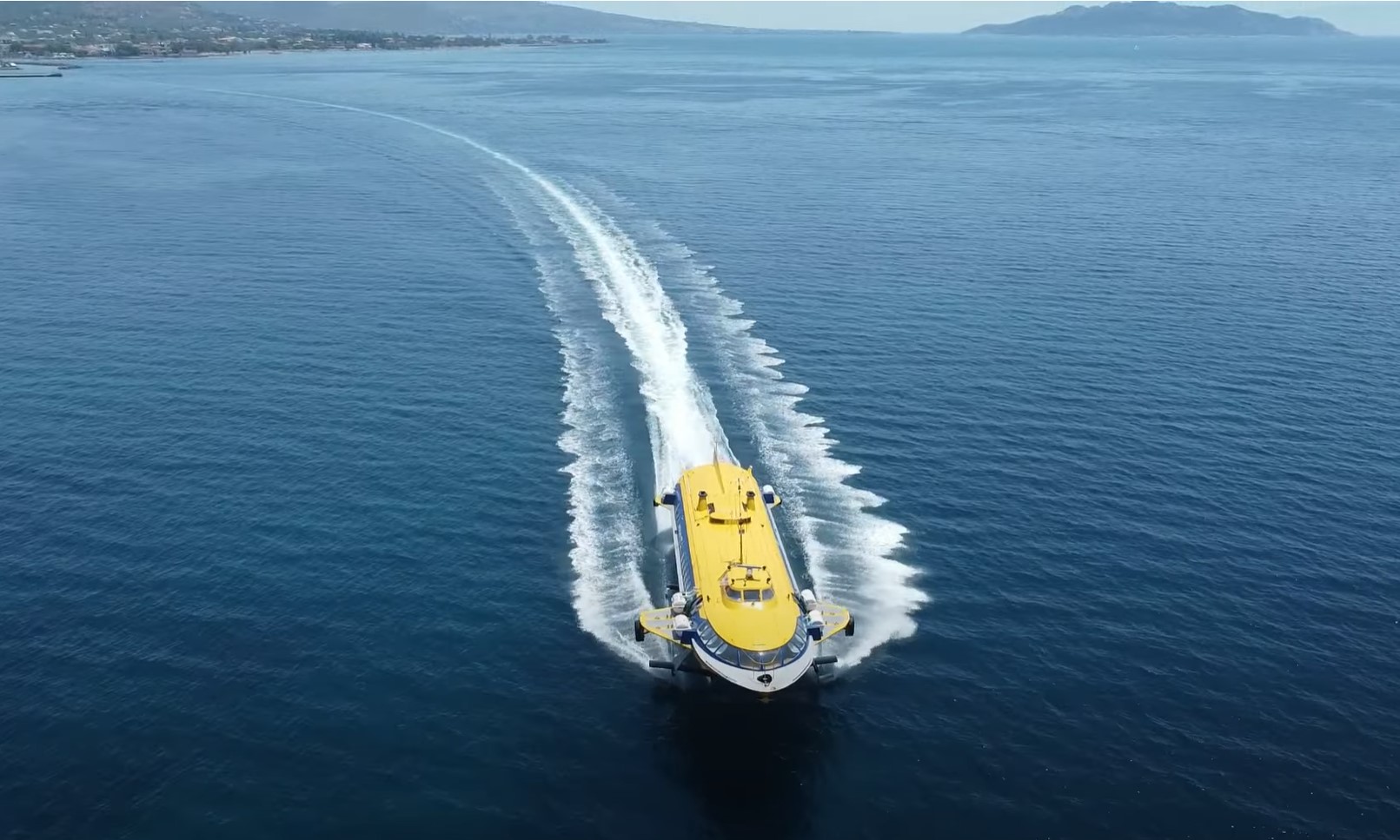
They will go down in history from August the flying dolphins, which have carried tens, if not hundreds of millions of Greek and foreign passengers over the last five decades. Associated in the perception of most people as noisy but fast means of summer and not only summer escapades, especially in the Saronic Gulf, they have successfully far exceeded their life expectancy. They will be replaced by three state-of-the-art modern diesel-powered carbon fibre high-speed catamarans with photovoltaic panels.
Today Attica Group, which controls a small but the largest fleet of Russian hydrofoils in Greece, operates three such vessels, while a fourth always remains in reserve to take over the shift of another in case of a breakdown. The obsolete, mostly Soviet-built, flying dolphins, which take advantage of their design to achieve almost zero friction with the water and high speeds with relatively low consumption, have been a lifeline for the islands of the Saronic Gulf, allowing them to grow in tourism. Many of their passengers may remember them either for the noise or the smell when the air conditioning was not working satisfactorily, but they travelled like no other ship for the Athenians, especially on unforgettable weekend getaways, and gave wings to the islanders of the Argosaronikos and the coast of the Peloponnese. It is estimated that these Argosaronic lines serve over 3 million passengers.
At one time there were more than ten such flying dolphins in Greek waters, not only in the Saronic Gulf, but also in the Dodecanese, in Gia, on the eastern coast of the Peloponnese and in the Ionian Sea. They first arrived in Greece in the 1960s but their widespread and structured use started after the mid-1970s. The urban legend then has shipowner Giorgos Livanos buying two Soviet-built hydrofoils abandoned in Elefsina and gradually developing the Ceres fleet into a dominant force based at the Zeus marina.
A few decades later, modern new technology high-speed vessels - mostly catamarans - with greater passenger carrying capacity started to gain passenger preferences. Attica Group, the company that inherited the flying dolphins introduced by Lebanos after a series of acquisitions it and other shipping companies before it have carried out in recent years, has long had two such modern catamarans on the Saronic Gulf, which will now be joined by three high-tech new-build Aero Highspeed catamarans. They have been built at the Brødrene Aa shipyards in Norway, at a total cost of 21 million and covered by Attica's own funds and bank loans. The first two have already been delivered and the third is expected to be delivered by mid-July, when they will all be loaded onto a special type of ship that will take them to Piraeus to start work immediately in late July or early August.
The flying dolphins will either be sold abroad or given to the recycling of the aluminium from which they are made. One last Attica dolphin will however remain in Piraeus for a few more years to serve as a backup for its younger «brothers» if needed. However, the dolphins will not disappear completely from the Greek seas just yet. Another shipping company operates some routes in the Saronic Gulf with hydrofoils, while it is possible that an ambitious entrepreneur will decide to buy them to give them a new life extension. However, their days will now be numbered, as the competition with modern Aero Highspeed and other catamarans will be overwhelming.
The flying dolphin replacements, the Norwegian-designed and built speedboats, have more seats -150 compared to 130 for the flying dolphins - and, as they are made entirely of carbon fibre, are more environmentally friendly given their low carbon emissions per person carried per mile, experts explain. It should be noted that they also have photovoltaic units, which will meet the lighting and power needs of hotel services.
The Aero has a maximum speed of 32.2 knots fully loaded, an overall length of 36 m, a width of 9.7 m and the interior layout and general design aims to offer much greater comfort and better service. Their operation will increase the available capacity for the destinations of the Saronic Gulf. They promise a new era for the Argosaronic, but also nostalgia for the noisy and shaky Soviet «Meteors», which first brought high speeds for passengers on the Greek seas.