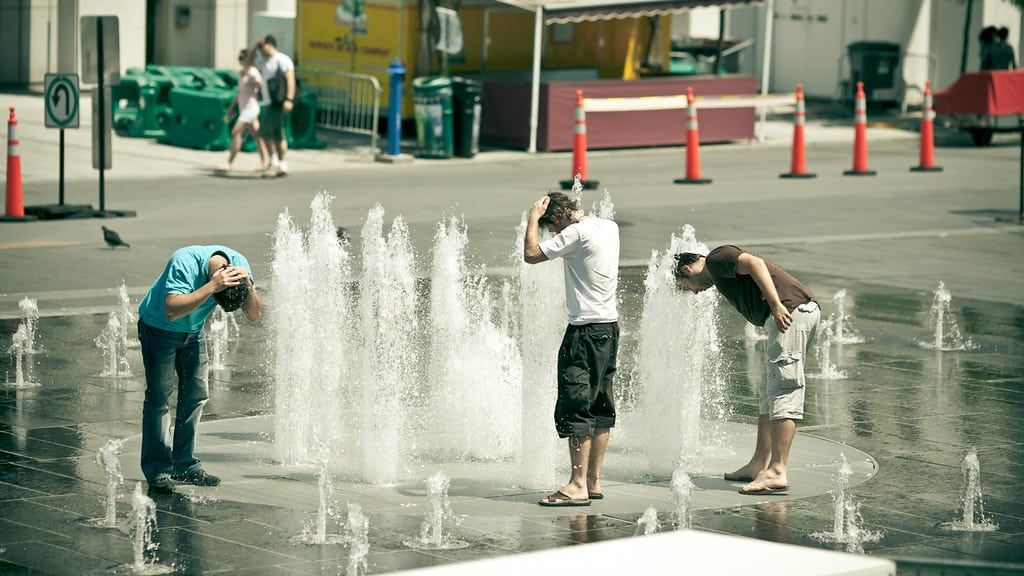
Warm air masses from the coast of North Africa to much of Eastern Europe and the Balkans will continue to cause very high temperatures in our country, with the highest values being recorded today Wednesday and tomorrow Thursday (18/7) in the interior of mainland Greece, mainly in the west, central and north.
In the update of the Weather Flash Update, it is noted that:
A. in the coastal areas of the mainland the maximum temperature will be 2 to 4 degrees lower than the temperature in the interior of mainland Greece and
B. minimum temperatures will also remain high, ranging in most areas around 27 to 29 degrees Celsius.
More specifically:
Today and tomorrow Thursday (18/7) the maximum temperature is expected to reach:
α. In the interior of the mainland 41 to 42 and locally in the west, central and northern parts 43 degrees Celsius.
β. 38 to 40 degrees Celsius in the Ionian Sea, the East Aegean islands, the Dodecanese and southern Crete.
c. 35 to 37 degrees Celsius in the rest of the island country.
d. 39 to 40 degrees Celsius in Attica and the prefecture of Thessaloniki.
On Friday (19/7) the maximum temperature is expected to reach:
α. In the northern continents 38 to 39 degrees Celsius and in the rest of the continents 40 to 41 degrees Celsius.
β. 37 to 39 degrees Celsius in the Ionian Sea, the East Aegean islands, the Dodecanese and southern Crete.
c. 34 to 36 degrees Celsius in the rest of the island country.
d. 38 to 39 degrees Celsius in Attica and the prefecture of Thessaloniki.
It should be noted that on Friday after noon and until the afternoon in the northern part of the country there will be instability phenomena.
4. On Saturday (20/7) from noon, thunderstorms will occur in the north northeast of the country (mainly in Thrace, eastern Macedonia and the eastern parts of central Macedonia) and temperatures are forecast to reach:
α. 37 to 38 degrees Celsius in the northern continent and 39 to 40 degrees Celsius in the rest of the continent and 41 degrees Celsius in the western continent.
β. 37 to 39 degrees Celsius in the Ionian Sea, the East Aegean islands, the Dodecanese and southern Crete.
c. 34 to 36 degrees Celsius in the rest of the island country.
d. 38 to 39 degrees Celsius in Attica and 37 degrees Celsius in the prefecture of Thessaloniki.
5. On Sunday (21/7) the temperature will drop by about 1 to 2 degrees and will have a maximum value in most continental areas of 37 to 39 degrees Celsius.
Guidelines for dealing with the thermal stress of workers
The General Confederation of Workers of Greece (GSEE), the Secretariat of Health and Safety at Work and the Information Centre for Employees & Unemployed of the Confederation (KE.P.E.A./GSEE), update the information to workers and workers to address heat stress, following the issuance of the sub. No. 40220/15/7/2024 circular of the Ministry of Labour and Social Security on the «emergency measures to address heat stress of private sector workers».
At the same time, the GSEE points out that it is an outstanding standing request to the Ministry of Labour to introduce in the current legislation on the health and safety of workers, explicit regulations on the obligations of employers and especially prohibitions to prevent the stress of workers and regulate their working conditions in cases of exposure to severe weather phenomena (heat wave, cold etc.), which are accompanied by strict sanctions and intensification of timely inspections by the Labour Inspectorate. On the contrary, as the Confederation says in a statement, there is «a constant weakening of the mandatory measures, as the impermissible regulation by (non-binding) circular of the obligations of employers to protect the health and safety of workers from heat stress is maintained, while maintaining at a very high level the thresholds of values of indicators above which a mandatory interruption of work is imposed.
On the working time of workers, the GSEE calls on trade unions to be vigilant about the complaints of workers who are called to work in jobs that must be stopped, stressing that:
- Following its strong opposition, supported by other bodies, the work stoppage was restored for the period between 12:00 and 17:00.
- Particular attention is required for illegal or abusive practices, the possibility that the circular gives to employers not to register in advance in the Information System “ERGANI” the change of working time, under the guise of facilitating the time of arrival or departure of employees from work due to high temperatures.
- Particular and timely attention should be paid to workers belonging to groups with a high risk to their health from high temperatures, such as cardiac patients, lung patients, sufferers of chronic diseases (e.g. diabetes mellitus, chronic kidney failure, blood pressure disorders, etc.), those taking certain medications (e.g. insulin, antidiabetics, diuretics, anticholinergics, etc.), women during pregnancy, as well as people working in a hot environment,» notes the GSEE.
The confederation stresses once again, that the prevention and protection of the health and safety of workers and the timely and effective response to delinquency through timely inspections of the Labour Inspectorate throughout the country, «must be a priority of the institutionalized regular social dialogue within the framework of the Supreme Council for Health and Safety at Work, the consistent and effective operation of which is absolutely necessary, while the postponement of the meeting of the body for the adoption of a ministerial decree by.
On the website of the National Meteorological Service, in addition to the weather forecast information for the whole country, the individual Regions and cities http://www.emy.gr/emy/el/forecast/deltia_kairou/geniki_prognosi, forecast maps with the ranges of the WBGT/THYMVAS index (bioclimatic index of thermal stress) for outdoor areas nationwide are posted http://www.emy.gr/emy/el/forecast/deikths_wbgt.
The following are the main points of the circular no. 40220/15.7.2024, which the GSEE quotes in continuation of the detailed information of 6/6/2024, which can be found here https://gsee.gr/deltia-typou/antimetopisi-tis-thermikis-kataponisis-ton-ergazomenon/
«Emergency measures to address the heat stress of private sector workers
Mandatory cessation of work in outdoor activities
For Wednesday 17/07/2024 to Friday 19/07/2024
For all workers in enterprises, for manual work carried out outdoors when the temperature is equal to or above 40°C, it becomes compulsory for them to stop work between 12:00 and 17:00. Indicative examples are work on technical and building projects, construction sites, distribution and transport of products and objects with two-wheeled vehicles, skates, trolleys, etc. (delivery), etc.
It is noted that the above cases of mandatory cessation of work include all employees regardless of their type of employment, including digital platforms under article 68 of Law no. 4808/2021.
In particular, for work in a ship repair area, the obligation in the above subparagraph shall apply to a temperature above 38 °C.
If the measure of the suspension of delivery operations is applied to delivery companies, the option of ordering with takeaway directly from the store may be kept active, as well as the possibility to carry out delivery by private and public vehicles other than bicycles and other means of the previous subparagraph, as defined in Article 2 of Law No. 2696/1999, under more specific terms or conditions, provided that they are equipped with air conditioning.
The closure does not apply to economic activities relating to important and socially critical infrastructure in the health, transport and utilities sectors (including, but not limited to, health care facilities, water supply, electricity, air transport, handling, maritime, land and rail transport), provided that the other technical and organisational measures set out in Article 4(1)(b) of Regulation (EC) No . 34666/03/06/2024 ’Prevention of heat stress of workers“ (ID: PΓ1N46NΛΔΓ-ΩO6), including the organisation of working time.
In the event of non-compliance with the obligations of this law, the Labour Inspectorate, in accordance with Articles 23 and 24 of Law No. 3996/2011 (A’ 170), a fine of two thousand euros per employee of the enterprise.
Provision of distance working using the teleworking system
For workers with a dependent employment relationship in the private sector belonging to high-risk groups (table in Annex 2 of the Annex to No. 34666/03/06/2024) and especially in cases where they are exposed to aggravating conditions in areas where, according to the Special Weather Forecast (EDEK) of the National Meteorological Service (EMY), updated on 15/07/2024, particularly high temperatures are expected to prevail, care should be taken by companies to enable them to work remotely, if this is possible due to the nature of their work.
Exceptional measures for the organisation of working time
In order to deal with heat stress in areas where, according to the updated 15/07/2024 Special Weather Forecast Bulletin (EDEK) of the National Meteorological Service (EMF), particularly high temperatures are expected to prevail and, to facilitate employees in any change of arrival and departure time from work, employers may not register in advance in the P.S. “ERGANI” any change in the organization of working time.
The trade unions, the local Labour Centres and the federations of the GSEE are vigilant about the workers» complaints.".
The GSEE stresses that it will continue to be at the disposal of trade unions and workers throughout the country for any issue of information, support and collective action and on health and safety issues, the Secretariat for Health and Safety at Work of the GSEE, email: info@gsee.gr, the Information Centre for Workers and Unemployed of the GSEE (KEPEA/SEE), tel. 210 00 83 630 & 210 00 83 640, www.kepea.gr and the Network of Information and Counselling Services for Employees and Unemployed Workers of the GSEE Labour Institute https://www.inegsee.gr/diktio-ipiresion-pliroforisis-simvouleftikis-ergazomenon-anergon/.
Very high fire risk today in the Region of Attica and in areas of the Peloponnese, St. Greece, West Greece, North. Aegean, E. Macedonia and Thrace
A very high fire risk (risk category 4) is predicted today in the Region of Attica and in areas of the regions of Peloponnese, Central Greece, Western Greece, North Aegean, Eastern Macedonia and Thrace according to the Fire Risk Prediction Map issued by the General Secretariat of Civil Protection of the Ministry of Climate Crisis and Civil Protection.
In particular, a very high fire risk is forecast today for the following areas:
- Region of Attica
- Region of Peloponnese (Corinth, Argolida, Laconia)
- Region of Central Greece (PE Boeotia, PE Evia, PE Fthiotida)
- Region of Eastern Macedonia & Thrace (Evros, Rhodope Region)
- Region of North Aegean (PE Lesvos, PE Chios)
- Region of Western Greece (PE Ilia, PE Achaia)
The General Secretariat for Civil Protection has informed the competent government departments involved, as well as the Regions and the Municipalities of the above areas, in order to be in increased readiness for civil protection in order to deal immediately with any fire incidents.
At the same time, the GGP recommends that people should be particularly careful and avoid actions in the open air that can cause a fire through negligence, such as burning dry grass and branches or cleaning debris, using sparking machinery such as circular saws, welding devices, using outdoor grills, smoking bees, throwing lit cigarettes, etc. It is also recalled that during the fire season, burning of fields is prohibited.
In addition, the personnel of the Fire Services of the above Regional Units remain on partial alert, in order to cope with the increased service requirements that may arise due to the very high fire risk (risk category 4).
Furthermore, the 2nd stage of operational readiness of the Fire Brigade remains in place and air surveillance patrols will be carried out, as well as patrols by fire, police and military forces.
At the same time, for the above areas, the Civil Protection Action Plan for dealing with forest fire risks remains in force, according to which, among other things, the implementation of the measure of preventive prohibition of vehicle traffic and stay of excursionists in national parks, forests and vulnerable areas is foreseen.
At the same time the Fire Brigade appeals to citizens:
1. Be very careful and avoid any activity that could cause a fire.
2. Monitor the information on forest fire prevention available on the website and on the official Fire Brigade website, Facebook and Twitter accounts.
3. In case they perceive a fire, they must immediately notify the Fire Service at the call number 199.
For more information and instructions on how to protect themselves from the risks of forest fires, citizens can visit the website of the General Secretariat for Civil Protection at www.civilprotection.gr.
ARCHIVE PHOTO