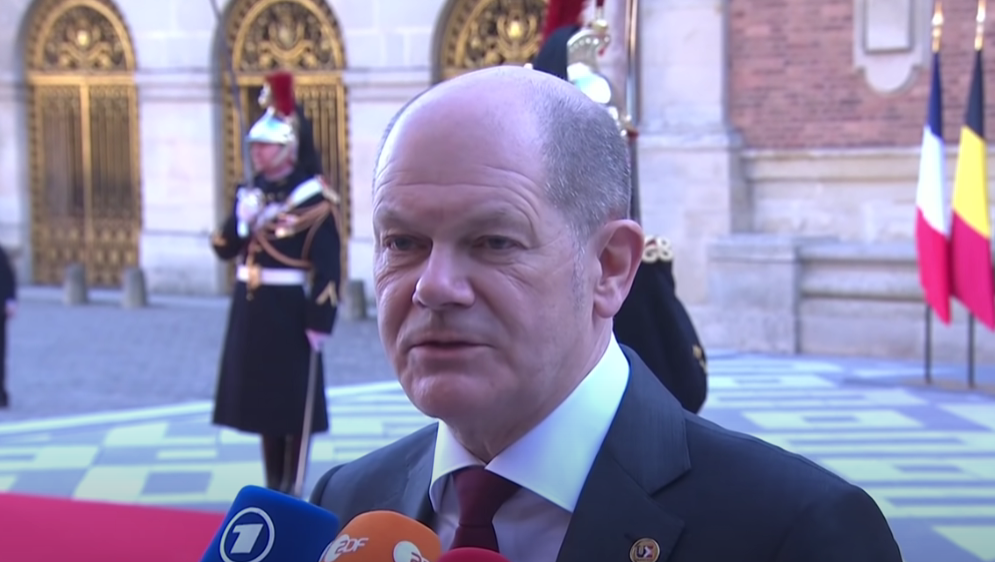
German Chancellor Olaf Scholz rejected Kyiv's request for Ukraine's rapid accession to the European Union, emphasizing the need to follow the path laid out in 2017 with the Ukraine-EU Association Agreement.
The chancellor also reiterated his opposition to a possible halt in energy purchases from Russia, even though it faced pressure from the Baltic states.
«It is very important that we continue to pursue what we have agreed upon in the past,» Mr. Scholz said during the informal summit held in Versailles, referring to the 2017 Ukraine-EU Association Agreement. He insisted that «what we need now is a ceasefire.».
The German chancellor also pointed out that, with 27 member states, the EU would in any case have difficulty reaching a unanimous decision, and took the opportunity to raise the issue of abandoning the principle of unanimity on foreign policy matters.
Estonia and Lithuania expressed a contrary view on Ukraine’s request, with Estonian Prime Minister, Kaja Kallas, telling the Süddeutsche Zeitung that, in her view, «there was a moral obligation to allow these people to realize their European dream.» Dutch Prime Minister Mark Rutte, for his part, emphasized that «there is no fast-track accession,» while his counterpart from Luxembourg, Xavier Bettel, assured that he is not obsessed with regulations, but added, «There are conditions for a country’s accession.».
Berlin’s stance on the issue of energy supplies from Russia has sparked reactions, with Latvia making it clear that it no longer considers Germany’s refusal to halt imports from Russia to be sustainable. «I am certain that we must make the decision to stop energy imports from Russia in order to bring (Russian President Vladimir) Putin to the negotiating table and end the war,» said Latvian Prime Minister Kārnis Kisiānis.
Poland and Lithuania have also come out in support of this measure, with the aim of depriving the Russian state of its main source of revenue and funding for the war in Ukraine.
Olaf Scholz stated on Monday, however, that «there is currently no other way to secure Europe’s energy supply for heating, transportation, and industry,» while in Versailles he emphasized that when considering sanctions, one must carefully assess how to persuade Moscow to end the war, but at the same time, how to ensure that the impact of the sanctions on Europe is as minimal as possible. «We must continue on this path,» he stressed.
Another key topic of the Summit was the EU’s response to the economic consequences of the war, with France proposing the adoption of a support program similar in approach to the one designed to address the effects of the pandemic. Germany and the Netherlands do not currently consider this necessary, arguing that the entire COVID-19 aid package should first be fully utilized.