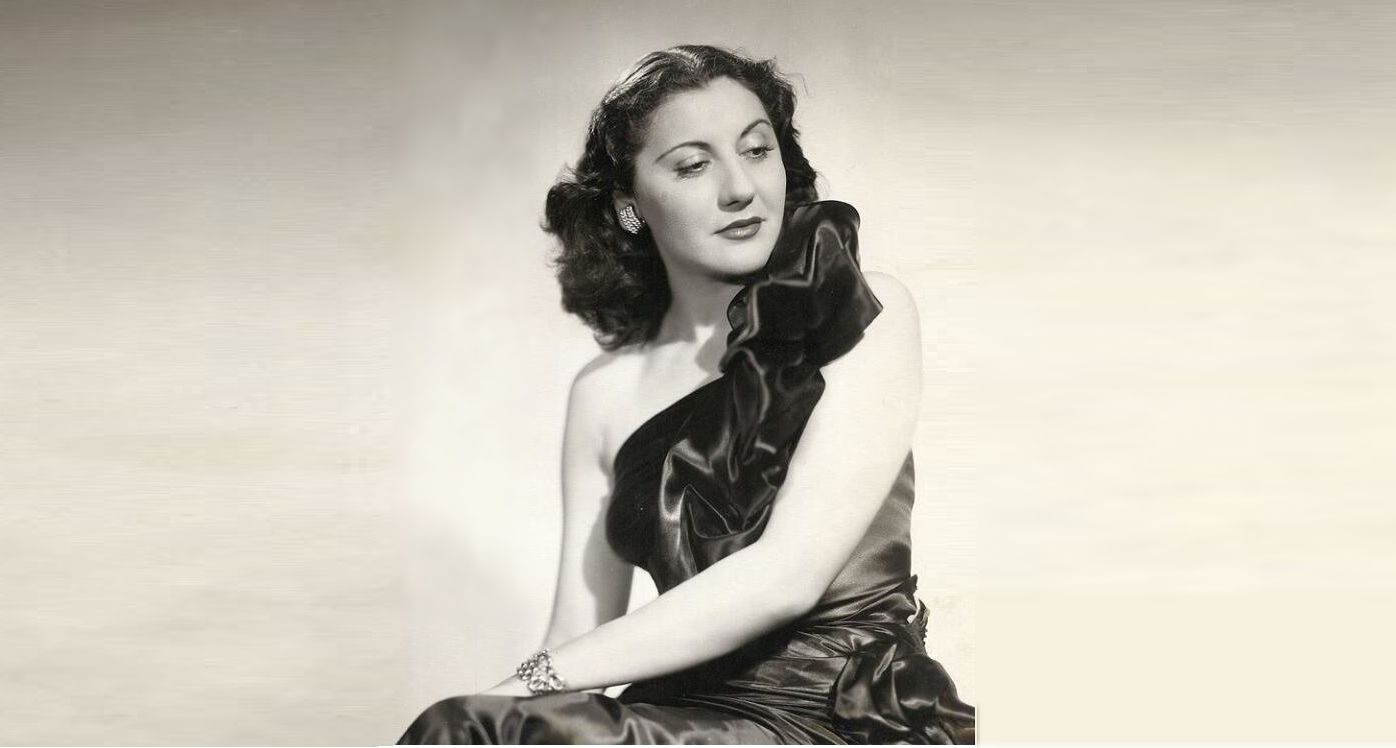
Sophia Vembo, a name - a symbol of a difficult time for the country. A time when the children of Greece had to defend with struggle and blood the long history of the country and Freedom and Democracy in Greece and Europe.
In this difficult time Sophia Vembo gave a fighting presence. She did not run away, but, fought. He didn't hide, but he was clearly fighting. For Greece. For the whole world.
Let's take the facts from the beginning. Sophia was born in February 1910 in Gallipoli, Eastern Thrace. From an early age, through Constantinople, with the population exchange in 1914, she arrived in Tsaritsani, Larissa, her father's village, and from there to Volos, where her parents worked as tobacco workers. After finishing high school, in order to help the family, which had three other children, she started working.
In September 1933 her brother George went to Thessaloniki to study and work. Because they had not heard from him, Sophia and her guitar took the ferry to Thessaloniki. During the trip she starts playing her guitar and singing. The passengers get excited and applaud. She is approached by the well-dressed Mr Konstantinos Tsimbas, who suggests that she should take up singing. With the agreement of her brother George, she accepts the gentleman's proposal and signs the first contract. 13 October 1933. Vembo's first public appearance as a singer , which was applauded. Subsequently, Tsibas, who is a man engaged in finding work for artists, convinces Athenian businessmen in the field to hire Sophia.
The first contract was signed with the theatrical entrepreneur of the theatre “KENTRIKON” Fotis Samartzis with a monthly salary of 14,000 drachmas per month, a very large amount for the time. Vembo asked Lola Votti, who was the theatre's music composer, to write a gypsy song for her. Thus was born her first song “Beautiful Gypsy”. October 25, 1933 is the premiere of the play and Sophia's song thrilled the audience, who forced her to sing it four times. Vebo comes out of obscurity and into the open.
The Columbia record company was interested in working with her on the song “Don't Ask for Kisses” by D'Angelis - Paul Nor. The label's artistic director was adamant. Eventually the song was released by PARLOPHONE and was a huge success. After that the Columbia artistic director visited Sophia and they signed a cooperation contract, which Vebo kept until the end of her life. The period 1933 to 1940 is a very good period for Sophia singing great and unforgettable hits.
The advent of 1940 finds Sophia on the front line. She tries to entertain the restless people with songs and theatrical performances, which are a success.
October 28, 1940, at 10:00 a.m. the Athens radio station interrupts its programme and the announcer broadcasts the first emergency communiqué of the General Greek General Headquarters. Kostas Stavropoulos, announces EXTRAORDINARY ANNOUNCEMENT. The celebration of the war begins, the whole world takes to the streets, determined to defend its native land, its Freedom, Democracy and Orthodoxy. All the people united as one against the invader. The theatres change their programmes and stage revues to inspire the soldiers who fight, the mother who gave her wish to her son to go to the front, the wife who called her husband out to the battlefield in support of country and freedom. They all give their best. As Alekos Sakelarios used to say, Sophia Vembo was the protagonist.
Vembo was informed that Mimis Traiforos writes beautiful lyrics and asked him to write a song based on the music of «Zehra» by M. Sougioul. Indeed Traiforos during the theatrical performance writes the song «The Children of Greece». This song was the reason they fell in love and years later, in 1957, they got married. After reading the song, Vembo thought that the last lyrics were harsh and Traiforos changed them. The lyrics said «If you don't come victorious, never come». Those lyrics became «With the branches of Victory, we await you guys». That night Sophia sings it through the paper. The audience is thrilled. She's delirious. A huge hit is born. A bomb of enthusiasm and patriotism. Fighting Hellenism draws strength and courage. A tonic injection of Greekness and patriotism. The theatre every night is packed to capacity. Half of the evening's proceeds go to the national cause.
Every night Vembo with Menios Manolitzakis on accordion and Marika Kotopouli, who was presenting her, would tour all the theatres, interrupting the performance in order to raise money for the “The Soldier's Fan” association. The Athens radio station called her and asked her for cooperation, granting her an hour a day to sing live with her band. Thus, Vembo created a small orchestra with Moschoutis on piano, Menio Manolitzakis on accordion and Avataggelos on violin, Traiforos confectioner and her sister Aliki. With this small orchestra she went from hospital to hospital every day to entertain the wounded returning from the front. The Germans entered deserted Athens on April 27, 1941, while Vembo was singing live from the Zappeion radio station. At some point her singing stopped and the voice of the announcer Kostas Stavropoulos was heard thunderously broadcasting the final message. Vembo becomes a target of the Italian-Germans. It was logical and expected. It is the voice of the true national resistance
She is punched one night when she returns to her house, a blue apartment building in Exarchia, she is imprisoned in Averoff Prison, her professional license is taken away (some time later it is returned to her). They will also go into the Columbia record company and destroy all her song matrices. The company will be shut down and reopened after the occupation.
Her life is in danger. With the help of the Greek secret services (headed by Major I. Tsigante), in collaboration with Angelos Evert (commander of the Athens Security, father of Miltiades Evert) and the British Middle East Staff, her escape to the Middle East is organized, where the nucleus of a free Greece is already beginning to be born. Her brother George is also escaping with her.
On October 8, 1942, Sophia and her brother, wearing old clothes, boarded a boat in Kymi, Evia, and fled to the Middle East. Sophia is dressed as a nun and has a fake identity under the name Sophia Vamvetsou. After an adventurous journey, which lasts almost a month, they arrive on the coast of Turkey and continue to Syria (Aleppo, Damascus), Palestine and Egypt.
The echoes of Vembo's songs, full of Greece and patriotism, are transported from the Greek mountains to the Middle East. It entertains and inspires the Greek soldiers and the allies.. On a jeep he crosses distances and deserts, making countless trips around Syria, Palestine and Egypt. The word ’fatigue« is not in her vocabulary.
Her offers for “Victory” in the Middle East are estimated at 20,000 pounds (“National Herald” New York, Saturday 3 May 1947), a huge sum for the time. She continues to give to soldiers' families, to victims of occupation, to war invalids, to orphanages (Spetsopouleio, Canisquario) to refugees, to the Red Cross. Until February 1946, then, he is in Egypt.
The war is now over and Vebo bids farewell to Egypt in an atmosphere of great emotion after the adoration she received from her audience, but also happy to return to her homeland. She arrived in Piraeus on 16 February 1946, on the flagged destroyer “CRITI”. In the following period until the end of 1946, Vembo, from the stage of the “KENTRIKON” theatre, will launch her great hit «Kane kouragio Ellada mou» with music by Leo Rapitis and lyrics by Mimi Traiforou. The revue was full of national pulse, with writers Traiforo-Vassiliadis and music by Leo Rapitis and expressed the country's complaint about the injustice done to it by the greats in sharing, sending a message of reconciliation to all Greeks.
During this period her brother George persuades her to go on a tour of America, despite Traiforos' strong opposition. There she is a huge success. Greeks and Americans alike rush to meet her and hear her in person. They had known her from her albums, now she is the voice of Greece, the voice of resistance.
On her return from America she organised tours to raise money to buy her own theatre. The premiere at the “VEBPO” theatre was held on June 18, 1950. She staged the revue «Vira the Anchors» and the writers were Mimis Traiforos and George Yiannakopoulos.
He participated in the play «Stella» by Cacoyannis. When names are dropped, the only name whose letter size is the same as that of the leading actress Melina Mercouri is Sophia Vembo.
In November 1973, on the tragic night of the Polytechnic, her house, on Stournaras Street, a hundred metres from the events, became a shelter for dozens of young wounded people. The morning the police knocked on her door, they asked her if she had entertained people in her house. She replied, «Of course I did. And if you knocked on my door shaking with fear and with broken heads I would have done the same!!!». In complete safety all her guests later left for their homes.
She moved into the zone of the immortals on March 11, 1978, quietly doing her duty to her country, to which she had only given.
«The older I grew, the more I became aware of the destination of my life. And I believed my destiny was to marry and raise a family of my own. If they had told me then that in 1947 I would be single and my profession would be singing songs in the theatre, I must confess that I would have been very sad and perhaps I would have cried. At home they believed and instructed me that I should be a good housewife, a loving wife and a caring mother,» she writes in her autobiography, published from Thursday, May 15 to Saturday, July 25, 1947, when she was on tour in the United States.
That's what he believed, that's what he dreamed. Other are the counsels of the Lord. He won worldly immortality. And a good place in history.
This is briefly the life of Sofia Vembo, whose maiden name was Bembou and she changed it, legally, to Vembo, as her fans called her.
Notes: The source of the texts are the books of the official biographer of Andreas Mamai, «Sophia Vembo the voice of Greece», published by KEDROS, and the album «VEBO» published by PATAKI. Some of the references in the text are from the album «Sophia Vembo» by Katerina K. Petridou.
I close this short "memorial" with the lyrics of the song "Children of Greece
Through the streets the mothers walk around and look around,
their children swore at the station when they were separated
to win.
But for those who are gone and glory enfolds them, let us rejoice,
and let no one ever cry, let her every pain burn, and let us wish:
Children, children of Greece, who fight hard on the mountains,
children to the sweet Virgin Mary we pray you all come again.
I say to those who love and for whom they stay up all night and sigh,
that bitterness and trembling in an honest Greek girl are not suitable.
Greeks of Zalongo and the city and the hill and Plakiotissa,
no matter how bitterly we ache, we proudly practice as Souliot women.
Children, children of Greece, who fight hard on the mountains,
children to the sweet Virgin Mary we pray you all come again.
With the branches of victory, we are waiting for you guys.
Myrgiotis Panagiotis
Mathematician