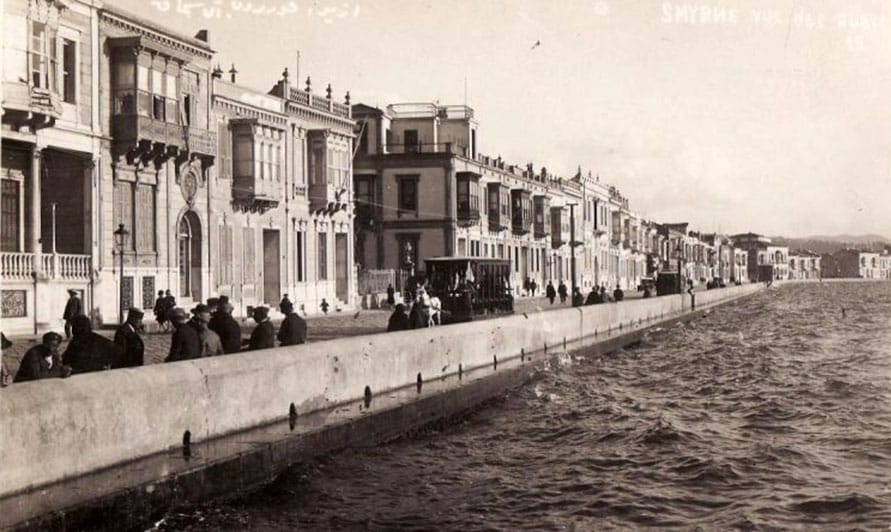
The word «koukloutza» means, in one sense of the Ottoman Turkish language, «fragrant.» Koukloutzas was a settlement 6 kilometers east of Smyrna, on the slopes of Mount Koklou. In the early 20th century, it had a population of approximately 5,000. It was an exclusively Greek settlement. Its official name was Koukouloutze. In Greek, it was called Koryfasio, though this appears to be a name given by immigrants from Koryfasio in Pylia.
In the late 18th century and early 19th century, there was a large wave of migration from the Peloponnese, Thessaly, Epirus, and the Aegean islands to the regions of Asia Minor, primarily Smyrna. Many Kythirians followed this wave and emigrated to Smyrna, using British passports since the Ionian Islands were under the «protection» of Great Britain.
The people of Kythira were mainly engaged in trade and seafaring. In the port of Smyrna, almost all the barge operators were from Kythira. The English-Kythirian steamship company Jolly & Victoria was also a major economic and business force.
During the Greco-Turkish War of 1897, many Kythirians living in Smyrna fought alongside the Greek Army. At the same time, the «rayahs» —local Christians who were subjects of the Ottoman Empire—enlisted in the Turkish army, either by paying a military tax or by being conscripted into the forced-labor battalions of the East (amele tamburu).
In 1911, the Italo-Turkish War broke out, which affected the sailors of Kythira. With the Balkan Wars in 1912 and 1913, the blockade of the port of Smyrna continued. The same was true later during World War I (1914–1918). At the same time, the Ottomans attempted to reduce the Greek population in Asia Minor. The Greek occupation of the Smyrna Zone attempted to stabilize the situation until its destruction in August 1922, when the entire Greek population fled the burning city. Very few of the residents of Koukloutza survived and fled to Thessaloniki, where they founded the settlement of Neos Koukloutzas, which is now the municipality of Evosmos. Others settled in Athens and, in 1935, founded an association called the ’Mutual Aid Brotherhood—Koukloutzas.«.
The income of the residents of Koukloutza was based mainly on sultana raisins, «rozaki» grapes, and wine. The village had up to ten distilleries and five olive mills. A well-known grape variety in the region was the «eri-kara» (arikaras), which the Kythirians of Smyrna brought to and cultivated on the island.
The ferry service between Kythira and Smyrna was just as frequent as that to the port of Piraeus. This indicates that Smyrna was an important urban center for the people of Kythira. The Kythirian Brotherhood of Smyrna was founded in 1830, and the Kythirian population of Smyrna numbered 15,000. Smyrna was an attractive destination for immigrants, unlike America or Australia, since, first and foremost, the city was experiencing an economic boom and Kythirian immigrants felt more at ease there, as they did not need to learn another language and were able to maintain their religion, customs, and traditions. Furthermore, the fare to Smyrna was nothing compared to the exorbitant sums required to travel to America or Australia. Many of the Kythirians attended the Evangelical School of Smyrna.