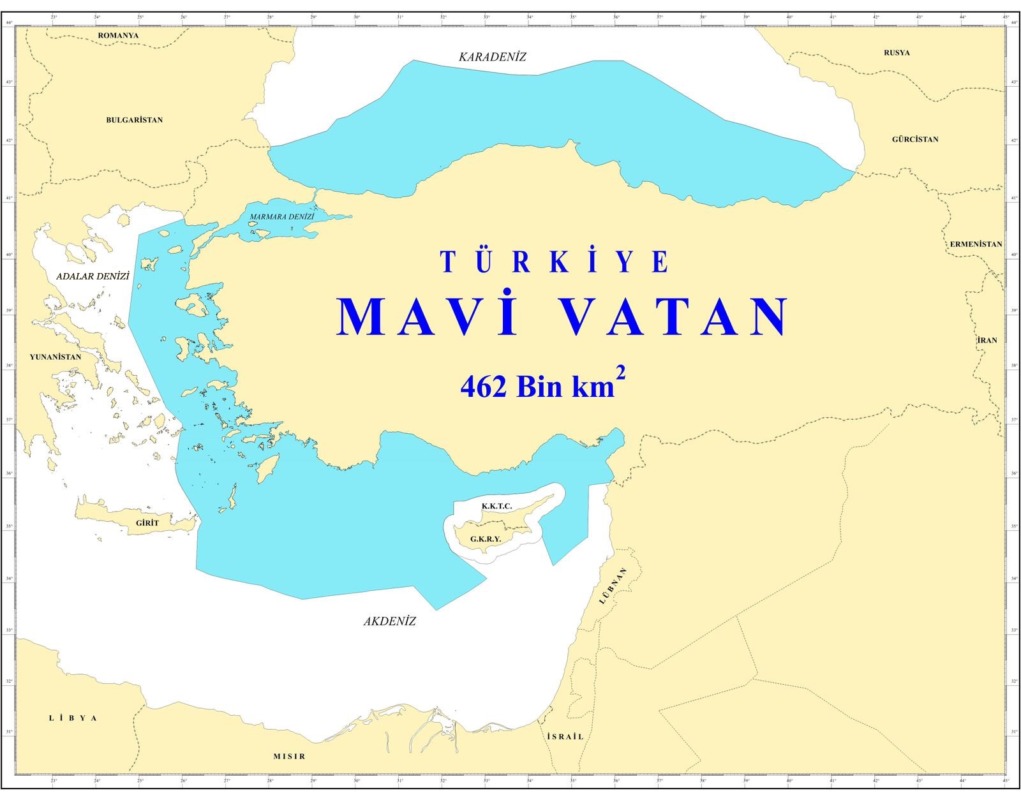
The postponement of the vote on the «Blue Homeland» bill by the Turkish Grand National Assembly until this coming October provides an opportunity, on the one hand, for a strategic assessment of the Turkish decision and, on the other hand, a level-headed review of how public discourse on national issues is conducted in Greece.
This decision, despite what has been said within Turkey (e.g., postponement due to the Turkish Grand National Assembly’s recess during the summer months), cannot be viewed in isolation from the broader context of Greek-Turkish relations and the ongoing shift in the regional balance of power.
Specifically, Turkey’s revised strategy in the Eastern Mediterranean is characterized by a combination of institutional initiatives, diplomatic moves, and military actions designed to demonstrate power, which do not always follow a linear or predictable course, but are often adapted to prevailing domestic and international conditions.
In this light, the postponement of the vote on the bill cannot automatically be interpreted as a change in strategic direction.
This assessment is further supported by the fact that Turkish officials attributed the postponement to scheduling and bureaucratic issues rather than to a review of existing policy.
It is possible that the postponement of the bill’s passage may be part of a strategic maneuver related to redefining the timing and manner in which Ankara chooses to advance the«Blue Homeland» doctrine.
Beyond the official explanations, however, there are certain factors that may have contributed to the Turkish leadership’s decision to postpone the passage of the bill.
Specifically, the upcoming NATO Summit which will take place on July 7 and 8 in Ankara, apparently played a decisive role in that decision.
The summit offers President Erdoğan the opportunity to take center stage in important diplomatic discussions, expand his influence within the Alliance, and highlight Turkey’s geopolitical role at a time of heightened geopolitical fluidity in the Eastern Mediterranean and the internationalsystem more broadly.
In the run-up to the Ankara Summit, raising an issue linked to Turkey’s revisionist policy and its claims in the Eastern Mediterranean could potentially create friction between Greece and its allies, thereby damaging the image of a responsible regional power that Mr. Erdogan projects, and weaken its negotiating power.
Following the reasoning set forth above, Turkey chose at this juncture not to undermine its relationship with Greece, but to keep the channel of Greek-Turkish dialogue open within the framework of the Athens Declaration.
At the same time, the postponement of the vote on the «Blue Homeland» bill de-escalates tensions between the two countries and allows Turkey to present itself as a conciliatory and responsible partner that is committed to dialogue aimed at resolving Greek-Turkish disputes.
The following must have played an equally important role: Ankara's decision to avoid a new round of tensions with the European Union (EU), especially at a time when it is trying to keep channels of political and economic cooperation with Brussels open.
Moreover, it should not be overlooked that the EU remains one of Turkey’s most important trading partners and one of the main sources of investment for the Turkish economy.
In this sense, the postponement of the vote on the bill regarding the «Blue Homeland» deprives the European Union of yet another arena for political confrontation with Turkey or for imposing sanctions on its policies, while at the same time allowing Ankara to keep EU-Turkey relations alive and maintain more favorable conditions for dialogue with its European partners.
This assessment is further reinforced by the recent stance of the European Parliament, which, by a broad majority, adopted a report that was highly critical of Turkey, condemning, among other things, the «Blue Homeland» doctrine, violations of the sovereignty and sovereign rights of EU member states, and the maintenance of a casus belli against Greece.
The following also fall under this category: Turkey's ongoing contacts with European countries in the field of defense cooperation.
Turkey has expressed interest in participating in the European funding mechanism SAFE (Security Action for Europe), which is the EU’s primary funding tool for strengthening its common defense industry.
In addition, Ankara continues to explore opportunities for cooperation with European partners to strengthen the country’s air defense capabilities, including discussions regarding the SAMP/T air and missile defense system.
Consequently, maintaining a climate of cooperation with European governments serves the broader objectives of the Turkish defense industry and makes it less appealing to undertake initiatives that would implythis strategic planning.
At the same time, The American dimension of the issue should not be underestimated. Turkey's relations with the United States continue to be characterized by a delicate balance of cooperation and competition.
The Turkish leadership attaches particular importance to the lifting of U.S. sanctions so that critical defense procurement programs that have been put on hold can move forward, as well as to maintaining functional relations with Washington.
Under these circumstances, the passage of a bill that would institutionally enshrine the «Blue Homeland» doctrine might reignite opposition within the American political system, a development that would undermine Turkey’s objectives.
Furthermore, Broader developments in the Middle East must also have played a significant role in the postponement of the vote on this bill.
Specifically, at a time when Ankara is presenting itself as a peacemaking force seeking to act as a regional mediator to restore peace and stability in the wider region, the creation of yet another front of tension in the Eastern Mediterranean does not appear to serve its immediate strategic plans.
Finally, we must not overlook the fact that Domestic developments in Turkey continue to be a major factor shaping Ankara's foreign policy.
Specifically, the Turkish economy continues to face significant challenges, while the Erdogan government is facing growing political erosion and intense criticism from segments of the opposition over foreign policy issues and
especially with regard to Greece's actions (the country's defense capabilities, alliances, etc.).
In this context, the highlighting of issues related to Greek-Turkish relations and Turkish claims in the Aegean and the Eastern Mediterranean has, at times, served as a means of political mobilization of the domestic audience.
In this perspective, It is possible that the Turkish leadership believes that exploiting the institutional protection of «Blue Homeland» could prove more beneficial in the future, when domestic or regional conditions make his election politically more advantageous.
After evaluating the above factors, it can be concluded that the postponement of the bill’s passage should not be interpreted as a sign that Turkey has abandoned its long-standing strategic objectives in the Eastern Mediterranean.
On the contrary, it is more likely to be a strategic maneuver, dictated by the current situation and Ankara’s need to manage geopolitical, economic, and diplomatic issues in a more advantageous manner.
In this light, the crucial question is not whether the bill will be passed in October or at a later date. The crucial question is whether the postponement is part of a broader strategic plan, within which this particular piece of legislation serves as a negotiating and political tool, the usefulness of which will be reassessed in light of developments in the regional and international environment.
In this case, its value lies not in its institutional enshrinement, but in the possibility of using it as a tool for political and diplomatic pressure to further Turkey's broader strategic objectives.
This finding is particularly significant for the Greek side, because The debate that took place in our country regarding this particular bill highlighted, once again, certain long-standing weaknesses and distortions in the way public discourse on national issues is conducted.
Specifically, recently A strong sense of unease took hold, which in some cases turned into alarmist rhetoric by certain political circles, analysts, and commentators who present themselves as experts on foreign policy issues.
In this context, scenarios of immediate escalation were outlined, predictions of a «hot incident» between Greece and Turkey, and either the failure of Greek foreign policy or an imminent geopolitical downgrade of the country was anticipated as an inevitable outcome.
In such a context, strategic debate moves away from a dispassionate assessment of the facts and gradually turns into an arena of communicative confrontation, where foreign policy options are evaluated more in terms of public perception than by criteria of effectiveness and deterrence.
Public debate ceases to function as a tool for informing the public and, whether intentionally or not, becomes a factor that reinforces the objectives of Turkey’s strategy.
Specifically, When every Turkish announcement, intention, or move triggers waves of concern, scenarios of an impending crisis, and doubts about Greek strategy, then Ankara gains a significant advantage in the realm of communication and shaping public perception, imposing its own narrative on the public discourse.
At the same time, it achieves a significant portion of its objectives without having to alter the balance of power on the ground.
In this sense, it must be understood that the analysis of Greek-Turkish relations is a complex process that requires distinguishing between actual strategic developments and tensions in public communication, as well as a constant effort to avoid interpretations based more on circumstantial impressions than on geopolitical realities.
Specifically, the «Blue Homeland» doctrine did not originate with the bill under discussion, nor does its validity depend solely on its passage.
This is a strategic narrative that has been taking shape for years, has substantially influenced Turkish foreign policy, and has already been put into practice through diplomatic initiatives, military activities, and political decisions made by Ankara.
Consequently, The passage or postponement of a bill does not automatically alter either Turkey’s long-standing objectives or the fundamental security realities of the region.
In conclusion, A national strategy cannot be formulated under the pressure of exaggerations, media hype, and a climate of fearmongering.
On the contrary, composure, knowledge, and the ability to conduct strategic analysis are necessary prerequisites for properly assessing an opponent’s strategic objectives and tactical moves.
After all, a state’s true power is not measured by momentary rhetorical outbursts and media hyperbole, but by its ability to understand reality with a clear head and manage it with strategic self-confidence.
After all, The postponement of a bill does not change Turkey's strategy.
What may change is the way Greece chooses to analyze and address it.
Author of the article:

Political Scientist – International Relations Specialist
Former Director General - Directorate General
National Defense and International Relations Policy (GDPAAD)
Ministry of National Defense (YPETHA)