By Christos Karampelas
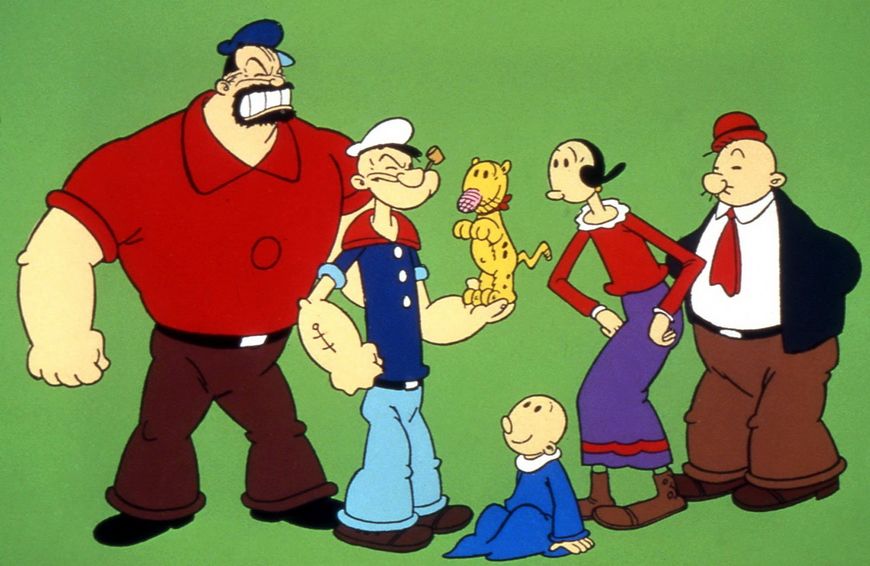
He was one of the first unconventional superheroes in the history of comics which managed to send the kids of that time into a frenzy of excitement. The Popay, a kind-hearted, tough-as-nails sailor who liked to smoke a pipe and eat spinach (which gave him superhuman powers), was warmly embraced by readers from the very first panel, despite the fact that he didn’t have the usual appearance of a superhero: He is one-eyed, toothless, and short, with a gruff voice and oversized hands (adorned below the elbows with two anchor tattoos), uneducated and a constant complainer. And yet this is his most significant victory, even more so than his duels with Bruto, given that from 1929, when his adventures were first published, to the present day, he has embodied a new model of a hero and the embrace of diversity.
But let's start his story from the beginning: Popeye was «born» from the pen of the American Elsie Chrysler Sigar. Starting in 1919, he drew daily cartoons that were published exclusively in newspapers. Every day, a strip consisting of 4–5 panels appeared, and the story always continued the next day. Popeye made his debut on January 17, 1929, in a comic strip in the New York newspaper Evening Journal. The series had already been running for ten years, starring his future fiancée, Olive Oil, her brother Castor and her beloved Ham Gravy.
Popay appeared in a supporting role and immediately won the hearts of readers. Gradually, Siegel began giving him increasingly larger roles, until he became the central character, won Olive’s heart, and eventually the series was named after him. After his creator’s death in 1938, various other artists took over the artwork, adding their own unique touches.
Popeye made his film debut in 1933, in the animated film *The Adventures of Popeye the Sailor*. His career on the big screen was destined to be even more glorious than his comic-strip career. In fact, in 1938, he was named the most popular cartoon character in the USA, surpassing even the Mickey Mouse.
World War II and the ’Forbidden“ Episodes
During the World War II, Popeye enjoyed even greater success, as his cartoons inspired and boosted the morale of American soldiers. Several of them contained offensive and racist comments about the Japanese, who were called “Jap-pansies” and were depicted with huge teeth and very thick glasses.
One of the most famous «banned» episodes of that era was the one titled «Seein’ Red, White ‘n Blue». It is the only episode in which Popeye and Brutus join forces and share a can of spinach, to beat up a… common enemy, namely the Japanese soldiers. Also, today some TV stations censor the parts of those episodes where the African Americans are presented in a clearly racist manner.
During the war, Popeye's wardrobe also changed. Popeye began appearing in a white sailor suit, instead of his classic captain’s hat and black shirt with rolled-up sleeves. The sailor suit remained a staple of Popeye’s wardrobe throughout the rest of the series, even after the war had ended.
Popeye in Greece
Popay was first introduced to Greece in 1956 by the publisher of the comic book magazine «Laughter and Joy». Around mid-1973, the Ioannis Dragounis (Pidalio Press) He obtained permission and republished his adventures in a magazine, which children immediately loved and which became Mickey’s main rival. It was so popular that even sales of spinach—the vegetable that fueled his strength—went up.
Most of his book covers in Greece, including this anniversary edition for the October 28, were created by the cartoonist and artist, Akis Avagianos.
5 things What You Need to Know
1. THE REAL POPAY
As strange as it may seem, Popeye is based on a real person named Frank Fiegel. The same goes, of course, for Olive Oyl, who was based on Sigar's neighbor, Dora Paskel, and the Poldo which was based on the William Suker.
Fiegel, who was of Polish descent, was born on January 27, 1868, in Chester of Illinois, a town of 5,000 residents. He lived in a small house with his mother near the municipal cemetery and was the town bully—a tough guy who didn’t go easy on anyone. A neighbor described him as follows: «Tall, strong, always ready for a fight, and always the winner.» His exploits were legendary in Chester, and everyone told the story of how five thugs had tried to beat him up, only to get a lesson they’d remember for the rest of their lives!
Frank, or «Rocky» as everyone knew him, worked at a bar in town. When he got off work, after having had a few drinks, he’d pull up a chair next to the bar’s front door, and with his pipe always hanging from his mouth, he’d take a nap. Naturally, he became the target of teasing by the neighborhood kids, who would sneak up on him, scream in his ear, and then run off. Frank would wake up startled, his fists always raised, ready for another fight. Except there was no opponent, since the kids had already made it to the other corner.
In fact, there were many folk tales circulating about his superhuman strength, which he, of course, put to the test on anyone who dared to confront him. In the local newspaper («Chester Herald Tribune») In an obituary for Fiegel dated March 28, 1947, we learn that he died peacefully at home on the 24th of that month, at the age of 79.
2. WHY SPINACH?;
In the comic book stories, Popeye didn’t have spinach to give him strength, nor did he have the superhuman strength we’ve all come to expect from him. When he found himself in difficult situations, he would constantly rub a hen’s head, thereby gaining her luck and becoming a little stronger.
Spinach first appeared in 1932. The creator chose spinach because of its high iron content. Popeye’s love of spinach contributed to a 33% increase in the vegetable’s consumption. Two statues of Popeye have been erected in two cities, in Illinois where Siggar is from, and in the Arkansas, which calls itself the «World Capital of Spinach.» The «Popeye Spinach» brand remains the second-best-selling brand in the country.
3. THE STATUE
In 1937, in the city of Crystal City, in Texas, a statue of Popeye was unveiled—the first statue in history to honor a cartoon character.
4. THE VILLAGE OF POPAY
In December 1980, the film *Popeye* premiered. It is a musical comedy, based, as always, on the series Elzie Segar, starring Robin Williams (Popay) and the Shelley Duvall (Oliv).
The film was shot in Malta and for the film, a seaside village had to be built. Construction began in 1979 with a crew of 165 people. It took hundreds of logs and planks, which were imported from Netherlands, while the wooden shingles used for the roofs were imported from the Canada. In addition, 8 metric tons of nails and 2,000 gallons of paint were used to build the wooden village.
Today, despite the fact that the film received mixed reviews, the Popeye Village It remains a popular tourist attraction. It is open to the public seven days a week. There are shows, themed museums, and play areas where children can climb and explore the village.
5. ENGLISH NEOLOGISMS ATTRIBUTED TO POPAY
- The noun “wimp” (coward, timid, weakling) comes from the adjective J. Wellington Wimpy (in Greek “Poldo”), Popay's apathetic, overweight friend who loves hamburgers. “Wimpy’s” It is also the name of an extremely popular fast-food chain in England.
- The noun “jeep” comes from the name of Popeye's pet (something like a dog), the Eugene the Jeep, which first appeared in 1936. Four years later, the first military jeep appeared. The Americans initially called it “GP” (pronounced “ji-pi”) from the initials of the words “General Purpose” (= General Purpose), but it quickly became known as a “jeep,” perhaps because of Popeye’s dog (?). American soldiers during World War II were familiar with the series because the comic strip was frequently shown in military camps to boost morale.
- The noun in slang “goon” (= criminal, thug) existed before Popeye, but because of the “Goon Family” (some rather odd-looking creatures) in the comics, he also came to be associated with the meaning of “strange” and/or “silly.”.
- The noun “dufus” (alternative spelling: “doofus”) comes from the name of Popeye’s nephew, Dufus (in Greek: “Revythoulis”), who first appeared in the 1960s, and in colloquial speech means ’fool, idiot, moron.“.