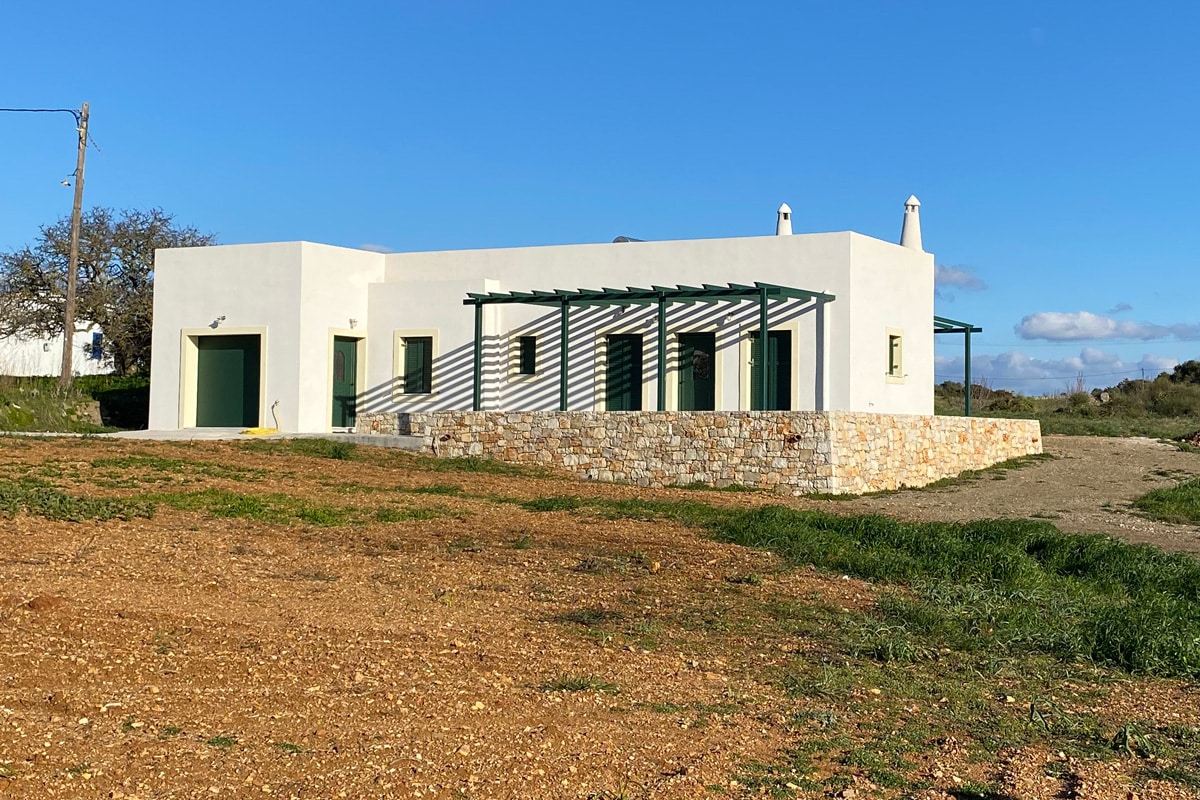
For the last two or three years, driving to work, I would drive past the intersection of St. Elias and see workers constructing a new building. As time went on the construction was taking its final shape and one day it ended up as shown in the photo. In this photo we can see that this beautiful house resembles the architectural form of the old Chiriot house with the courtyard, the lean-to and the arbor. I was really impressed by the aesthetic result and the «discipline» of the house in the bioclimatic know-how of our ancestors! Let's see how this «genius» of the old ones is confirmed in reality.
Reading texts of scholars of Kythera architecture, which I found in the minutes of the cultural conferences of our Municipality (2000 and 2001), I was impressed by the wisdom that the old Tsirigotes had when constructing their houses. In Kythera, we could say a little more generally, two architectural types of houses can be distinguished. In northern Kythera, we notice that the houses are two-storey or ground floor, with tiled roofs and are quite similar to those of Laconia. In southern Kythera, we see that houses with flat roofs predominate and are more similar to Aegean houses.
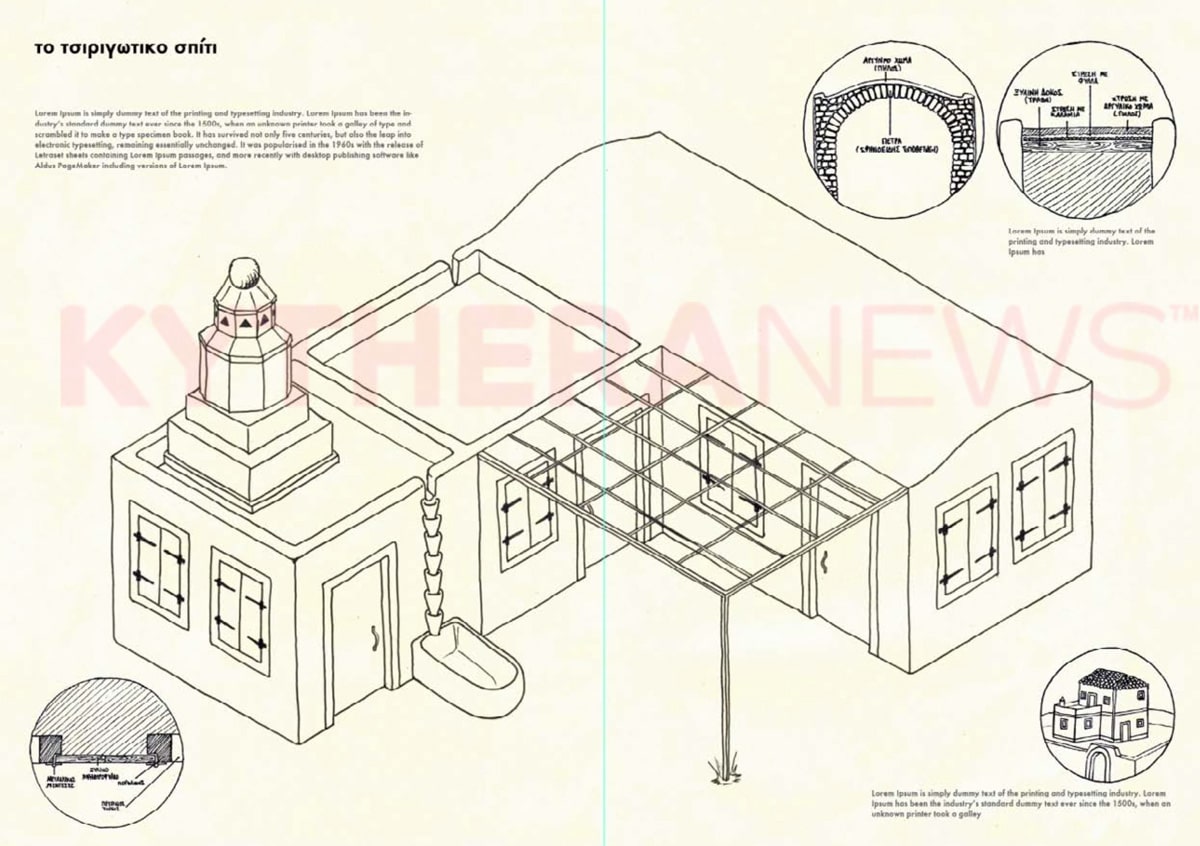
The Tsirigotiko house that you will see in the photo below combines the basic principles of construction that of course were not suggested by a scientific engineer of those times (they did not exist) but by the empirical knowledge of centuries.
Economy, weather conditions and practical benefits in the Chirigo house
In several cases the houses are constructed in stages, starting from one room and then following additions of new premises. This evolution usually goes hand in hand with the needs of the growing family, but also its progress in time and activities. The rooms are built next to each other, making them resemble «train cars» where you pass through one door after another. The houses usually have south orientation with large openings that allow the sun to «enter» the space. On the northern walls the windows are smaller, just enough for the ventilation of the houses and the repulsion of annoying moisture. At some point, the family, building another room, decides to space it, giving the floor plan of the house the form of the letter “C” (gamma). So it creates a windless courtyard which, depending on the provision, protects against northeast winds or their Northwest winds. A little before or a little after, another element is placed, the vine. The courtyard gets shading with the lush vine leaves that in the summer keep it cool, while in winter they fall and more light comes into the house. The flat surfaces on the roof collect rainwater and lead it to the cistern or the sternopitheater of the courtyard. This way the family always has water available in their home.
This is how scholars analyse them and this is how I perceived them in the old houses of my village. I had time to experience the old Tsirigotes and understand that nothing was accidental in their household economy. I still remember my grandmother, when and which windows of the house she would open, depending on the weather. I often saw Grandpa enjoying the coolness of the arbor after lunch, smoking his Karelia after lunch. And as for our well in the yard, we drew water from it for every chore in the house. We kids would gather after the game to quench our thirst and drink water from the same well! That and much more. Of course, our houses also had an oven (to bake nuts - buns) and elaborate chimneys in various designs, and on top of them was a marble from a castle cannon.
Somehow, the wisdom of the old seems to be contained in this wonderful new house in Agios Ilias. The house faces south, it has the north at its back, it has its pergola waiting for the vine to climb, its beautiful chimneys. Of course, this modern house was obviously built with a different interior layout and different building materials. And if the thick stone walls provided a thermal insulation in those days, this house has been clad with insulating facades so that it is bioclimatic, ecological and economical!
The house that was built in Agios Ilias is one of the most beautiful on our island in my opinion. May its owner enjoy it and may those who inspired, designed and built it be happy! Surely they will know the meaning of both moderation and excellence!