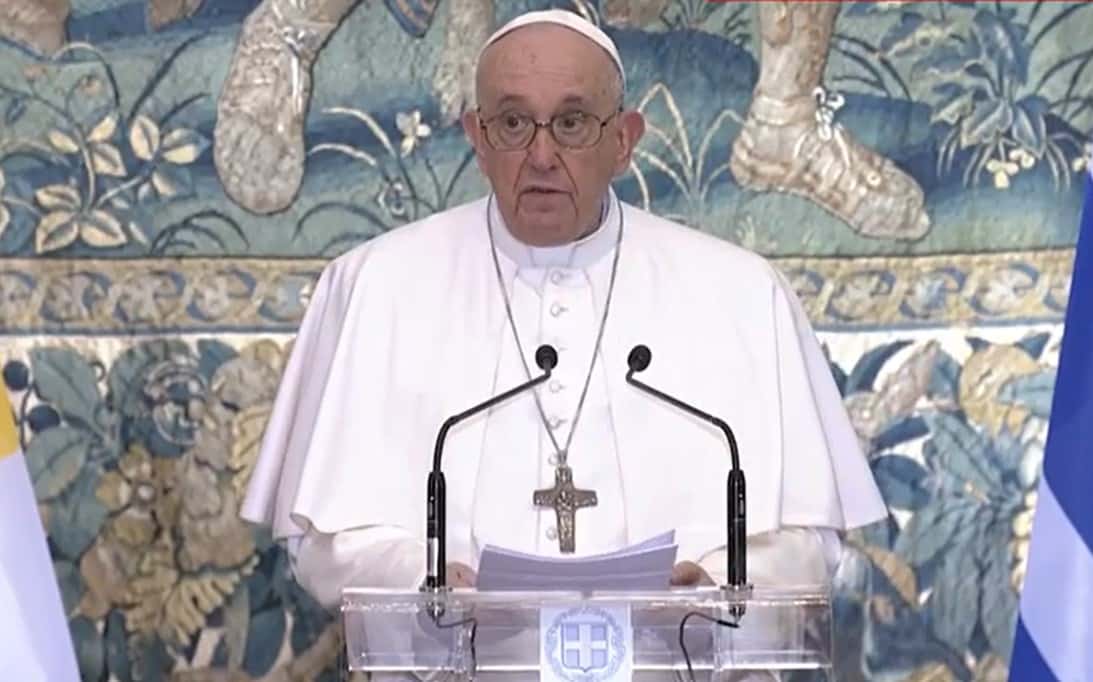
In his speech at the Presidential Palace, Pope Francis highlighted Greece’s contribution to world affairs, beginning his remarks with the characteristic phrase: «Without Athens and without Greece, Europe and the whole world would be less wise, joyful, and happy,» adding that «it was from here that humanity’s horizons were broadened.» He concluded by offering a blessing in Greek: «May God bless Greece.».
“You are the memory of Europe,” said the Pope, adding, “It is an honor for me to be in this glorious city, a pilgrim on soil that overflows with spirituality, education, and culture.” It was here that the paths of the Gospel passed through; the Gospel was written in Greek, the immortal language of human wisdom, which became the voice of divine wisdom. It was here that humanity began to feel like a citizen of the entire world and realized that it is a political being.
From this city, the cradle of civilization, let a message always rise to the heights—one that will counter the deceptions of authoritarianism and individualistic indifference, and will champion care for others, to create the cornerstone of humanism that our times and our Europe need.
In his speech, Pope Francis identified the pandemic, climate change, the common market, and widespread poverty, and proposed that, to address them, we move—through concrete and active cooperation—from partiality to participation.
The Pope, as his speech was broadcast in translation by ERT, expressed concern over the decline of democracy and the rise of skepticism, noting that addressing this requires effort and patience, and emphasizing that «the remedy lies in good politics,» while calling for priority to be given to supporting the most vulnerable groups and to social justice.
The Pope went on to say that the international community needs this in order to pave the way for peace through a multilateralism that is not stifled by excessive nationalist claims; politics mustto prioritize common needs over private interests may seem like a utopia—a hopeless journey across a stormy sea, a long and elusive Odyssey—yet this journey through stormy seas—as the great Homeric epic teaches—is often the only way and the only path, and one reaches one’s goal by being inspired by the desire to return to the family hearth, the quest to move forward together. From this perspective, amid this pain, I would like to reiterate my appreciation for the difficult path that led to the Prespa Agreement signed between the Hellenic Republic and the Republic of North Macedonia.
On the issue of migration, he said it has created rifts between the South and the North. He spoke of European indecisiveness and added that the European Community insists on appearing paralyzed and uncoordinated, rather than serving as a driving force for solidarity.
He called for a comprehensive community vision, urging that attention be given to the most disadvantaged so that, in accordance with each country’s capabilities, they may be welcomed, protected, supported, and integrated, with full respect for human rights and dignity, since, as he said, this is a guarantee for the future.
Our hardships unite us, and the recognition that we are all part of the same fragile humanity will help build a more inclusive and peaceful future, he added, calling on us to turn what seems like an unfortunate setback into an opportunity.
Referring to the environmental crisis, the Pope expressed his concern and his hope that the commitments to address it will be taken seriously.
In his extensive remarks on the pandemic, he described it as a major adversity, while regarding our country, he said that it is addressing the challenge this poses through appropriate measures by the authorities, such as the need for a vaccination campaign.
The Pope said that during the pandemic, a remarkable sense of solidarity emerged, one that must not be lost once the storm gradually subsides.
He advocated for everyone’s right to care so that the most vulnerable—and especially the elderly—are not cast aside, saying that they must be respected, as they are a sign of a people’s wisdom. Life is a right; death is acceptable, but not if it is caused artificially, he emphasized.
Elsewhere in his speech, he referred to the Catholic community in Greece, expressing his gratitude for its public recognition and reaffirming his commitment to promoting the common good of Greek society. He added, “Who is closer to us than you?” We have differences in ritual, yet we share a single homeland; we belong to one people; we Christians are brothers and sisters in our roots, in our growth, and in our fruit—brothers and sisters beneath the cross.
Pope Francis, turning his gaze toward the Mediterranean, proposed that the olive tree become the symbol: uniting different lands that look out onto the same sea, representing our determination to tackle the environmental crisis, and serving as a call for solidarity, especially toward those who are not part of our own people.