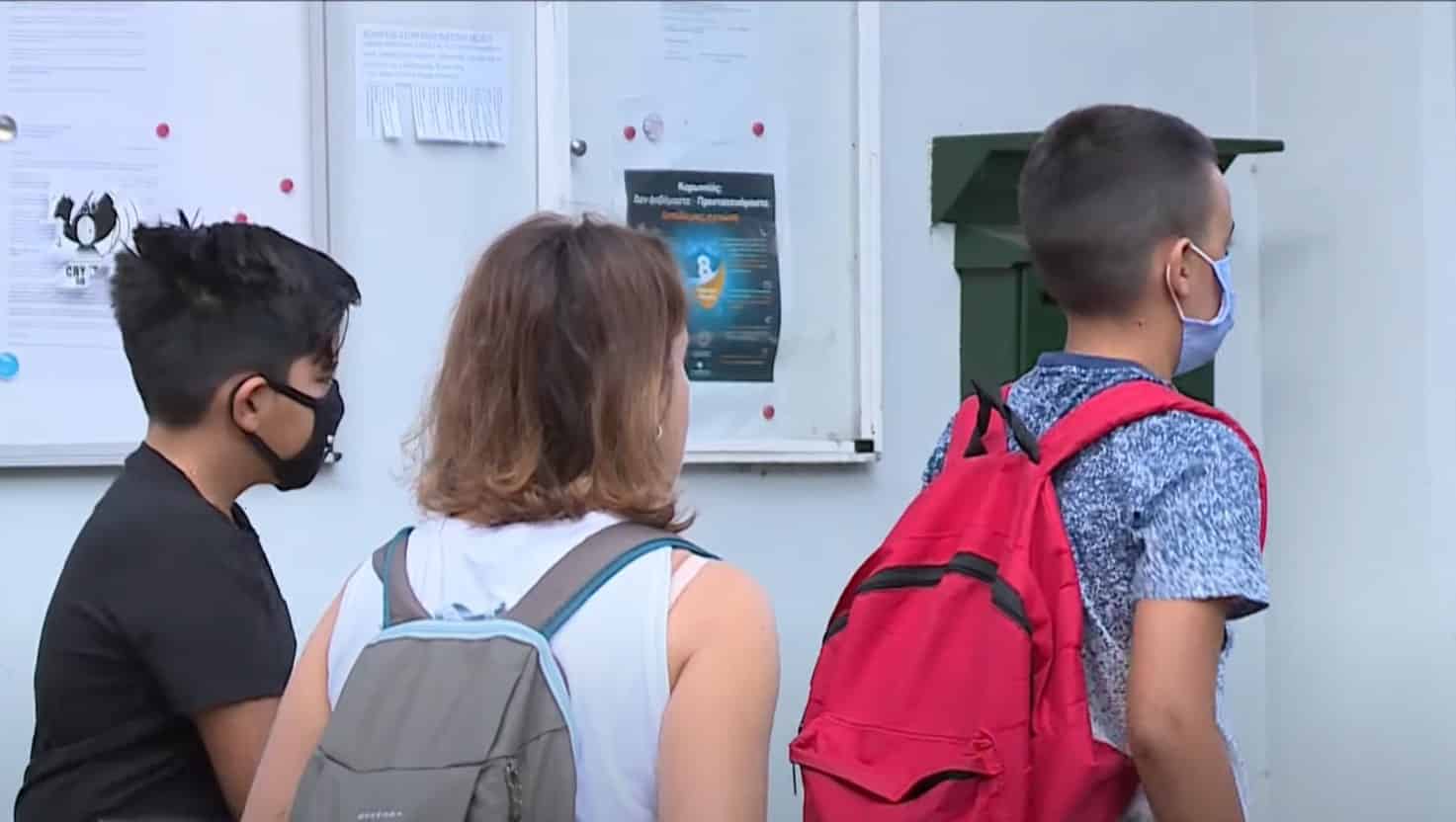
Schools will open as usual, in person, on Monday 10 January and the Ministry of Education has published 12 questions and answers on the functioning of schools which are useful for students, parents and teachers.
In the questions of the ministry, answers are given on what changes in the operating protocol of schools, on self-tests, on what will happen if a student or teacher is diagnosed positive to COVID-19, what will apply to unvaccinated students and teachers who have been infected and when tele-education will take place.
- When will the schools open and what reasons led to this decision?;
Schools will open normally, in person, on Monday 10 January, as scheduled.
The face-to-face operation of schools is crucial:
First of all, for the educational work itself - nothing can replace face-to-face teaching.
For the psycho-emotional development of our children, which is very important for them to function in their physical space, with their peers and teachers.
The live operation of schools in times of pandemic ensures greater safety for our children, as an effective safety net for the educational community is provided in schools, by carrying out systematic tests every week for school attendance, by the strict use of masks, by extensive daily checks in case of an outbreak in the classroom, among other measures already in place. Most of the above does NOT apply when schools are closed.
The in-person operation of schools is also fully in line with the international trend of opening schools with increased controls. Schools are regularly opened live in the European Union - for example in: Germany (3/1), France (3/1), Hungary (3/1), Bulgaria (4/1), Latvia (5/1), Ireland (6/1), Luxembourg (9/1), Estonia (10/1), Italy (10/1), Netherlands (10/1), Finland (10/1), Belgium (10/1), Belgium (10/1), Slovakia (10/1), Poland (10/1), Malta (10/1), Cyprus (10/1), Croatia, Lithuania, Sweden, Czech Republic, Romania.
Our schools have been operating live since September a) when the Delta mutation was at its most complex and b) when there was almost no vaccination coverage among students. It does not make sense with the milder Omicron and with all other social and economic activities in operation, even with restrictions, that there should be any thought of suspending the schools.
Children cannot be «punished» because a minority of the population does not wish to be vaccinated.
- How is the school operating protocol changing?;
On the recommendation of the Special Committee, the protocol for the operation of schools is updated to meet the needs of the new phase of the pandemic and the characteristics of the transmission of the Omicron mutation. The changes to the Protocol aim to strengthen and generalise controls.
Briefly, three main changes are envisaged:
An extra page test is planned for the first week of school for all students and teachers. Therefore, during the week of 10-15 January, three free self-tests, instead of two, will be carried out by students and vaccinated teachers. This enhanced testing should be carried out in the last 24 hours before the start of school and aims to limit the spread of the virus, given the particular holiday season with its increased confusion. During the same period, non-vaccinated teachers are required to obtain a self-test at their own expense, in addition to their two regular rapid tests.
The two free weekly self-tests will now be carried out not only by unvaccinated students but also by vaccinated students and teachers. This measure is aimed at early detection of cases, given the transmissibility of the new virus mutation to vaccinated persons and given the vaccination coverage of the school community.
In case of an outbreak in the classroom, we move away from the «cross» logic, i.e. increased checks only on children sitting near the outbreak, and we are expanding to increased controls throughout the department. Plus all unvaccinated students will get a free test, every day, for 5 days. Specifically, they will take two rapids and a self test over 5 days, in addition to the two fixed self tests per week, so 5 tests in 5 days. Vaccinated students will take a self test, in addition to the two weekly self tests, i.e. a total of three free tests per week. (see attached table)
- What are the results of the school operating protocol between September and December 2021?;
From 13/9 to 23/12, no particular trend of intra-school spread of the virus was observed: each compartment where cases were detected between September and December had an average of 1.2 cases per day in total. In other words, at least in 80% of the cases where a student case was detected within a department, there was not even a second case in the same department.
The highest daily average number of cases per department with positive cases was 1.5. This number was observed on the first day of this school year (13/9), indicating that children are safer at school, where masks are worn, strict protocols are followed and increased checks against coronavirus are carried out, than outside school.
Each school day an average of 2.78 out of about 81,000 classes were closed - i.e. 0.003% of classes were closed - with a maximum of 10 classes (0.01%), a value observed on 26/11.
The 32 million self tests given free to schoolchildren this period detected 84% of laboratory-diagnosed cases in these ages. Therefore, open schools with increased diagnostic testing are effective in detecting cases and reducing the spread in the community.
In Greece, between September and December, the proportion of child cases (aged 0-15 years) in the total number of cases was much lower than in most other EU countries, demonstrating that open schools with enhanced school protocols, and in particular, increased controls, ensure the safety of students and limit the spread of the virus (see attached graph).
- There is a lot of talk about self tests in relation to the Omicron mutation. Do they protect us sufficiently?;
Self-tests licensed in the European Union are designed to detect the virus in people who have sufficient load to transmit it. The state-available self tests detect a virus protein (nucleocapsid) that is also found in the Omicron strain, therefore the international organisations consider that their usefulness has not been affected. In general, throughout the course of the pandemic it has been observed that a small proportion of patients will not develop a sufficient load to be detected by rapids or self tests. Therefore, only when there are persistent symptoms molecular testing is recommended. These patients, however, are not thought to be transmitting the virus (or to be transmitting very little). Therefore, both self and rapid tests remain valid and reliable tools for limiting viral transmissibility.
- Why does 50%+1 apply to the suspension of a department?;
The approach of the Committee of Experts and internationally is to make the most of diagnostic tests and to reduce quarantine. The aim is to keep the departments open as much as possible, but with much increased diagnostic testing.
Epidemiological surveillance is further enhanced by the new protocols because:
Vaccinated students and teachers (not just unvaccinated ones) will now also be systematically tested
In the event of an outbreak, competitive testing will be done every day on the entire classroom population for 5 days.
If extensive dispersion is observed in a section, then that section will be closed in a short period of time. Otherwise, the intensive controls foreseen by the epidemiologists will continue to be used to limit the spread of the virus, just as was done during the first months of this school year.
Between September and December 2021, the health protocols worked in a very satisfactory way, as there was no major trend of intra-school spread of the virus. This is illustrated by the fact that in each department in which COVID-19 cases were detected during this period, a total of 1.2 cases were detected daily on average. Thus, at least in 80% of the cases, the presence of one case in one department was not associated with the presence of even a second case on the same day.
- Is there any change in the documents with which pupils have to come to school?;
Declarations for certificates of vaccination or sickness or negative rape test or self-tests for pupils attending public schools continue to be submitted on the edupass.gov.gr platform, while self-tests for pupils attending private schools continue to be submitted on the self-testing.gov.gr platform.
What changes is that the two free weekly self-tests will now also be carried out by vaccinated pupils. This measure aims at early detection of cases, given the infectiousness of the new mutation of the virus also in vaccinated persons, and the vaccination coverage of the school community. The test will be carried out twice a week up to 24 hours before school on Tuesday and Friday.
For the first week of school after the Christmas holidays, an additional page test is provided - so, in the first week, students will be provided free of charge and will have to take a 3 page test. For the first week of operation, as an exception, the self-tests must be taken up to 24 hours before school on Monday, Tuesday and Friday to limit the spread of the virus, given the particular holiday season with its increased confusion.
- What happens if a student is diagnosed positive for COVID-19? How long is the quarantine period? When and under what conditions does he or she return to school?;
If a student is diagnosed positive for COVID-19, then they will be placed in isolation for at least 5 days. The isolation will be discontinued after 5 days (a) if there are no symptoms, or the symptoms after the five days - predominantly fever - subside, and (b) with a negative self test. If fever persists or there is a positive self (or rabies) test, isolation will be prolonged.
- Is there any change in the documents with which teachers have to come to the schools?;
The necessary documents of unvaccinated teachers are kept as they are.
Vaccinated teachers undergo 2 free self-tests per week. The test will be carried out twice a week (Tuesday and Friday), up to 24 hours before school on Tuesday and Friday. This measure aims at early detection of cases, given the transmissibility of the new virus mutation also in vaccinated persons, and given the vaccination coverage of the school community.
For the first week of schools after the Christmas holidays, an additional self test is provided - so, in the first week, vaccinated teachers will be provided free of charge and will have to take 3 self tests. For the first week of operation, as an exception, self-tests must be done up to 24 hours before school on Monday, Tuesday and Friday to limit the spread of the virus after the increased confusion of the Christmas holiday. During the same period, non-vaccinated teachers are required to obtain a self-test at their own expense, in addition to their two regular rapids tests.
- What happens if a teacher is diagnosed positive for COVID-19? For how long is the quarantine planned? When and under what conditions does he or she return to school?;
If a teacher is diagnosed positive for COVID-19, then they will be placed in isolation for at least 5 days. The isolation will be discontinued after 5 days (a) if there are no symptoms, or the symptoms after the five days - predominantly fever - subside, and (b) with a negative self test for vaccinated teachers, and a negative laboratory test (rapide or PCR) for non-vaccinated teachers. If fever persists or there is a positive SFF or rapide test, isolation will be extended. When leaving quarantine, teachers are required to use a high respiratory protection mask (N95 or KN95 or FFP2) or a double mask for at least another 5 days.
- What are the provisions for students and teachers in case of close contact with a confirmed COVID-19 case outside school? That is, what happens when, for example, there is a case at home?;
If students or teachers are close contacts of a COVID-19 case outside of school:
Teachers, vaccinated with both booster dose or teachers vaccinated with 2 doses in the last 6 months or with one dose of J&J vaccine in the last 2 months, attend school as usual and have a laboratory test (rapide or molecular test) on the 5th day after exposure. Teachers wear a high respiratory protection mask (N95 or KN95 or FFP2) or a double mask for 10 days after exposure.
Teachers, vaccinated with 2 doses over 6 months without booster dose or with one dose of J&J vaccine over 2 months without booster dose or unvaccinated, remain in isolation for 5 days, and laboratory testing (rapids or molecular test) is performed on the 5th day after exposure. After day 5, teachers use a high respiratory protection mask (N95 or KN95 or FFP2) or a double mask for at least another 5 days.
If they are vaccinated students, they come to school as usual and take three self-tests on days 0-1, 3 and 5-7.
If they are unvaccinated students, then they are kept in isolation for 5 days, and a self test is performed on the 5th day after exposure.
- What about unvaccinated students and teachers who are sick?;
Unvaccinated students or teachers who have become ill within the last three months have the same status as vaccinated students or teachers respectively.
- When will there be a teleclass?;
Distance learning will be provided exceptionally in specific cases including the following:
If confirmed cases of COVID-19 are detected in a school department at the same time to more than half (50%+1) of the students of the.
If a primary education teacher (teacher/preschool teacher, non-specialist) is ill, and there is no possibility for his/her immediate replacement by the relevant Directorate of Education, but tele-education by another teacher is foreseen.
If a teacher is positive, and while in solitary confinement, he or she wishes to do tele-education on an optional basis.
For students who have one of the serious underlying diseases listed in Annex I of the protocol «Measures for the protection and prevention of the spread of SARS-COV-2 in schools» and who participate in online classes.
TABLE
| Case study | Supporting documents / week | |
| Students | ||
| For school attendance | Vaccinated | 2 pp* |
| Unvaccinated | 2 pp* | |
| Close contact with a case | Vaccinated | 3 pages (within 5 days) |
| Unvaccinated | 5 tests (2 rapids + 3 shifts) over 5 days | |
| Teachers | ||
| For school attendance | Vaccinated | 2 pp* |
| Unvaccinated | 2 rapids* | |
| Close contact with a case | Vaccinated | 3 pages (within 5 days) |
| Unvaccinated | 5 tests over 5 days (4 rapids + 1 shelf)* | |
| *For the first week of school after the Christmas holidays, all students and vaccinated teachers will undergo an additional free self test - so they will have 3 self tests. Non-vaccinated teachers will also take a sf test, in addition to the 2 rapids, at their own expense. | ||