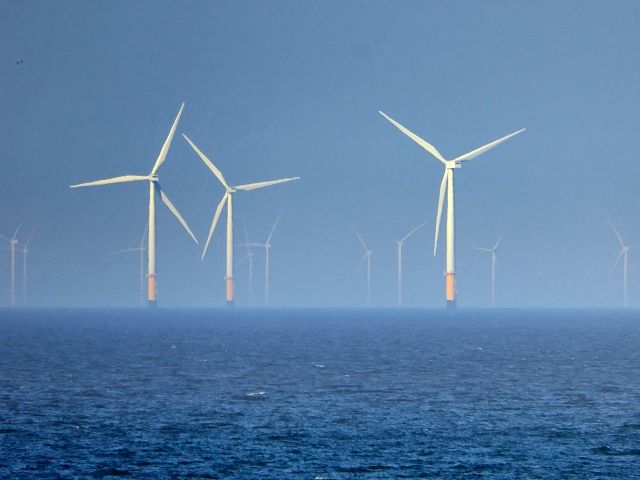
It's the future of Energy in Europe. The offshore wind farms will gradually replace the fossil fuels, as it is a source of clean energy that does not cost much. Many wind farms are expected to be built in the coming years, such as Borssele 1 & 2 in the North Sea. These are located 22 km off the Dutch coast. Steven Engels is the CEO of Ørsted: «__Look how impressive it is. This wind farm is very large. We’re standing beneath a wind turbine that’s already in operation. It’s enormous.».
94 wind turbines They have been installed at depths ranging from 14 to 40 meters. Once completed, this will be the largest offshore wind farm in the Netherlands. Klaasjap Buijs is the project manager for Ørsted’s construction project: «__This cable comes from the seabed; it’s being laid here and will later be connected to the switchgear. We’ll install the tower with the turbine on top, and the wind turbine installation will be complete.».
This wind farm will supply electricity to one million Dutch households. It will also help decarbonize the coastal industry through a plant that uses electrolysis. It will process wind energy to produce environmentally friendly hydrogen: «There are mature plans for hydrogen production. Everything is ready. The key is to start production,» notes Steven Engels.
These are the first signs of the change to come as part of the EU’s new strategy for offshore renewable energy. This plan includes replacing imported fossil fuels and creating new industrial opportunities and green jobs across the continent. It is expected that 30 years from now, more than 25% of Europe’s electricity will be generated from the sea. Today, that figure stands at just 2%.
We want to generate more energy at sea and from the sea.
Our new offshore renewable energy strategy will increase Europe’s offshore wind capacity to help meet our 2050 climate targets.#EUGreenDeal pic.twitter.com/3RX8vqLY7E
— European Commission ?? (@EU_Commission) November 19, 2020
Europe, which is already the world leader in this sector, aims to increase its offshore wind power generation capacity twentyfold by 2050. This means new power plants, new port infrastructure, and new jobs in coastal regions and beyond. It represents a significant opportunity for Europe’s blue economy. Investments in offshore wind energy are enormous.
The Apollo is a new vessel used to transport wind turbine components between the port and the offshore wind farm.Teams at the port of Ostend in Belgium are working around the clock to complete another large wind farm, SeaMade, located 45 km off the coast. Loading 81-meter-long blades onto a ship is no easy task, especially when it’s windy: «Right now you can see one of the blades being brought to the dock for transport. We’re bringing the blades one by one and loading them onto the Apollo. __We’re using this entire area here to assemble the largest components,» explains Georg Horvat, site manager for Siemens Gamesa Renewable Energy.
Some new ports are being built with a view to serving offshore wind farms. The port of Ostend needs to be modernized.
Georg Horvat, site manager for Siemens Gamesa Renewable Energy, adds: «For most regional ports that weren’t built for this specific purpose, we need to invest money to make them suitable for our operations. Some of the improvements will be permanent here. For example, the ramp for RO-RO ships—where we transport our equipment and load and unload it from the ship—needs to be modernized to support the weight of our equipment.».
The entire supply chain must be improved to handle components that are manufactured in various European countries and are becoming increasingly larger in size. Jan Klaes is a project manager at Siemens Gamesa Renewable Energy: «The A380, the world’s largest passenger aircraft, could fly between our blades. The area they cover is almost three soccer fields. Wind turbines are getting bigger and bigger to meet the growing need for green energy. This leads to more jobs, the construction of new factories, and assembly sites like this one.».
This technological advancement is being driven by industrial giants. However, it also gives small, innovative startups the opportunity to distinguish themselves in terms of new ways to harness offshore renewable energy sources, such as this prototype that combines solar collectors with vertical rotors.
Developed with European funding, these new energy systems can be installed at sea and provide energy for water desalination on small islands and in developing countries: «There is high demand for these systems, because we need to realize that developing countries represent a market worth billions of dollars, and water is a market of comparable size. Both are expanding and need reliable solutions,’ says Yvon Timmerman, project manager and co-founder of Blue Power Synergy.
Improvements to the design will enhance the economic performance of these investments. The future Kriegers Flak wind farm is located offshore, between Denmark and Germany. It will be connected simultaneously to the power grids of both countries, supplying electricity based on demand.
Costs can be reduced through new technologies, such as floating wind turbines, or telescopic towers, which can be installed without the need for heavy-lift vessels. This means a one-third reduction in costs.
Cherbourg
This sector employs 62,000 workers in Europe and is constantly in need of a more specialized workforce. This Wind Power factory in Cherbourg, France, is the world’s largest manufacturer of wind turbine blades. They are 107 meters long. Éric Petty is the plant manager: «The advantage of having a plant in Cherbourg is the port. The blades can be loaded onto a barge and delivered to the nearby wind farms. We have about 400 people working here, and our annual goal is to produce four blades per month.».
To meet growing demand, the factory recently hired hundreds of new employees. They have different backgrounds and are being trained here. Arian Mera is a trainer at the factory: «We need more training because we’re short-staffed in the production department. The blade is 107 meters long. We need more people to get the job done. There are a great many open positions in the wind energy sector—in production, quality assurance, logistics, and maintenance.».
With the 12-megawatt wind turbine having recently received a license for commercial use, the company has many blades to manufacture: «It’s a growing sector. The establishment of the plant in Cherbourg, Normandy, has led to the creation of 550 direct jobs at the factory and 2,000 indirect jobs locally,» emphasizes Florence Martinez-Flor, director of human resources at LM Wind Power.
However, the significant growth in offshore wind energy also comes at a cost: The European Commission estimates that 800 billion euros in investment will be needed over the next thirty years, most of it from the private sector. It is a necessary step toward decarbonizing Europe and transitioning to a sustainable economy and society.