I am not, by nature, suspicious or biased in my political judgments. On the contrary, I try to see things from the other side, to put myself in the other person’s shoes, no matter how much they provoke me with their ideological obsessions.
He irritates me with his insistence on stereotypes, which I have always rejected, even if some of them are—most likely —the result of personal experience that justifies their repetition or the outcome of research that is sometimes correct and sometimes incorrect.
With this in mind, I have learned not to prejudge negatively the rise of any politician to the office of prime minister based on the rumors surrounding him or her. Rumors that are not based solely on his own merits, but carry all the sins of his family tree.
Above all, they bear the weight of our people’s folk wisdom, encapsulated in the proverbial saying, ”The apple doesn’t fall far from the tree,’ especially if that apple tree has had a turbulent history in its political journey and bears a name that is both heavy and unbearable. ”Konstantinos Mitsotakis.”.
Being a heavyweight isn’t always a good thing, of course; it has its downsides. Drawbacks that accompany the political heir for life, no matter how hard he tries to eliminate them and, above all, to avoid repeating them, but to retain only the positive traits he inherited from his father.
Given these facts and with a deep understanding of the bittersweet burden it carries, I approached the Kyriakos Mitsotakis, Adding to his positive qualities was the willingness he demonstrated as a candidate for the leadership of the New Democracy party to present his positions as Kyriakos rather than as Mitsotakis, something that few recognized and appreciated based on his advertising campaign.
«I made mistakes, but I was never one to give in to fate. I never lacked courage, and I poured all the passion I had inside me into politics,» the father of the current prime minister, Konstantinos Mitsotakis, admitted in one of his interviews, as he looked back on his 60-year political career.
Except that the fire the late honorary president of the New Democracy party felt within him—which drove him to refuse to compromise, to refuse to follow the beaten path, but to courageously challenge the status quo in both domestic and foreign policy—that fire is not shared by his son and successor.
At least, he doesn't have it to the extent that he should, so as to stand out rather than get lost in the crowd of prime ministers who have governed this country.
For me, the criterion for distinguishing a prime minister’s political stature is not so much his performance in the ”minor” matters of domestic policy (which historically resemble the administrative skills required by Byzantine emperors when selecting governors for the Byzantine Themes, excluding the military jurisdictions with which they were entrusted).
The criterion is his performance on the ”major” issues of domestic policy (economic and social recovery) and, above all, on those of our foreign policy. And in these areas (especially the latter), the negatives far outweigh the positives, since he fell short of the mark in most of them.
The exception is the victory in the Evros (March 2020) – which confirmed the existence of a state that successfully defended itself against the Tayyip Erdoğan's instrumentalized migrant army – and, subsequently, the prevention of uncontrolled mass migration flows to the islands of the Eastern Aegean, as we experienced in 2015 SYRIZA.
As for the phrase ”below the bar,’ as with the rest, this is not merely scaremongering, since—with his ”Good morning”—Kyriakos confirmed his acceptance of it ”Prespa Agreement” (which will have the force of a treaty once the Skopje Protocols are ratified), which was followed by a series of concessions to Turkey.
We need only recall the government’s delayed response due to a lack of foresight in turcolibian memorandum and the an incomplete Greek-Egyptian agreement that left the maritime zone between the 28th and 32nd meridians unprotected, leaving it open to exploitation by the Turks, since it includes half of Rhodes and Kastellorizo.
We need only recall the waiver of the right to extend the Exclusive Economic Zone to 12 nautical miles under the pretext of casus belli by the Turks, our unacceptable tolerance of the three-month violation of our territorial waters by the Turkish research vessel Oruc Reis and the statements Dendia and Mitsotakis that We are not interested in hydrocarbon exploration and production in Greece.
All of this is already reason enough for us not to be complacent about our foreign policy, especially when we observe covert political tactics—beyond those we are already aware of—that serve the purposes of secret diplomacy (the secret trilateral meeting in Berlin in July 2020 was only the beginning).
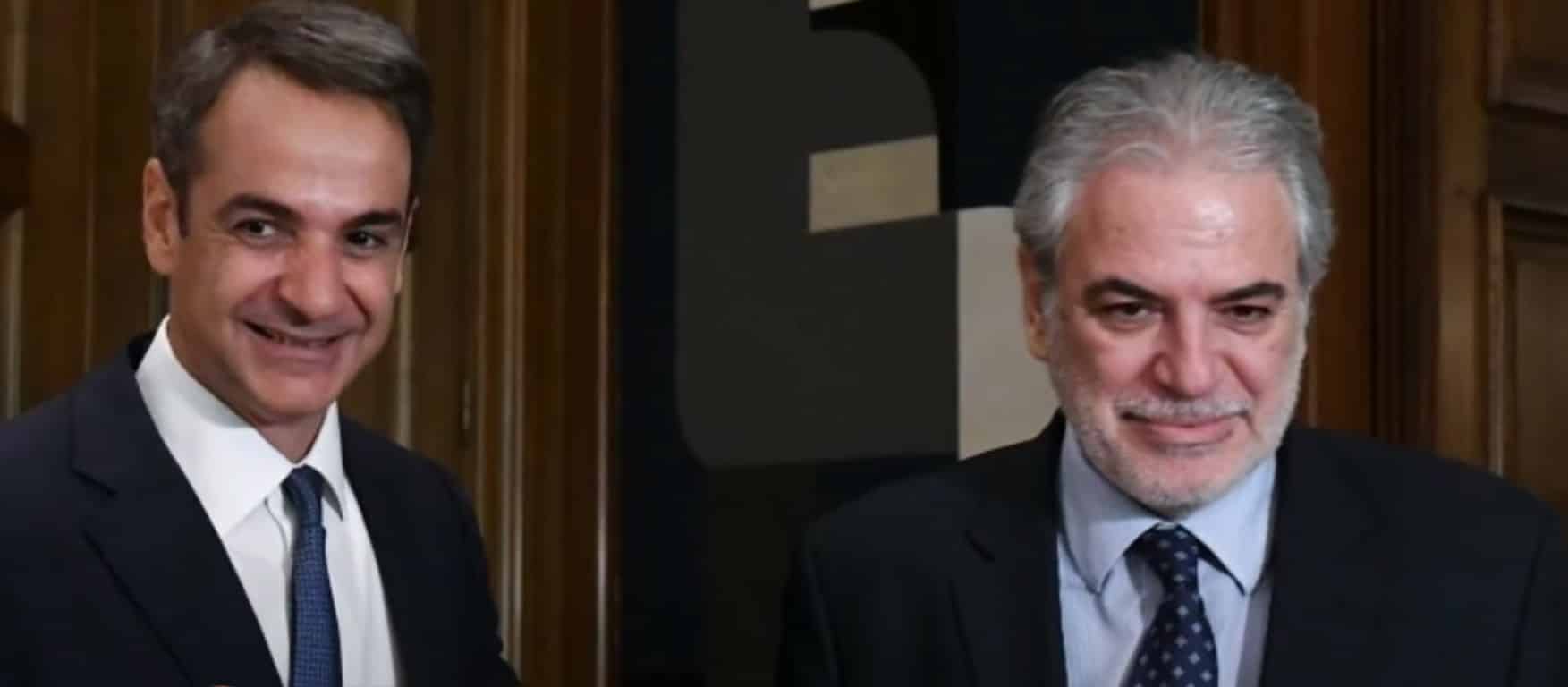
And I consider the deliberate choice of Christos Stylianidis (who will obtain Greek citizenship before taking office) at the new ministry Climate Crisis and Civil Protection, which was established to respond to and manage crises and natural disasters.
In any other case, I must admit, I would be happy if the prime minister’s motivation for making this choice were to fill certain government positions with Greek Cypriots or Greeks living abroad, wherever they may be.
Except that this isn't the case here, which is why I'm talking about covert political tactics. We are dealing with yet another ELIAMEP-style appointment (following those of the advisors during the Simitis era on national issues at the Ministry of Foreign Affairs and the Prime Minister’s Office), a choice by Kyriakos Mitsotakis that reflects the ANANA mindset., who is doing everything he can to prove that he is one and the same as the ”progressive” Dora, who holds a prominent position among the group of Anarchist politicians.
Those who continue to go overboard in The Annan Plan (see Anna Diamantopoulou, whom the prime minister had nominated to lead the OECD in 2020) and to assert without hesitation that if we had agreed to this in 2004 (that is, if we had voluntarily handed over Cyprus), Tayyip Erdoğan would not now be threatening to take the Aegean islands from us.
Therefore, by the principle of reductio ad absurdum, justify the Simitis government’s policy of appeasement, which effectively resulted in the cession of the Imia islets to Turkish sovereignty in 1996, since by failing to react, we accepted their ”gray-area” status, which opened the back door to the legitimization of ”gray” zones in the Aegean.
Given these facts, the political supporters of the Annan Plan in Greece—who today wholeheartedly advocate for ”bizonalism with political equality” (the old British-Turkish plan) as a solution to the Cyprus problem—not only do they not care about resolving it, but They don't even care if the Republic of Cyprus is downgraded to a Community…
But to return to the selection of Christos Stylianides (who is described by some who have in-depth knowledge of the Cyprus problem as the foremost ”advocate of appeasement” in Cyprus, because he was openly in favor of the ”YES” vote), if we combine this with the convergence of views on the BZF (Bi-zonal, Bi-communal Federation) Mitsotakis-Anastasiades, we would say with a heavy heart that:
The Annan Plan is making a comeback—and a triumphant one at that—since it has been accepted (in its new version) with open arms by the political representatives of Greece and Cyprus (Nicos Anastasiades and Kyriakos Mitsotakis).
The frightening thing is that this has been confirmed to us for over a decade by the eminent scholar of Turkish politics and professor at Panteion University, Neoklis Sarris (in response to the British-Turkish plan that the Turks had proposed at the time as a solution to the Cyprus problem).
Specifically, the late professor (in an interview with the Cypriot newspaper ”Simerini”) said that ”The DDO will be the final nail in the coffin not only of the Republic of Cyprus, but of Cyprus itself—and especially of its culture and people.”.
And he justified this by saying, characteristically, that ”Nowhere in the world has a minority 18% of the population come to hold 50% of state power, with all that entails (rotating presidency, etc.)”. Something that, if nothing else, is based on the racist principle of racial and ethnic discrimination.
Finally, to those ”Ananists” who hold up—as a sword of Damocles—the danger that the Turkish proposal to partition the island might be adopted in the Cyprus issue, Neoklis Sarris’s response was that ”The DDO is worse than partition because the inevitable Turkification will take place across the entire island, where the demographic factor far exceeds current conditions.”.
Which means, in other words, that a solution to the Cyprus problem based on the latest resolutions of the UN, its unanimous decisions National Council of Cyprus and the joint communiqué of November 25, 2019, in Berlin (a trilateral meeting on the Cyprus issue) will not only fail to bring about the reunification of Cyprus, but will also set his plans in motion Tayyip Erdoğan to turn it into a Turkish protectorate…
By Krinios Kalogeridou