The summer season in Greece is not merely a change in the calendar, but the structural reproduction of the dominant capitalist ideology, in which the «tourism miracle» is imposed as the ultimate social imaginary institution.
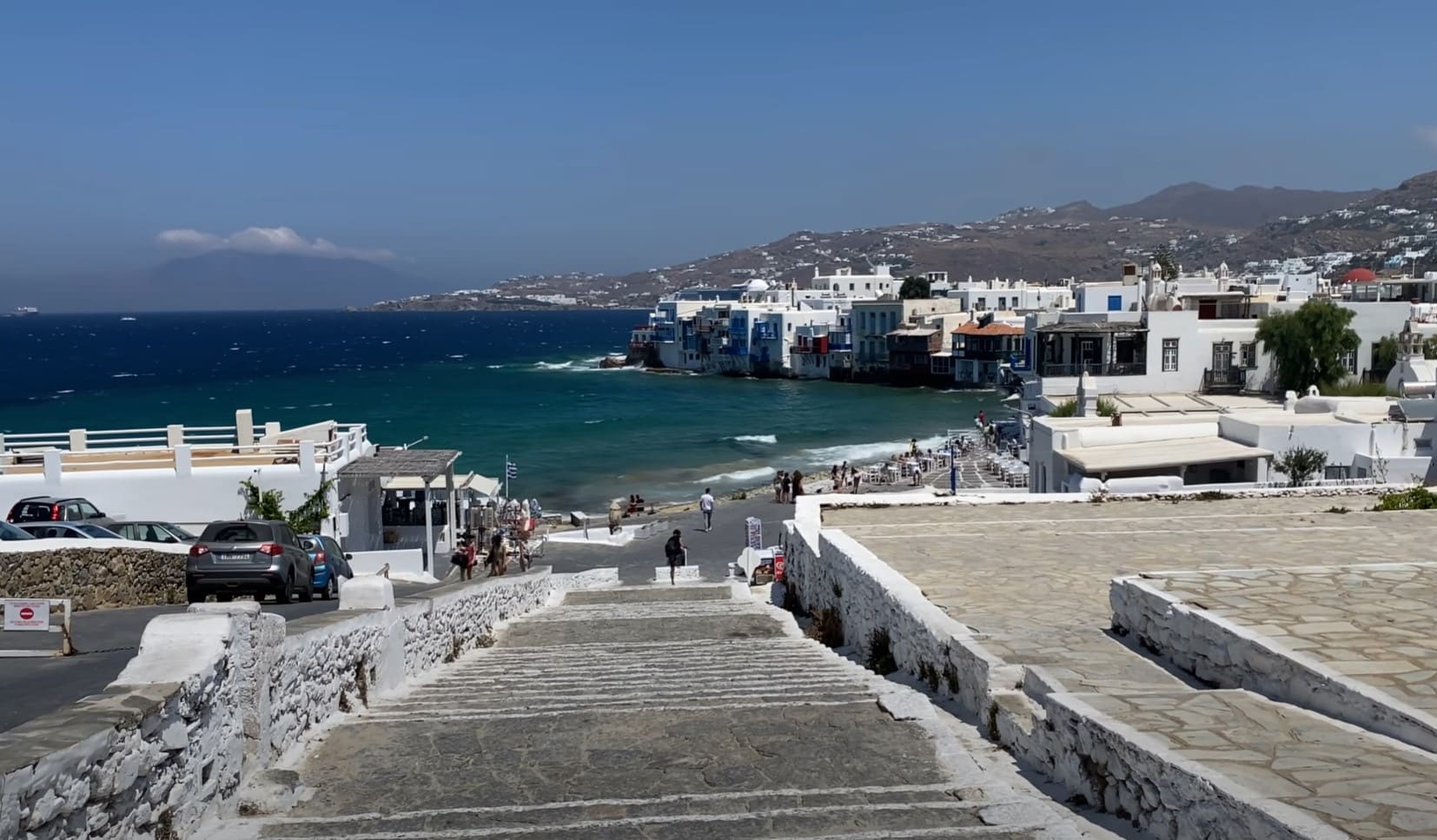
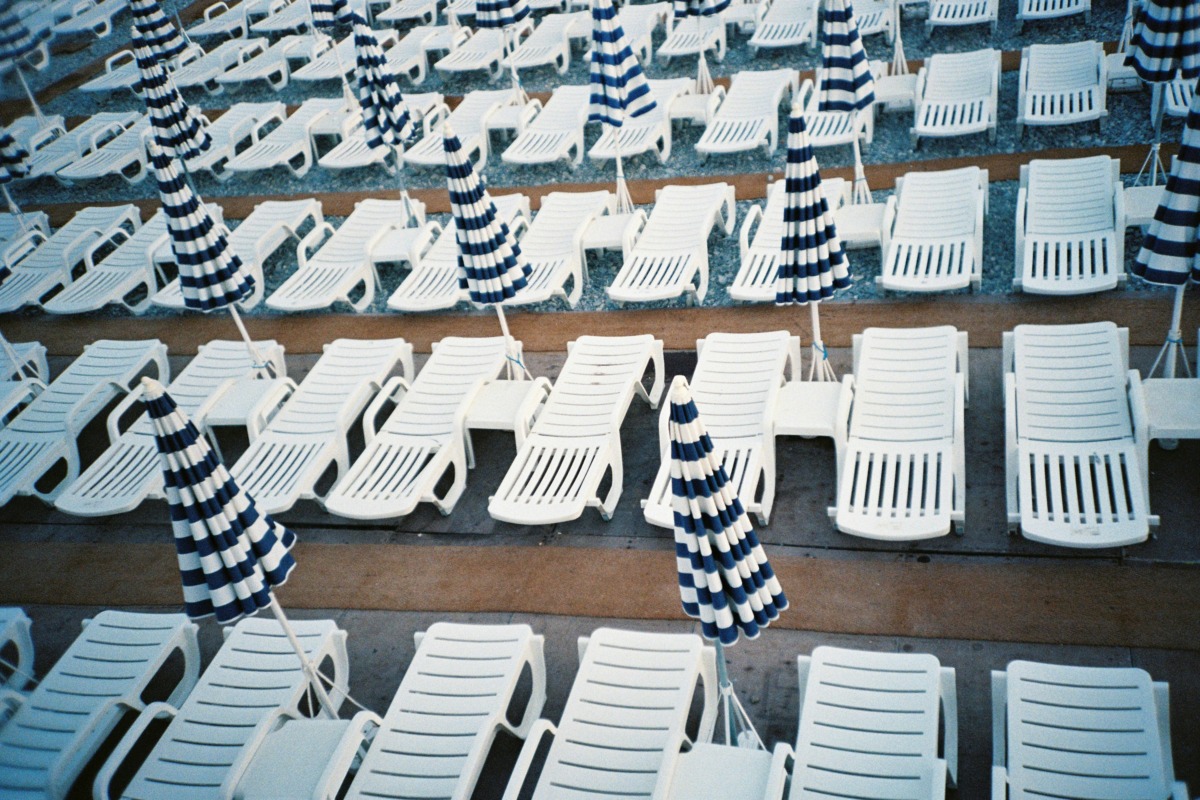
Summer is finally here! Sunshine, crystal-clear blue seas, refreshing cocktails on a lounge chair, sunscreen, and pink flamingos by the pools. Social media stories set against the backdrop of the endless blue are ready to capitalize on the ultimate—yet fleeting—promise of freedom. Lights, camera, clapperboard… and action! Put on your most affable, institutionally mandated smile, submit to an exhausting, standardized politeness, and feign bliss. The grand tourist spectacle begins, as the spectators-customers demand the realization of the myth they’ve purchased, seeking to consume a fabricated authenticity, a prefabricated escape from their own eleven-month wage slavery, buying a few days of artificial bliss at the heavy price of your own total subjugation.
But the tide of reality is violently receding from behind the ideological filters of the idyllic postcard, the leisure industry reveals its carefully concealed, grim secrets. For the season’s captive, the rosy chimera of vacation dissolves during the first endless shift, where the natural sun ceases to be a source of delight and becomes a relentless pursuer of biological exhaustion, and the sea becomes a distant, inaccessible backdrop, a frame within a frame, trapped outside the windows of the sweltering kitchens and underground laundries. This is not a temporary malfunction of the system, but the very spatiotemporal condensation of capitalist relations of production, a biopolitical condition in which human life is stripped bare, where the body, gestures, and expressions are transformed into exchange value through exhausting emotional labor, and time is colonized so deeply that the distinction between working life and leisure is de facto erased under the weight of the uninterrupted flow of capital.
This cannibalistic phase of the state-capitalist maelstrom is brought to a close by the violent emergence of hyper-tourism, which is no longer content merely to exploit human labor, but proceeds to a total, transformative colonization of the natural environment. In the name of «development,» ecosystems are reduced to a cheap, disposable backdrop for the eyes of consumer-spectators. In places with limited natural resources, aquifers are being drained—not to quench the thirst of local communities, but to supply the hundreds of thousands of resort swimming pools and golf courses, transforming water from a common good into a commodity in a state of artificial scarcity. Fragile habitats, coastlines, and mountain ranges are being leveled by the concrete of tourist infrastructure, suffering irreparable landscape alteration, as cruise ship pollutants, tons of plastic waste, and the destruction of biodiversity wash ashore as the indelible imprints of the leisure industry.
Alongside ecological plundering, overtourism is transforming our cities and villages into sterile theme parks, driving the residents themselves out of their own living spaces. Daily life is under all-out attack by the forces of gentrification and real estate speculation. The rise of short-term leases is turning the right to housing into an unattainable privilege. Workers, students, doctors, and teachers are being forcibly driven out of their neighborhoods, unable to compete with the inflationary rents imposed by the tourism monoculture. Public spaces, squares, and parks are losing their character as spaces for social gathering and free exchange, and are being transformed into exclusive zones of restaurant seating and commercial consumption. Local communities are stripped of their structures of solidarity, as every human relationship and every inch of land must yield a profit; otherwise, it is deemed «useless.».
And yet, the tragedy of housing exploitation is not limited to investment firms, real estate funds, or the insatiable mechanisms of the market. The deeper success of the state-capitalist system is revealed precisely where sovereignty ceases to appear as external coercion and is transformed into an internalized social logic. The spread of short-term leases is not merely an economic practice but constitutes the material expression of a society that has been trained to perceive the world exclusively through the lens ofcommodification.
In a reality of widespread precariousness, where wage labor fails to ensure a decent standard of living and the future appears as an impenetrable horizon of uncertainty, the home ceases to be a place of residence, memory, and social coexistence. It is transformed into an asset, a microcosm of capital, a profit-generating machine. People are driven to view their own space not as an extension of their lives but as an investment opportunity. Thus, heteronomy completes its cycle, and people themselves reproduce the very relationships that subjugate them, because they have been convinced that there is no other way to survive.
Tourism monoculture does not merely colonize landscapes, coastlines, and the bodies of workers. It colonizes the imagination itself. Housing ceases to be understood as a social good and is transformed into a stock market commodity. Neighborhoods cease to be communities and are turned into portfolios of investment opportunities. Residents no longer recognize one another as participants in a shared world and begin to view each other as competitors within the same market. Social relationships give way to transactions. Solidarity crumbles under the pressure of the demand for profit.
Under the regime of overtourism, entire cities are transformed into sites of accumulation. Every empty room is considered lost profit. Every home occupied by permanent residents is regarded as underutilized capital. Every neighborhood that still maintains social ties is treated as an area ripe for «upgrading» and commercial exploitation. Thus, life itself enters a process of ceaseless economic valuation, where every aspect of quality of life is crushed under the cannibalism of exchange value.
At the same time, tourism monoculture colonizes not only the natural environment and labor, but also the collective imagination of local communities. Cultural life is gradually severed from its organic roots and transformed into a commodity for consumption. Customs, festivals, music, social relations, and historical memory itself are repackaged as spectacles for the visitor’s gaze, stripped of their social content and adapted to the demands of the market. Communities are pressured to present an idealized version of themselves—a folkloric stage set designed to be consumed and photographed.
At the same time, tourism development ceases to be a mere economic strategy and emerges as a dominant imaginative force in modern Greek society. Entire generations are raised with the belief that their future lies solely in either providing services or managing the consumption of others. Social imagination itself is shrinking, unable to conceive of alternative forms of production, community organization, and collective well-being. Agriculture, small-scale manufacturing, research, creativity, and every possibility of social self-determination are dismissed as economically «unrealistic,» while dependence on the heavy industry of tourism is presented as a natural and indisputable necessity. In this way, heteronomy is not only imposed by institutions, markets, and state mechanisms, but is deeply embedded within social consciousness itself, consolidating its supremacy precisely at the moment when it ceases to be recognized as a historical choice and begins to be experienced as a natural law.
And the tide of critical analysis grows deeper, washing ashore the absolute dominance of heteronomy, where the blind laws of the market and the sacred dogma of economic growth are touted as invincible natural laws, convincing local communities and the working youth that there is no alternative beyond the «heavy industry» of Greek tourism. In this way, people internalize their exploitation, accepting 14-hour shifts, the lack of rest, living in sunless basements or shipping containers, and the loss of their own homes as a «natural necessity»—the inevitable price of survival— while the state apparatus, acting as a collective capitalist, stands guard over employer impunity through the deliberate inaction of regulatory mechanisms and the legal dismantling of every hard-won labor right. The geography of tourism highlights class division in its most raw, spatial dimension.The luxury leisure zones of the few directly entail the spatial ghettoization, captivity, physical exhaustion, and displacement of the many.
However, none of these forms of domination constitutes a natural law. The exploitation of labor, the commodification of housing, the plundering of the land, and the monoculture of tourism do not stem from some ahistorical necessity. They are historical institutions, products of a specific social imagination that elevates unceasing accumulation to the highest value. This is precisely why they can be challenged. Criticism is not limited to exposing the mechanisms of domination; but acquires political meaning only when it restores society’s forgotten capacity to self-constitute, to collectively assume responsibility for its own institutions, and to recognize that no market, state, or form of capital embodies an objective destiny. Where heteronomy imposes the tacit acceptance of the existing world as the only possible one, autonomy begins the moment people recognize that the world they have created can be recreated according to their own needs, their own desires, and their own collective decisions.
And because no «live your myth» lasts forever. When capital seeks to take over the air we breathe, the home we live in, and the landscape we behold, the political philosophy of autonomy does not promise new hierarchical hegemonies, but advocates the radical deconstruction of this state-capitalist narrative. It calls on us to transform the tourist season and tourist normality from a scene of subjugation into a site of conflict, where the needs, desires, and dreams of the invisible people of this world will return like a wave to sweep away the lifeless geography of profit.
The path toward autonomy is not a sterile theoretical construct, but a rhythmic, living movement, a wave-like flow that springs from the depths of radical negation, breaks the chains of theoretical abstraction, and transforms into breath, transforms into rhythm, transforms into a wave. Because our lives cannot be quantified. And so the wave swells. Autonomy begins. And the black calm shatters on the rocks of our own foaming tide.
Invisible Mind