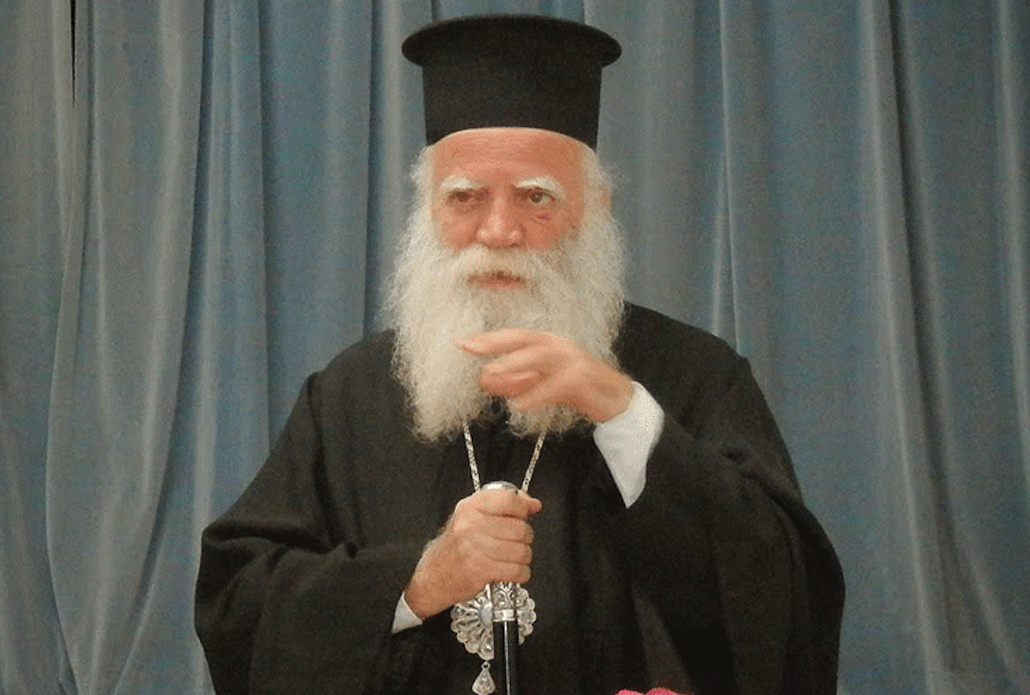
In a letter to the Holy Synod of Greece, Metropolitan Seraphim of Kythira sends his own message to the government regarding the pressing issue of worship within our places of worship amid the pandemic.
It refers to the problems faced by Christians regarding the Joint Ministerial Decision on temporary measures in places of worship and points out: «The exclusion of Orthodox Christians from Divine Worship and from the Cup of Life is the most painful thing of all.».
Furthermore, the Metropolitan of Kythira emphasizes in his letter that «The government’s team of infectious disease specialists, guided by rational criteria and skepticism, includes the Church in the general measures, without delving into the metaphysical and mystical nature of the Church.».
Finally, the Metropolitan of Kythira, referring to vaccination, emphasizes that «The Church must uphold the divine gift of personal freedom in Christ and respect for human free will.».
What does he say in his letter?
Your Beatitude, Holy President; Your Eminences, Holy Members of the Synod; Please bless us
I am writing to you in response to your Circular No. 664/299/February 11, 2021, through which Joint Ministerial Decision No. 9147/10.2.2021 was forwarded to us, ’on provisional measures in places of worship for the protection of public health against the COVID-19 coronavirus,’I would like to address the issues arising from this for the Christian community and ask you for the following:
1. In accordance with the provisions of the aforementioned Joint Ministerial Decision, the presence of worshippers inside places of worship will be permitted in accordance with the level of epidemiological burden in the municipality or regional unit where each place of worship is located: a) Surveillance Level b) Increased Risk Level c) Very High Risk Level, and d) Metropolitan Area Level.
In cases (a), (b), and (d)—levels or participation of the faithful—are defined as follows:
On the first level, one (1) light fixture per twenty-five (25) square meters of floor space, with a minimum distance of two (2) meters between them, and a maximum of fifty (50) worshippers present.
On the second and fourth levels, one (1) toilet is provided for every twenty-five (25) square meters of space, with a minimum distance of two (2) meters between them, and a maximum of nine (9) worshippers present. Meanwhile, on Level C, the celebration of the Divine Liturgy is to take place ’behind closed doors,’ without the presence of the faithful. Furthermore, ’within the framework of permitted reasons for travel« (Annex to the Joint Ministerial Decision, Government Gazette B» 534/10.2.2021, p. 5174), the attendance of the faithful for veneration and «private prayer» is permitted after the conclusion of the Divine Services.
2. In cases (a), b), and d)—the regulations stipulate the presence of only one (1) person within an area of twenty-five (25) square meters, maintaining a distance of two (2) meters from the nearest person, whereas the Joint Ministerial Decision of December, which ’exceptionally permitted the celebration of Divine Liturgies on December 25, 2020, January 1, 2021, and January 6, 2021,’ stipulated the presence of one (1) worshipper per fifteen (15) square meters, with a distance of two (2) meters from the next person. And the question arises: where else are these excessive square meter requirements (15 before and 25 now) being enforced? In supermarkets and other food stores, in pharmacies, in school classrooms, on airplanes, on the subway, on the electric railway, on city buses—where? Are our holy and consecrated churches considered so dangerous in terms of contamination and transmission of the virus? How should we treat these sacred and liturgical spaces, as well as the faithful?;
Furthermore, the stipulation of one (1) person per 25 square meters of floor space, with a distance of two (2) meters between each person, for parish churches, means, strictly speaking, in practice, the presence of only 3–5 people, while the maximum number of worshippers is (theoretically) set at fifty (50)—in other words, a ’gift that’s no gift at all.«.
3. In the third category—the very high-risk level—are classified all areas (cities, regions) that fall under the ’red« category, that is, this applies to the majority of the population of Greece (the Attica region, Thessaloniki, Achaea, and the prefectures of the Peloponnese, Euboea, the prefectures of Crete, etc.). Kythira and Antikythira are also included in this category, as they belong to the Attica Region. One case has emerged on Kythira, caused by a migrant returning from Albania, who transmitted the virus to those around him (about ten confirmed cases are currently in quarantine), while Antikythira remains uninfected so far.
The coronavirus has, therefore, spread to the majority of our country’s population, and for this reason, the celebration of the Sacred Services—and especially the Divine Liturgy— will take place «behind closed doors,» without the presence of the faithful. «The beginning of (new) sorrows.» The exclusion of Orthodox Christians from Divine Worship within the Churches and from the Cup of Life—the most sacred and life-giving Holy Mystery of the Divine Eucharist —Holy Communion—is the most painful thing of all. The gathering of the faithful for worship and «private prayer,’ after the conclusion of the Divine Services, is important, to be sure, but it is the least thing compared to the greater and supreme, which is communal Divine Worship and its culmination, the Divine Communion of the Holy Mysteries. Veneration and »private prayer« cannot replace or make up for communal Divine Worship and Holy Communion. For a month, the People of God were deprived of these Divine Gifts, and now this bitter cup of spiritual famine is being offered to them once again, the bitter experiences of the past Great Lent, Holy Week, and Holy Pascha—this most heavy cross borne by Christ’s flock. In a recent interview, the Governor of our country expressed the hope that by Easter we would be rid of the ’Pharaonic plague» of the coronavirus. Since last fall, however, there have been signs pointing to yet another Easter approaching without the participation of the faithful. This possibility is unthinkable and unforgivable—even as a mere thought. God forbid! A thousand times, God forbid!
The government’s team of expert advisors (infectious disease specialists), approaching the issue with rational criteria and skepticism: the Church and its congregation, include this as well among the general measures and, just as they decide on all other matters, they also make decisions regarding the Church without, as a rule, addressing its metaphysical and sacramental nature. However, since we find ourselves in a Greek Orthodox—by an overwhelming majority (and not a secular one)—the Land of Saints and Heroes—we must approach the spiritual magnitude which is called the Church and has been the mother and savior of our Orthodox Nation for more than twenty (20) centuries. And our devout Nation, inextricably linked with Orthodoxy, has achieved great things throughout the ages. Over the centuries, it has endured the most difficult circumstances (occupations—enslavement, invasions, wars, disasters, epidemics, severe weather events, etc.), yet ’from all these the Lord has delivered us.« Therefore, it is not correct to equate the Church—with its divine and lofty mission—with all the other institutions of this world.
4. The Church of Greece, Your Beatitude, Holy President, which, as is well known, has distinct roles in relation to our Greek State, and its relations with the State are those of cooperation; after approximately one year (since the outbreak of the coronavirus pandemic), standing in solidarity with the Orthodox flock in its deprivation of the most precious gift of its Christ-named People, despite its repeated interventions in support of the unimpeded conduct of worship, and having exercised its constitutional right, ensuring the right to freedom of conscience and freedom of religious worship (Article 13, paragraphs 1 and 2), in light of the fact that, despite Joint Ministerial Decision No. Δ1α/ΓΠ. οικ.80588/14.12.2020 (B’ 5509/15.12.2020) Joint Ministerial Decision No. Δ1α/ΓΠ. οικ.80588/14.12.2020 (B’ 5509/15.12.2020), which permitted, under strict health restrictions, the operation of places of worship (Orthodox Churches) with the presence of the faithful during the Holy Feasts of Christmas, St. Basil’s Day (New Year’s Day), and Theophany, through Joint Ministerial Decision No. Δ1α/ΓΠ.No. 2/2.1.2021, which abolished ’the exceptional and restricted possibility of collective worship (public worship) on the feast day of Theophany’ (January 6, 2021), which had been permitted by the aforementioned Joint Ministerial Decision, exercised the right to appeal to the Council of State against this latest Joint Ministerial Decision.
In an application for annulment dated January 5, 2021, the Church of Greece, as well as the Holy Archdiocese of Athens and the 81 Holy Metropolises of the Church of Greece, against the specific Joint Ministerial Decision and the previous Joint Ministerial Decisions, on the basis of which «during the year 2020, the Church of Greece and its Holy Metropolises complied, time and again, with the ban on public worship, that is, the ban on the participation of its members in collective worship during periods and on feasts of the Lord and the Mother of God of paramount importance to its liturgical calendar.».
As is its duty, our Church of Greece appealed to the Council of State, not to litigate against the Greek State, but to assert its constitutional rights, as stated above, and in accordance with the Divine and Sacred Canons of our Orthodox Catholic Church and with the Statute of our Church (Law 590/1977), both of which possess constitutional force and protection under the Constitution of the Hellenic Republic. This step was thus taken to eliminate this harmful precedent once and for all.
5. Concurrently with the Greek Orthodox Church’s appeal to the Council of State, a case was heard before the Supreme Court of the United States, the equivalent of our Council of State, following an appeal by the Roman Catholics of Brooklyn against the decision of the Governor of New York (November 25, 2020), who solemnly declared that: «even during a pandemic, the Constitution cannot be set aside and forgotten.» This means that he ruled the violation of the constitutionally guaranteed right to freedom of worship to be unconstitutional, specifically the restriction on its exercise (a limit of 10 or 25 worshippers in churches). Similarly, the French Council of State (Conseil d’État) considers the limit of 30 worshippers for participation in worship to be an unconstitutional restriction on the right to worship and has ordered the French government torevise the relevant decree, because the Court considers that, as a result, a large portion of the faithful would be deprived of their constitutionally recognized right to worship. In fact, the Conference of the Roman Catholic Bishops of France (CEF) has asked the government ’to revise the unrealistic and unenforceable ’thirty-believers« rule, which is completely out of touch with the reality of Catholic religious practice.».
We, the Orthodox clergy and laity, members of the One, Holy, Catholic, and Apostolic Church, do not have equal rights before the law, divine and human alike, nor does the Constitution of Greece equally safeguard the right to religious conscience and the free worship of God? (Art. 13, paras. 1 and 2). Why should we be subject to different or inferior treatment, especially since the aforementioned article of the Constitution is not suspended even in times of siege or war?;
6. “As for the vaccination of our country’s population, it is right and proper for our Holy Orthodox Catholic Church to uphold the divine gift of freedom in Christas well as respect for human free will. The relevant European Council and the National Public Health Organization (EODY) maintain that vaccination should be voluntary. Various opinions from medical experts are being voiced from all sides. The pros and cons of vaccination are being discussed online (side effects, paralysis of limbs in the vaccinated individual, sudden deaths following vaccination, as seen in the cases of 23 residents of a Norwegian nursing home), but many also express positive views after receiving the vaccine). «Time brings the truth to light,» as our ancient ancestors used to say, and
7. “Perhaps some of our fellow human beings may take offense at what we write, having been informed by the media of the daily reports from the front lines of the coronavirus crisis, and they may consider us to be out of touch with the times and out of touch with reality.”.
“However, Your Beatitude, our adherence to the tradition and practice of the Christ-named Flock, which has been upheld for twenty (20) centuries of tradition and practice of our Holy Orthodox Catholic Church is the God-pleasing and God-inspired solution to the problem, if we delve into historical parallels of similar or even more threatening epidemics and how they were addressed within the context of processions, etc.).
“When the Holy Temples are closed to the faithful and are not honored by the People of our Holy Church through the sacred means at its disposal (Divine Liturgy, Holy All-Night Vigil, and the liturgical and processional veneration of the Holy Protectors and Patron Saints of various places (e.g., Saint Demetrius in Thessaloniki, Saint Andrew in Patras, Saint Spyridon in Corfu) we are witnessing a sharp rise and spread of the pandemic—not because the Saints are taking vengeance or inflicting punishment, but because they are sending their messages to the Christ-loving people. Pray, Your Beatitude, Holy President, and Holy Synodal Fathers, that this terrible and global trial of the coronavirus may pass as soon as possible, and that the entire Christ-named Flock of Most Holy Church of Christ may learn from this terrible calamity and, in repentance, worship the Savior, our Redeemer and Benefactor, our Lord Jesus Christ, and that under no circumstances may the tragic events of Great Lent, Holy Week, and last year’s Holy Easter, when our Holy Churches were empty due to the absence of devout and Orthodox Christians.
And with this in mind, I remain,
The Least Among the Bishops
The Metropolitan
+ Seraphim of Kythira and Antikythira