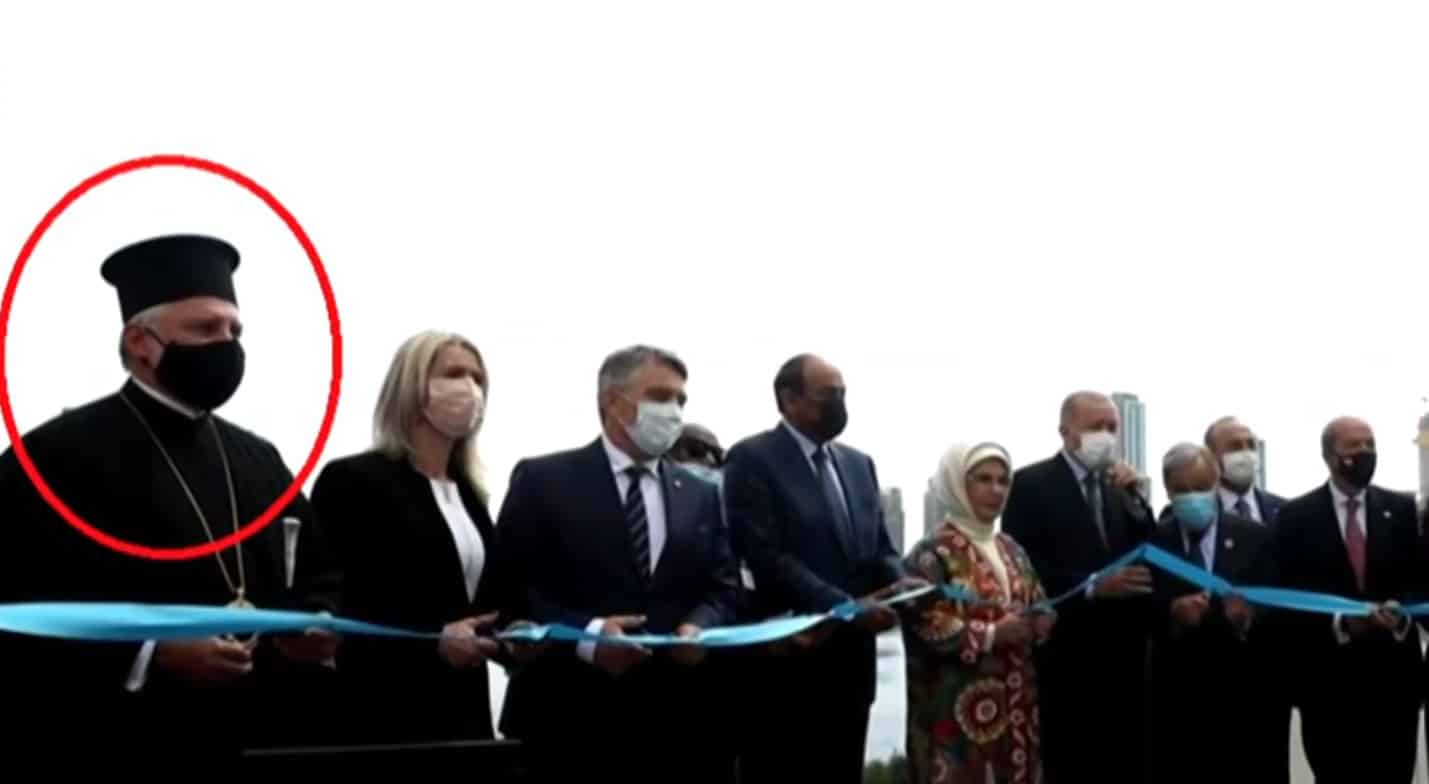
His presence Archbishop Elpidophorus of America at the inauguration of the “House of Turkey” in New York by the Turkish President and his inevitable meeting with the leader of the pseudo-state, Ersin Tatar, provoked strong reactions, not only to the expatriate community but also by the governments of Greece and Cyprus. These developments gave the Turkish side and in particular Mr Tatar the opportunity to accuse Greece and Cyprus of «politically motivated actions that show the level of fanaticism and intolerance of the Greek and the Greek Cypriot side».
The history pretty much known. After the inauguration of the “House of Turkey”, Cypriot President Nicos Anastasiades and the Greek Prime Minister, bewildered by this development, announced that they will not meet with Mr.Elpidophoros during their stay in New York, where they are in the framework of the UN General Assembly.
The Archbishop is in an awkward position and Archdiocesan circles are trying to downplay the issue at first, saying that the Archbishop was not aware of Tatar's presence. This explanation is not enough to relieve the uncomfortable atmosphere, nor are the clarifications from interlocutors of Mr. Elpidophoros explaining that the «Archbishop talks and will talk with Turkish officials». And they add that «it is in this context that the Archbishop's participation in the Turkish event is part of this.».
The Archbishop had to express his regret for the «pain he unwittingly caused to Cypriots and Greek-Americans».
This was enough for Prime Minister Mitsotakis to reconsider and announce through his spokesman that the meeting with Mr.Elpidophoros will take place after all.
However, the Archbishop's statement continues to provoke reactions, especially in the part that refers to the Cyprus problem.
«As a Greek from Istanbul, I and my family have experienced the terrible consequences of being uprooted from our ancestral homes, as have many of my compatriots, as well as the Imbrians and the Tenedians, because of another flare-up of the Cyprus issue in the 70s.»
Cypriots and Cypriots comment that it was not an «escalation of the Cyprus issue» but a Turkish invasion and occupation.
Mr. Elpidophoros, they continue, uses diplomatic language and does not mention the word Turkey anywhere, as the perpetrator of this disaster.
His supporters, on the other hand, say that this is reasonable considering that Archbishop Elpidophoros is a Turkish citizen. They also underline that the pressures on the Patriarchate are enormous, recalling that only a few years ago Erdogan threatened to expel the Ecumenical Patriarchate from Istanbul.
In any case, after the dimension that these developments have taken, Greece and Cyprus seem to have been damaged.
In contrast to the presence of Erdogan, who, although he did not manage to meet the American President as he had hoped, had a very successful presence in New York with the inauguration of the skyscraper right next to the UN and the favourable, if not flattering, comments of UN Secretary General Antonio Guterres on him.
At the same time the κ. Erdogan in his speech expressed his positions on the Cyprus problem insisting on the legitimacy of the pseudo-state and the two-state solution in Cyprus and expressed his discomfort that Tatar cannot speak at the UN headquarters, just as Mr Anastasiades will do, while stressing that in order to have a good neighbourhood in the eastern Mediterranean, «the a perception that ignores the fact that Turkey has the largest coastline in the eastern Mediterranean».
At the same time, Tatar, who seemed to be upgraded after the support of Erdogan and the incident with the Archbishop of America, but also after the announcement by Turkish Foreign Minister Mevlut Cavusoglu that the «House of Turkey» will include an office of the Pseudo-state delegation, noted in a statement that «at a time when efforts are being made to reach an agreement in Cyprus, it is clear that such attitudes, which will deepen the mistrust between the two peoples, will damage these efforts». Ersin Tatar concluded by saying that this kind of behaviour is reprehensible and expects the international community to draw the necessary conclusions.
It is a fact that the Turkey with regard to foreign policy shows a unbroken front with consensus at home, which is also reflected in international fora.
At the same time, Greece seems to suffer from the chronic malady of the partisanship of foreign policy, although it knows that everything these are recorded by both opponents and allies.
By Demosthenes Gaveas