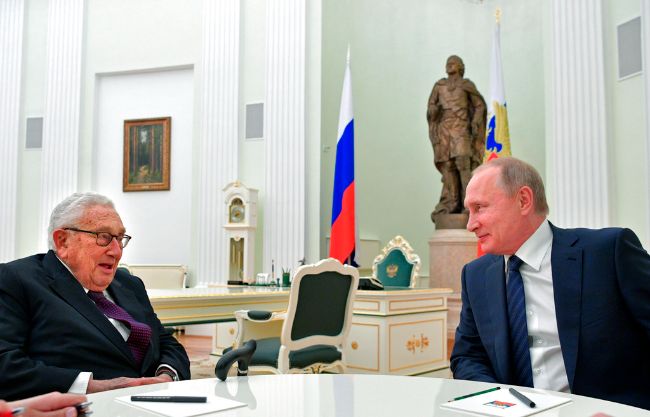
Henry Kissinger’s 2014 article in the *Washington Post* on the future —as it was then—of Ukraine is proving prophetic today, following the dramatic developments in the country and the Russian invasion.
As the leading American politician and diplomat noted at the time, the Ukrainian issue has always been a source of conflict and confrontation between East and West, regarding which side it would align with.
According to Kissinger, however, Ukraine should not align itself with either side if it wants to survive and thrive. Instead, it should serve as a bridge between them.
Kissinger: What Stance Should Russia and the West Have Taken?
The American diplomat’s position was that Russia, for its part, should refrain from attempting to force Ukraine into a satellite status and thereby redraw Russia’s borders. This is because, according to him, such an action would condemn Moscow to repeat the history of «vicious cycles» of mutual pressure with Europe and the United States.
Kissinger, however, does not fail to specify the stance the West should take in order to avoid creating problems. Specifically, he argued that the West should understand that Ukraine can never be merely a foreign country to Russia. He explains, in fact, that Ukraine was part of Russia for centuries and that their histories were intertwined long before that.
Kissinger wrote in 2014:
«Russia must accept that any attempt to force Ukraine into a satellite status, and thereby redraw Russia’s borders, would condemn Moscow to a repeat of its history of self-fulfilling cycles of mutual pressure with Europe and the United States. The West must understand that, for Russia, Ukraine can never be merely a foreign country. Russian history began in what was known as Kievan Rus». The Russian religion spread from there. Ukraine was part of Russia for centuries, and their histories were intertwined long before that. Some of the most important battles for Russian freedom, beginning with the Battle of Poltava in 1709, took place on Ukrainian soil. The Black Sea Fleet—Russia’s means of projecting power into the Mediterranean—is based under a long-term lease in Sevastopol, Crimea. Even famous dissidents such as Alexander Solzhenitsyn and Joseph Brodsky insisted that Ukraine was an integral part of Russian history and, indeed, Russia.”.
In this context, then, the American diplomat argued in 2014 that the European Union should acknowledge that its practices up to that point in negotiating its relationship with Ukraine had contributedto turning a negotiation into a crisis.
The Unique Case of Ukraine, According to Kissinger
«Foreign policy is the art of setting priorities. The Ukrainians are the decisive factor,» Henry Kissinger wrote specifically, adding:
«Treating Ukraine as part of a confrontation between the East-West confrontation would eliminate for decades any prospect of bringing Russia and the West—particularly Russia and Europe—into a cooperative international system.».
As the American diplomat and politician pointed out at the time, «Ukraine has been independent for only 23 years. Prior to that, it had been under some form of foreign rule since the 14th century. It is no surprise that its leaders have not mastered the art of compromise, much less historical perspective (…) A wise U.S. policy toward Ukraine would seek a way for the two parts of the country to cooperate with one another. We must strive for reconciliation, not the dominance of one faction.».
And while Kissinger may have suggested these steps as the right choices, he acknowledged, however, that neither Russia nor the West has acted in accordance with this principle.
«Everyone has made the situation worse. Russia would not be able to impose a military solution without isolating itself at a time when many of its borders are already precarious. For the West, the demonization of Vladimir Putin is not a policy; it is an excuse for its lack of one,» he noted.
He emphasized, in fact, that Putin must realize that, whatever his grievances may be, a policy of military coercion would trigger another Cold War.
«For their part, the United States must avoid treating Russia as a miscreant that will be patiently taught the rules of conduct established by Washington.».
Kissinger's ideas for an outcome consistent with the values and security interests of all sides
Ukraine should have the right to freely choose its economic and political alliances, including with Europe.
Ukraine should not join NATO.
Ukraine should be free to form any government that is in line with the expressed will of its people. Wise Ukrainian leaders would then choose a policy of reconciliation among the various regions of their country. On the international stage, they should adopt a stance similar to that of Finland. This nation leaves no doubt about its absolute independence and cooperates with the West in most areas, but carefully avoids institutional hostility toward Russia.
Russia’s annexation of Crimea is incompatible with the rules of the existing world order. However, it should be possible to place Crimea’s relationship with Ukraine on a less problematic footing. To this end, Russia will recognize Ukraine’s sovereignty over Crimea.
«These are principles, not formulas. The goal is not absolute satisfaction but balanced dissatisfaction. If a solution based on these or comparable factors is not reached, the shift toward confrontation will accelerate. And that will happen quite soon.».