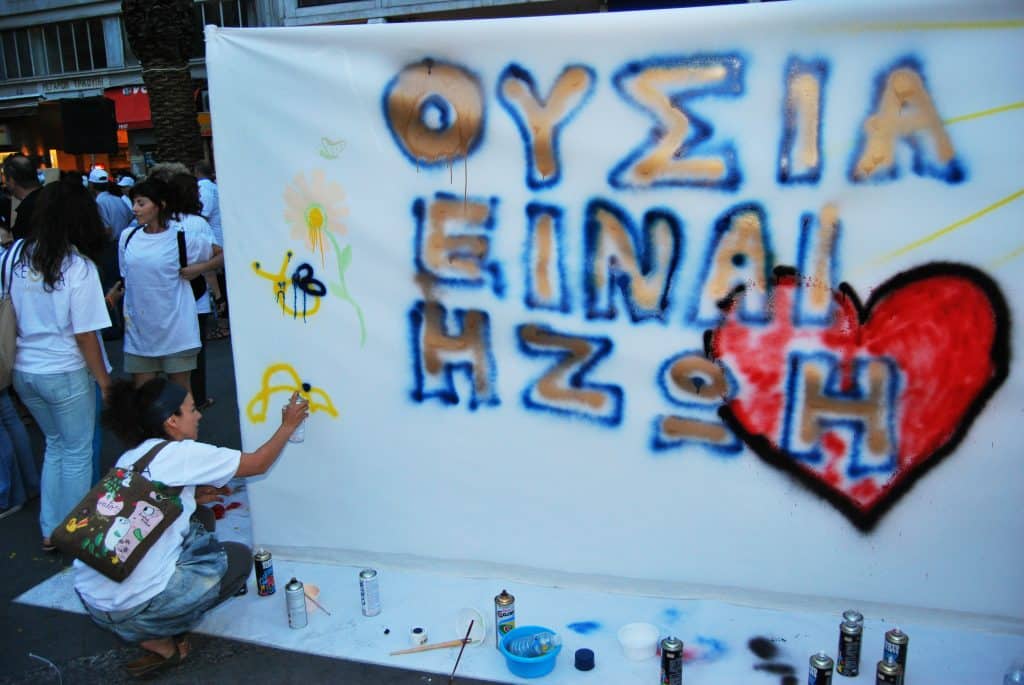
A hand. A hand that pulls you from the quicksand and pushes you to take your first steps while acting as a safety net. This is the KETHEA.
Talking to graduates and participants of the KETHEA programs, it becomes clear that the phrase «we are like a family here», which is commonplace for all of us, takes on flesh and blood in their souls and in their eyes. I don't know if one can call it luck considering the reasons that brought them together, but certainly the gleam in the eyes of those who talk about the great work of the therapeutic communities is something remarkable.
Addiction takes many forms and is a purely experiential process that can only be effectively addressed in the same way. Experientially. This is what the people at KETHEA have been doing for 38 years - have invested in experiential rehabilitation, in the dry programme and in the diversity of each programme, building distinct character, culture and history under the umbrella of the same philosophy.
But now it's time for the Mitsotakis government to shrink with the changes it imposes this philosophy of freedom which allows for diversity within therapeutic communities. In doing so, it neuters efforts to create active people who take responsibility and come of age emotionally through reintegration.
«These are not innocent changes»
«Right now, with the choices made, the KETHEA is changing the definition of the treatment community.
This is not innocent. The KETHEA grew by developing treatment units and as it grew the management structure changed. The administrative structure was not done and then the therapeutic units were hanging below it. The way of treatment has very much influenced the way the administration was organized. It started from the bottom.
The treatment and the mode of administration were directly related. This is being abolished,» Documento notes. Andreas Krommidas, in charge of the Social Reintegration Centre of KETHEA Nostos and adds: «Now all horizontal communication stops. No framework for cooperation is defined. The president will decide. That's not how it works. With limited people you can't inspire others to achieve their freedom. The staff of the CCF is a positive model, taking risks, testing, collaborating, supporting.
They don't care about efficiency. It's a given that the CDC will collapse under this mode of operation. They may possibly not care, there is a targeting. A shambolic organisation has no efficiency and no reason to be funded or may be getting financial injections in partnership with the private sector.».
«They showed me affection»
Ο Hercules is in social rehabilitation 27 months. «I've been using for 22 years, I've drunk all the drugs. I lost myself, my family was always under the stress that at some point I would die. I went to jail twice, I spent three years in the street in Omonia, I couldn't come back. My parents forced me into a psychiatric hospital. When I recovered a little bit, I went back to different programs.
Everyone treated me like I was a sick person whose need was to drink and they helped me in that part by giving me substitutes or some medicine and that was it. They considered me a burnt paper and I considered myself the same. When I came into the treatment community at the CDC, I was 48 pounds. What touched me right away is that I went in and people showed me interest and affection. They wanted to help me eat, to calm my nerves with a cup of tea or milk in the evening, they looked after me.
My family couldn't do all that either because they didn't know how to deal with me. In the therapeutic community I learned what boundaries are. I learned to say what was making it hard for me. One thing that I really liked and kept me was that both in the community and now in the hospice I am active. I was involved in things, I felt alive again, that I was back on my feet again. I felt that I was contributing and that I wasn't a burnt paper anymore.».
«It saddens me that such a worthwhile programme is going to be lost. For me, the KETHEA is a family. Here I was born again. For someone who does not know the KETHEA and asks me what it is, I will say that it is a living organization and a family that accepts people who seek treatment directly and through a process delivers citizens who are decent and active in society. It's a shame to be lost,» Hercules notes and wonders, «With this whole situation, a question arises in my mind: do some people not want me back active and thinking?».
«I saw a selflessness»
Ο Panagiotis started taking drugs when he was 13. For eight years he was a user in secret from his parents in a family of five children, three of whom were using. The delinquency was growing, resulting in courts piling up.
«After eight years of use, at 21, I approached the programme. I hadn't quit a day, I always wanted my head to be full of either heroin or cocaine. After a robbery, a police officer referred me to the CDC. We had a meeting, I told them my problems and that I wanted to quit drugs and within half an hour I got a lot of caring, a lot of information, something I never had before. I saw other people who were in the community.
I went as a user to ask for help and I saw others like me, who used to do drugs, bringing me water, asking me if I wanted anything. I saw a selflessness in that offer, something I didn't have in my daily life. I envied them and was very proud of them. Then I started thinking that I could do it too. When I joined the program I felt for the first time that I belonged to a circle. That I was entering a house where I was washing my clothes for the first time, taking a bath every day for the first time, I started talking to other people, expressing my thoughts.
The programme also supported my family. They joined a team too. I finished the program and for seven years I was clean. Seven years later my father died, I relapsed but I didn't let it roll over because this time I had an update and I picked it up in ten days and knocked on the door of the CDC and it was like nothing had changed. I got exactly the same care and I saw it more maturely.».
In the program you are reborn. When I was 21, I said “good morning”, I said “do you need help”. I'm coming up on three years in the program, I feel like I've accomplished a lot of things that seemed like a mountain, to quit drugs, to finish school, to go out and flirt, to be able to be honest with people.».
On the changes it notes: «I am very upset that they are going to change the program and the philosophy of the KETHEA. It scares me because I don't know if I will be able to have the services as I have them now. I want all of this to be found by a child who knocks on the door now or next year because I know it helps.
I have experienced a feeling that everyone deserves to feel. Along the way I have watched the evolution of others. I also watched the kids completing. When I saw a podium of 300 people a year graduate it was a great thing. I admired them, I was like, “I'm going to make it too.” KETHEA saved me from death and prison.».
No Graduation Joy
Since the new administration took over, no graduation ceremony has taken place, so that the graduates themselves have not had the opportunity to feel the joy they have been looking forward to for so long.
In the therapeutic communities of the KETHEA, people in treatment are reborn and learn from the beginning that they can play an active role in society. They learn to be independent, to take care of themselves and others, to be responsible, honest, to take responsibility. The community works in a hierarchical way, with all members constantly evolving, taking on more and more responsibilities day by day.
Ο Manthus a graduate of the KETHEA, came to the program after a relapse and having previously been through 18 Ano. As he says, the gift that KETHEA has given him is that he has been able to put into practice what he had theoretically had in his head: «Going through time there are the greatnesses that we say. In essence, what happens? They teach you to function without using in a society, but at the same time the therapists help you to solve the problems that led you to use.
In essence, a person is not born and one day says “I'm going to do dope” just like that. There are many reasons: social, socio-political, family reasons, there are many reasons that lead you there. The most vulnerable kids, who can't handle either their own situations or what is happening in society today, find an “outlet” in using. For me, KETHEA really helped me to be able to move from the theoretical part to the practical part.
So that's where I really got in touch with the responsibilities towards my life, towards other people's lives. Because you had responsibility for other people's lives as well. Taking them to the hospital, seeing what problems they were facing, helping them within a treatment team, taking a stand, speaking up. It made you functional and not passive towards things.».
«Commercialization of pain»
Manthos explains the success of KETHEA: «For some others who had never been through a program before, the first thing you learn is to be clean. When we say clean, we mean rehabilitation. And when we say rehab we mean not depending on anything.
In fact, there are many addictions, not just dope. In the KETHEA you enter from day one and in practice. You come face to face with your responsibilities, you don't just do therapy, you do action.».
As for the changes, he has to say: «I'm upset with what's going on now. They're basically going to do away with the whole thing. This was evident from the moment they abolished self-government. We, the members, the people in treatment, elected the administration of the KETH. There were elections. And they were all unpaid. Now they're all paid by the government, paid and unpaid. irrelevant to the point, irrelevant to what they want to do. They're not ignorant. They know exactly what they're doing.
They have sold out the entire state in the name of pathogenicity and now they are selling out the right of the common man to rehabilitation.. Because what they want to do in the end is to privatise that part of it as well. In the future, only those with money will get well. Commercialization of human suffering. They want addicted people. The system wants you dependent on something so that it can function.».
«They will find us across»
With Panagiotis K. and Kostas T., graduates of the KETHEA, we met at the Altar of Freedom in the park of Kaisariani and, as they said, the meeting point was not accidental, referring to the deprivation of freedom of the organization. «They will find us against them. We are family. The community is our home, not everyone can come to my home where I have grown up and say “I will do what I want”. No, you won't. We're going to be the spike in the chair you sit in every day. For many of us, this house is more beloved than the house we were born in,» they both said.
Kostas T. turned to the KETHEA for the first time in 2011, successfully completed the program and some years later he relapsed. «In those two and a half years, I saw everything that my treatment friends and therapists in the community were telling me, that the relapse would be worse than all the years of drinking before. Indeed, those two and a half years were worse than the twenty years I drank before. The second time I entered the community on withdrawal. I told them that if I didn't get into the community immediately, I would either die or go to jail.
The community has a very specific character. You go in as a young child, you erase everything and go on and build yourself up as an adult emotionally, take responsibility for your actions, which is the main thing. Every community has character. That's what they're trying to do away with, they want to make a community that's called a residential hostel. What is a hostel? The one we see in Vathi Square? That's a hostel. Users go in, sleep, take a bath, eat, take methadone and leave. If this is the vision for the next day of the KETH, we will be against it with all our might.
I've been abroad three times, I've been to Mount Athos seven times, I've tried every way a user can think of to cut: on islands, in mountains, everywhere. The thing is, there wasn't a single person there to teach me what I am. How can I manage the situation, how can I not be ashamed to raise my hand and ask for help?» She notes.
«We look at the forest»
A big role in the success of the programmes is played by the fact that among the scientifically trained staff are former therapists who, having studied, combine experience with knowledge, inspiring others.
«The one therapist position at the KETH is a former user. The former user has the experience. When you train him, he has the training. They all study with scholarships from the KETHEA. When you manage to combine experience and knowledge, it's a very powerful thing. When you try to cut that, you've cut the root. You've started with failure.
What they taught me in the community is not to look at the tree but at the forest. I can't cut down the tree next door and not worry about it. These people don't want these people, it is not in the interest of any government for each of us to start not looking at our own tree and start looking at all the trees,» concludes Kostas T.
«It's terrible interests»
Panagiotis K. says that he benefited from the KETHEA both as a patient and as a parent of a patient and explained how important the work done in both cases is.
«I started trying to get clean in 1996, 25 years ago. I have made a total of nine attempts and I have now succeeded. Apart from that, I had experience as a parent. I have a child who in his teens also had a substance issue and it's very different to the way I dealt with being on dope for 30 years and different to a child who was six months old and had had ten cigarettes. I sought help from the KETHEA again. They referred me to Cruise, which is for teenagers who are at the beginning of using. And now my child is fine. Beyond the user, we need to put a lot of emphasis on supporting families.
I've tried a million times to get out of it. The only one who was able to help me was the CDC. There's no basis for what's going on.
Last year on the 26th of June we visited Maximou and we had a meeting with the Prime Minister who said that he would support the KETHEA and ten months have passed and we are ahead of what they are doing now. It is very dirty what is going on. They are aiming for eradication. It's a lot of money. It's all the black money from drugs. It's a terrible vested interest,’ he stresses.
By Danae Kiskira - Bartsoka