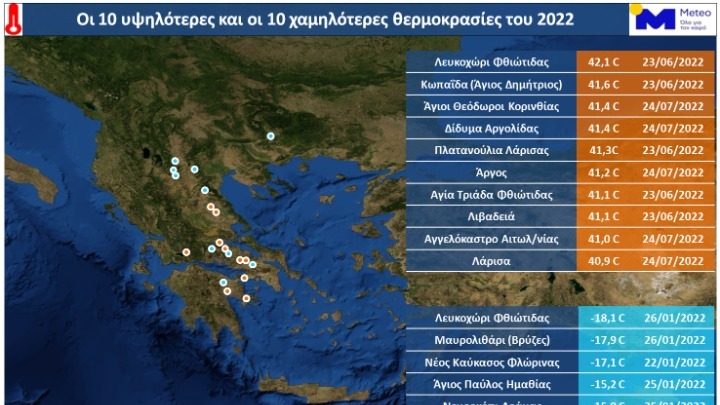
The warm invasion that started about a month ago will be prolonged and the summer weather - with temperatures averaging 3 to 4 degrees above normal for the season - will continue until the end of next week, while Epiphany Day is forecast to be sunny and relatively warm.
«It seems that with small breaks of mild bad weather next week - the first 3 or 4 days of next week - and no significant phenomena associated with a large drop in temperature or snowfall, this summer will continue until the end of next week. We cannot forecast with certainty for more than two weeks. On Theophania we will have very good weather, with sunshine - except for the morning fogs - and relatively high temperatures for the season,» Professor of Meteorology and Climatology and Vice Dean of Economics of the Aristotle University of Thessaloniki, Charalambos Fidas, told the APPE-MPA.
He explained that this weather phenomenon is «observed throughout southern Europe and the Mediterranean and not only in our country and its characteristic is the long duration, which exceeds 30 days and this classifies it in a category of climate instability and not just a simple weather instability, a hot invasion of a few days.».
Regarding the interpretation of the phenomenon, Mr.Fidas explained that «it seems to be due - in meteorological terms - to the shift of the polar airmass to the north» and added: «The polar vortex determines the course of the weather systems over our country and its northward shift implies the absence of bad weather systems over our region.».
Regarding the possibility of extending the summer after the next two weeks, the professor replied that «we do not believe that we will spend the next winter months without having the feeling of winter and when the climate instability comes to a decline we expect cold invasions and snow in the region, otherwise it will be a unique phenomenon if it continues throughout the winter».
«The relationship between the warm invasion and polar temperatures in the USA»
The phenomenon of high temperatures in southern Europe seems to be related to the polar temperatures recorded at the same time in the USA. «If we combine the two weather extremes, the prolonged high temperatures in Europe and the unprecedented low temperatures in the US, the two phenomena are related,» Fidas pointed out, explaining that they «act like a form of wave action», as «the very strong cold invasion pushes warmer air masses from Africa towards Europe».
Asked whether the phenomena are a consequence of climate change, he replied that «the combination of the two phenomena is indicative of the climate instability that we have been experiencing for several years and which is increasing year by year», but «the basic criterion for linking extreme phenomena of this kind with climate change is the increase in their frequency of occurrence», so «the more we observe such phenomena, the more they are related to climate change».
«Concern about drought. Only 1% snow cover in the territory, against 10% expected this time of year»
Regarding the impact of the phenomenon, he noted that «on the one hand there is the positive aspect of reduced energy demand, but on the other hand, it sets the stage for drought in the coming year, as the largest water reserves come from snowfall».
«During spring, when the snow cover disappears due to high temperatures, the water reserve is enhanced. If snow is missing, we will have a deficit in the water balance,» he noted and concluded: «Such a long period of warm invasion, lasting more than 30 days, has not been observed in the last decades. For over 4-5 weeks now, the temperature has averaged 3 to 4 degrees above normal for the season and without snowfall. The snow cover in the territory is not even 1%, whereas at this time of year it would be over 10%.».
Smaro Avramidou