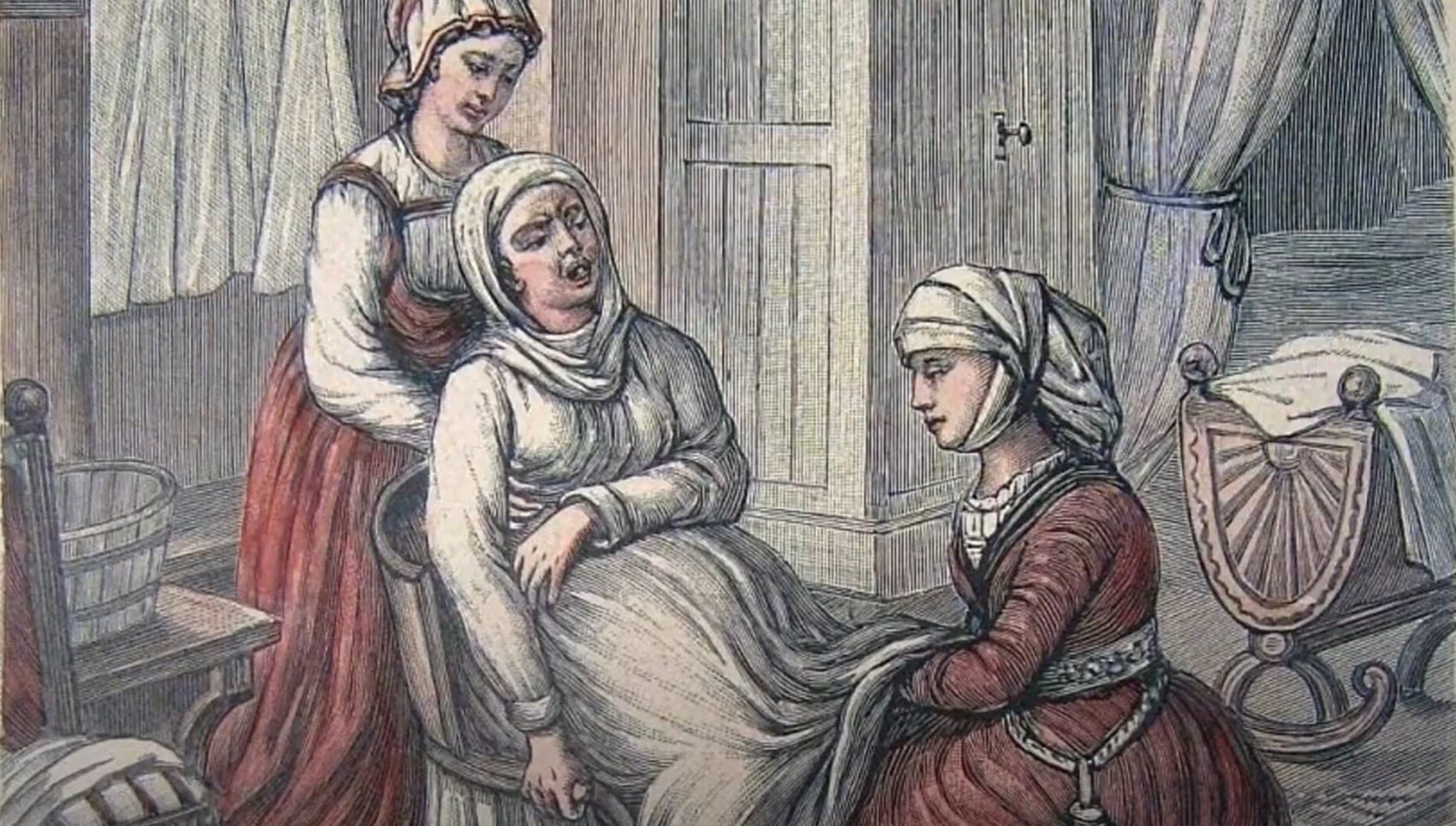
Since classical antiquity, the line distinguishing contraception from the termination of pregnancy—that is, abortion—has remained a fine one. Juvenal, for example, notes that women poison their bodies to avoid conception or to terminate a pregnancy (Satires 6. 595–7). Contraception and abortion are categories that are often confused. The physician Soranus distinguished between contraceptive drugs (ἀτόκιον) and abortifacient drugs (φθόριον). Until the early Christian era, contraceptives and abortifacients were similar, resulting in them often being confused, and the Church would condemn them under the concept of sin, which had recently been introduced by Christianity. It is therefore interesting to examine which methods were used in antiquity, how these methods persisted in the Middle Ages in both the East and the West, and how the respective societies managed the biomedical landscape.
The method with a long history
Contraception as a method of fertility control has evolved alongside human history, although references to it in written sources are scarce. The history of contraception is a synthesis of the history of women, the history of medicine, and the history of the family. Since these components are generally considered fundamental, they typically present a history of contraception filtered through the lens of family history. Historically, changes in family structures and gender relations have been causally linked to shifts in ideas about fertility.
A recipe for the first contraceptive product, a vaginal sponge, dates back to Egypt around 1550–1500 B.C. and is recorded in the Ebers Papyrus, which provides a summary of Egyptian medical practices. There is evidence, albeit fragmentary, that the Sumerians and Egyptians possessed similar knowledge. Contraceptive methods are divided into two categories: first, based on the user’s gender, and second, based on the type of method. Based on gender, they are divided into male and female methods—those used by men and those used by women—for example, the male condom and the birth control pill, respectively. Based on their type, they are classified as «natural» and «artificial» methods; for example, coitus interruptus and the diaphragm.
Fertility control has always been a topic of interest, and it continues to be so today. The question is how people manage their fertility and what the corresponding discourse is. Research suggests that the withdrawal method is the oldest form of contraception. The first mention of it is found in Old Testament in the famous—yet often misinterpreted—story of Onan in the Book of Genesis. Most historians agree that the deliberate use of «masturbation» can be traced back to the 18th centuryο century, when reproduction and sexual pleasure became separated, as new family structures emerged at that time. And as far back as antiquity, people were aware of the effectiveness of coitus interruptus, the practice with the hidden history, as evidenced in the work About ἀforῶν from the Hippocratic Collection.
The Ancient Method: Natural and Artificial Practices
Indeed, there is not much information available about ancient methods. We conclude that coitus interruptus, long-term contraception, abstinence, and abortion These are contraceptive methods used in ancient times as the surviving accounts attest. Although coitus interruptus is the most enduring method of contraception, references to the practice itself are rare. The earliest Greek record of it is found in lyric poetry, in the closing lines of a fragment by Archilochus from the Archaic period. Apart from poetry, some allusive references to contraceptive practices can be found in all forms of art.
In depictions of heterosexual love—in classical vase paintings, for example—unnatural intercourse and oral sex predominate. These practices undoubtedly serve as a barrier to conception, but there is no record anywhere indicating whether they were practiced consciously at that time. Withdrawal is the primary method of male contraception in Rome, as one can see by reading the De Rerum Natura by Lucretius. If this refers to the self-evident means of controlling reproduction in both ancient and modern times, this may explain its unspoken and tacit acceptance. It is also possible that this omission conceals a male ambivalence toward this method, since its use is considered to deprive men of a significant part of their sexual pleasure.
Most information on artificial contraception, particularly herbal remedies, comes from 2ο 1st century A.D. from the work of Soranus (About) Women's (pathῶ(n). Soranos, despite his extensive list of female contraceptives, makes no mention of male contraceptives. On the contrary, the cedar (cedar oil) is listed as a contraceptive substance that should be applied to the penis before intercourse in the Natural History by Pliny the Elder—and this is the only reference to herbal male contraception in the ancient world. If we assume that “withdrawal” and “unnatural intercourse” correspond to artificial male methods of contraception, then the pessaria (pessos: vaginal suppository) and filters (filter: drinkable plant-based solution) define the female reproductive system. Herbal solutions for drinking, known in Latin as venum (poison), were considered effective. Most of these aimed to close the cervix or induce uterine contractions. Soranus considers oral contraceptives to be better than suppositories. Roman and Greek women in general tended to prefer oral and artificial methods over natural methods of contraception.
Dioskurides in On Materia Medica and Soranos at the Women's They provide information on corresponding recipes, while the Hippocratic Corpus discusses infertility but remains silent on contraception. Soranus states that fennel prevents conception but also terminates an existing pregnancy (Women's I.63), Dioscorides mentions it as a contraceptive and an abortifacient (On Materia Medica 3.48.80), while Pliny the Elder notes it as a regulator of the period (Natural History 22.48.100). The wild carrot, a powerful contraceptive taken after intercourse, is classified by Dioscorides and Pliny the Elder as an abortifacient. Similarly, they mention the fliskouni as an abortifacient (Aristophanes, Lysistrata [87-9] and Peace), the aphegeon, the cypress, and the artemisia. In contrast, aloe and dictamum are cited as abortifacients and contraceptives, while myrrh and wild cucumber (both abortifacient and emmenagogue) remained in continuous use from antiquity through the Middle Ages. Willow tea is considered a contraceptive in Greece and Rome (Homer, Pliny the Elder), while cold or seawater and lemon juice are considered spermicides. The pomegranate, too, in depictions of the female figures of Demeter and/or Persephone, is portrayed as the means of controlling fertility and infertility (Athens, National Archaeological Museum: no. 484).
The Cultural Context in Antiquity
Women remain closely connected to the inner, hidden, and mystical elements, which are none other than the home and religion. At the same time, men represent the external, the open, and the political aspects of a patriarchal society. Childbirth, as the emblem of womanhood, symbolically embodies this distinction. If gender socialization truly constitutes the most powerful process of socialization, then everyday life, together with gender, creates a network of relationships and associations within the social fabric with a common denominator: femininity and masculinity, corresponding to female and male identity, respectively. In the spheres of everyday social interaction, women and men cement their identities through their cultural connotations.
In classical times, children were seen as the embodiment of civic duty toward the homeland and the preservation of their father’s memory and posthumous reputation. Men and women, Greeks and Romans, married for the purpose of having children. According to ancient reasoning, anything that hinders procreation falls within the sphere of action of illegitimate spouses. It is speculated that married women learned about contraceptive methods from prostitutes. Furthermore, in Roman society, the question at hand was not whether or not to conceive, but whether to prevent or encourage conception, abortion, and infant survival. When a couple wanted to limit fertility, they turned to either magic or medicine—fields of knowledge that still overlapped. Galen combined medicine with magic in matters of pharmacology (for example, in amulets), whereas Dioscorides did not combine medicine with magic, but did mention it in his work On Materia Medica, while Soranos considered amulets to be deceptive.
Where Biology and Medicine Meet: Anatomy and Reproduction
In biology, women were defined as early as the time of ancient anatomy in comparison to men. According to the model of a single biological sex, female anatomy was viewed as the inverse of male anatomy: female and male reproductive organs are similar, except that in women they are located inside the body, while in men they are outside and therefore visible, as Bishop Nemesios of Nyssa noted in the 6thο in the 1st century A.D., among the most distinguished physicians and anatomists.
In the ancient, absolute correspondence between male and female genitalia, the female vagina corresponded to an internal—and therefore hidden—female penis, the labia to the foreskin, the uterus to the scrotum, and the ovaries to the testicles. Ancient physicians were unaware of the existence of the ovaries because ancient biology viewed the testicles as a counterpart to the erect penis. This misinterpretation was not due to limited knowledge of human physiology, but to the cultural perceptions of the time. Aristotle, for example, viewed women as incomplete men; indeed, for him, women were the product of weak semen, while men were the result of strong semen (On Genesis On Animals, 608 a-b). The Aristotelian conception of reproduction places women in a lower social status. Consequently, in the classical era, women’s biological nature was inextricably linked to their overall social position.
This is, broadly speaking, the model of a single biological sex, or otherwise the theory of structural isomorphism, whose leading proponents were Hippocrates, Aristotle, and Galen. At first glance, the clearly patriarchal positions of biology are not merely an interpretation of the biological body, but will essentially shape social perceptions of the social body and, consequently, of gender until the mid-17thno century. The shift from isomorphism to dimorphism will take place in the mid-18th centuryno and will be finalized in early 19no century. This, in a nutshell, is Thomas Laqueur’s theory of a single biological sex, which became dimorphic in the 17thο – 18ο century, and despite its broader scientific acceptance, it has at times been criticized for the sources on which it is based—sources that belong to an elite scientific discourse. The criticism centers on the chronological framing, the emphasis on change, and the relationship between this elite anatomical discourse and popular experience.[ii]
In addition to the biological Aristotelian perspective, there is also the medical perspective, whose most prominent representative is the Hippocratic school. According to the thinking of the Archaic and Early Classical periods, medicine was regarded as an art and was not distinguished from the other natural sciences and philosophy. At the same time, it maintained unbreakable ties with religious and magical beliefs. However, from the second half of the 5thno From the 5th century B.C. onward, Hippocrates would be the one to separate medicine from religion and magic, thereby establishing medicine (as an art) as a science.
According to the Hippocratic school, the four bodily humors—blood, milk, fat, and semen—are transformed, thereby bringing balance to the body. In the Hippocratic corpus, women’s participation in reproduction is presented in its most favorable light, as women are recognized as having the ability to produce semen. Female pleasure is essential for conception, as is active female participation in sexual intercourse. In contrast to Aristotle, the Koan school embraces gender equality in the reproductive process. Nevertheless, eight of the books in the Hippocratic Collection are devoted to women’s diseases and none to men’s illnesses. This fact indicates the distinct nature of women’s treatment as a deviation from the male norm. Female physiology, as in Aristotle, incorporates ethical and social dimensions.
Roman physicians would draw upon Greek medicine to understand reproduction. Galen’s theories constitute a synthesis of Aristotelian and Hippocratic concepts. Galen agrees with Aristotle regarding the deficiency of female heat, but acknowledges the usefulness of the ovaries. He does not accept the theory of the wandering womb and considers sexual intercourse essential for women’s health. Soranus of Ephesus, perhaps the most important author on gynecology in Rome, similarly challenges the theory of the wandering womb, denies that women produce semen, and strongly opposed the Aristotelian view of structural isomorphism and the Hippocratic theory of humors. Both Galen and Soranus, however, believed that female pleasure is a sine qua non condition for conception. The Romans, following the Hippocratic tradition, held that both sexes play an active role in fertilization.
Roman medical literature views sexuality with apprehension and, in particular, regards reproduction as a problem. Doctors during the Roman Empire considered sex to be a remedy for melancholy. In the ancient world, the view was widespread that conception occurs shortly before and immediately after menstruation—a view that, like many others, persisted into the early Christian era. In fact, Soranos—centuries before the official emergence of feminism—understood the social pressures women faced to marry and have children; he observed that menstruation and pregnancy were used in men’s propaganda. According to Hippocratic physicians, menstruation is caused by the dilation of the veins in the genital organs during puberty. According to the Aristotelian view, menstrual blood is the raw material that, together with semen, forms the embryo. In other words, blood shapes and forms new life.[iii] However, the woman’s participation is passive, since it is the man who provides the life-giving force and the beginning of life: creation takes place when the sperm meets the menstrual blood and gives form to the unformed material (On the Generation of Animals 716a, 727a–729b, 765b). The view that a child comes from both its father and mother is a commonplace, thus acknowledging women’s participation in the process of reproduction (Aristotle, Hippocratic Collection, Parmenides, Empedocles).
In many cultural codes, a woman is considered impure during her menstrual period. Blood is considered unclean, and therefore so is a woman’s menstrual period. Thus, a natural function of the female body is elevated to a source of contamination and constitutes a taboo. However, this assumption does not hold true in the case of ancient Greece. Menstruation was perceived as purification and that is why they portrayed it in a positive light as a ’necessary correction to the inherent flaws.«. In fact, a woman’s postpartum discharge is likened to the blood of sacrificial animals: «It is not fitting that blood should come from priests» (Hippocratic Collection, On Women, a 72).
Whether the general population actually shared these views remains unproven. It also remains unclear to what extent women sought to avoid pregnancy and how they achieved this. It is most likely that contraception took place without the men’s knowledge. Most historical and literary references from early and late antiquity pertain to methods used by women and thus categorize contraception as exclusively «female.».
The Practices of Modernism: The Discourse of Theology and Medicine
In the pre-modern period, the existing discourses on sexuality were the theological discourse and the medical discourse. Theology frames sex as a moral issue, while medical treatises, mostly written in Latin, contained knowledge inaccessible to the general public and accessible only to the aristocratic elite—specifically, the male aristocracy. Doctors associate sexuality with health: sex is considered a factor in vigor, physical strength, and health.
Until the 1600s, ancient conceptions persisted unchanged (the Hippocratic School, Aristotle, Galen). The female body continued to be ranked as the opposite of the male body—and therefore inferior—pushing the boundaries of the male and female sexes to their extremes. And just as the male and female bodies are perceived as opposites and unequal, so too are men and women, viewed through the biomedical lens, socially constructed in an asymmetrical manner. For most of the seventeenth century, being a man or a woman did not mean that you biologically corresponded to one of the two sexes, but rather that you occupied a position in the social hierarchy and assumed a social—and therefore cultural—role. Biological sex therefore remained a sociological category of analysis for scientific theory.
Gender is what defined sex differences, that is, before the 18th centuryο For centuries, social gender has shaped biological gender as well. Men have constructed a system based on male supremacy, in which male sexual needs take precedence. Women, on the other hand, share a feminine domain of knowledge about sexuality based on reproduction, which is primarily shaped by experience and observation. Consequently, medical ideas are recognized as sexual knowledge by both men and women, though in different ways for each gender depending on class background. Aristocratic men have access to doctors and books—and thus to the dominant discourse, which differs from the popular discourse of the masses—; however, women from the popular classes have access to midwives, that is, to the oral tradition. Thus, women’s knowledge is limited to reproduction.
Around the middle of the 17thno Throughout the century, there has been an effort to make medical scientific knowledge accessible to the general public, as many medical books on anatomy and reproduction were translated from Latin into English. So, the writings of the 16thno and 17no Throughout the century, they openly address the issue of abortion, discuss menstruation, and, for example, note that a missed period indicates pregnancy (1658: James Primrose), but they gloss over the use of contraception. Furthermore, according to John Riddle—more specifically, in his book titled Eve’s herbs: a history of contraception and abortion in the West (Harvard University Press), he cites four possible reasons for the absence of contraception in the texts of the 16thno – 17no century: simplicity of application, ineffectiveness, disposal in nature, and the potential decline in their use due to the Reformation’s opposition to infanticide. Folk culture, he adds, continues to possess an awareness and knowledge of contraception, knowledge that, however, does not correspond to the medical and pharmaceutical texts of the time; religious, ethical, and legal provisions clearly influence the official biomedical discourse.
In the pre-modern period, information on contraceptives could be found in recipe books intended for pharmacists. The ancient tradition of herbal medicine waned, and as it began to lose its purely medicinal character, it was replaced by the medicalization of reproduction. Those contraceptive secrets from the medieval period that are still known today are classified as sterilizing agents. Thus, contraception is viewed more negatively than abortion. Abortion will be considered part of medical science, while contraception will not. And regardless of its scientific acceptance, abortion will always be considered a crime by the Catholic Church, while for Catholics, contraception is a sin.
In anticipation of the reading of the circular on September 8, the feast day of the Nativity of the Theotokos, opposing abortion, the churches throughout Greece, the Orthodox clergy is reverting to the era of Gilead, where abortion carries the death penalty. We are not merely going backward; we are rejecting the verdict of reality: the freedom of women’s bodies and, consequently, the independence of human life.
SOURCES
Blundell, Sue (2004) Η Women in Ancient Greece: The Role of Women in Art, Society, Religion, and the Family. Athens: Hellenic Letters.
Buckley, Thomas & Gottlieb, Alma (eds.) (1988) Blood Magic – The Anthropology of Menstruation. University of California Press.
Cadden, Joan (1993) Meanings of Sex Difference in the Μiddle Ages: Medicine, Science and Culture. Cambridge University Press.
Crawford, Patricia (1994) “Sexual Knowledge in England, 1500–1750.” In Sexual Knowledge, Sexual Science – The History of Attitudes Toward Sexuality. Porter, Roy & Teich, Mikulás (eds.). Cambridge University Press, 82–105.
Demand, Nancy (1994) Birth, Death, and Motherhood in Classical Greece. The Johns Hopkins University Press.
Deschner, Karlheinz (1999) Sexuality and Christianity. Athens: Black List.
Douglas, Mary (1966) Purity and Danger: An Analysis of the Concepts of Pollution and Taboo. Routledge & Kegan Paul.
Flandrin, Jean–Louis (1976) Families in Former Times: Kinship, Household and Sexuality. Cambridge: Cambridge University Press.
__________________ (1985) “Sex in Married Life in the Early Middle Ages: The Church’s Teaching and Behavioral Reality,” In Western Sexuality. Aries, Philippe & Bejim, André (eds.), 114–129.
Harvey, Karen (2002) “The Substance of Sexual Difference: Change and Persistence in Representations of the Body in Eighteenth-Century England.”. Gender and History, vol. 14.2, pp. 202–223.
Hufton, Olwen (2003) A History of Women in Europe (1500–1800). Athens: Nefeli.
Laqueur, Thomas (2003) Constructing Gender – The Body and Gender from the Ancient Greeks to Freud. Athens: Polytropon.
Tsatsani, Georgia (2022) «Fertility and Reproduction,», journalism (2.2.2022)
Tsatsani, Georgia (2022) «The Condom and New Methods of Contraception,», journalism (13.2.2022)
By Georgia Tsatsani
Author of the article:

Georgia Tsatsani is a philologist and comparative literature scholar.