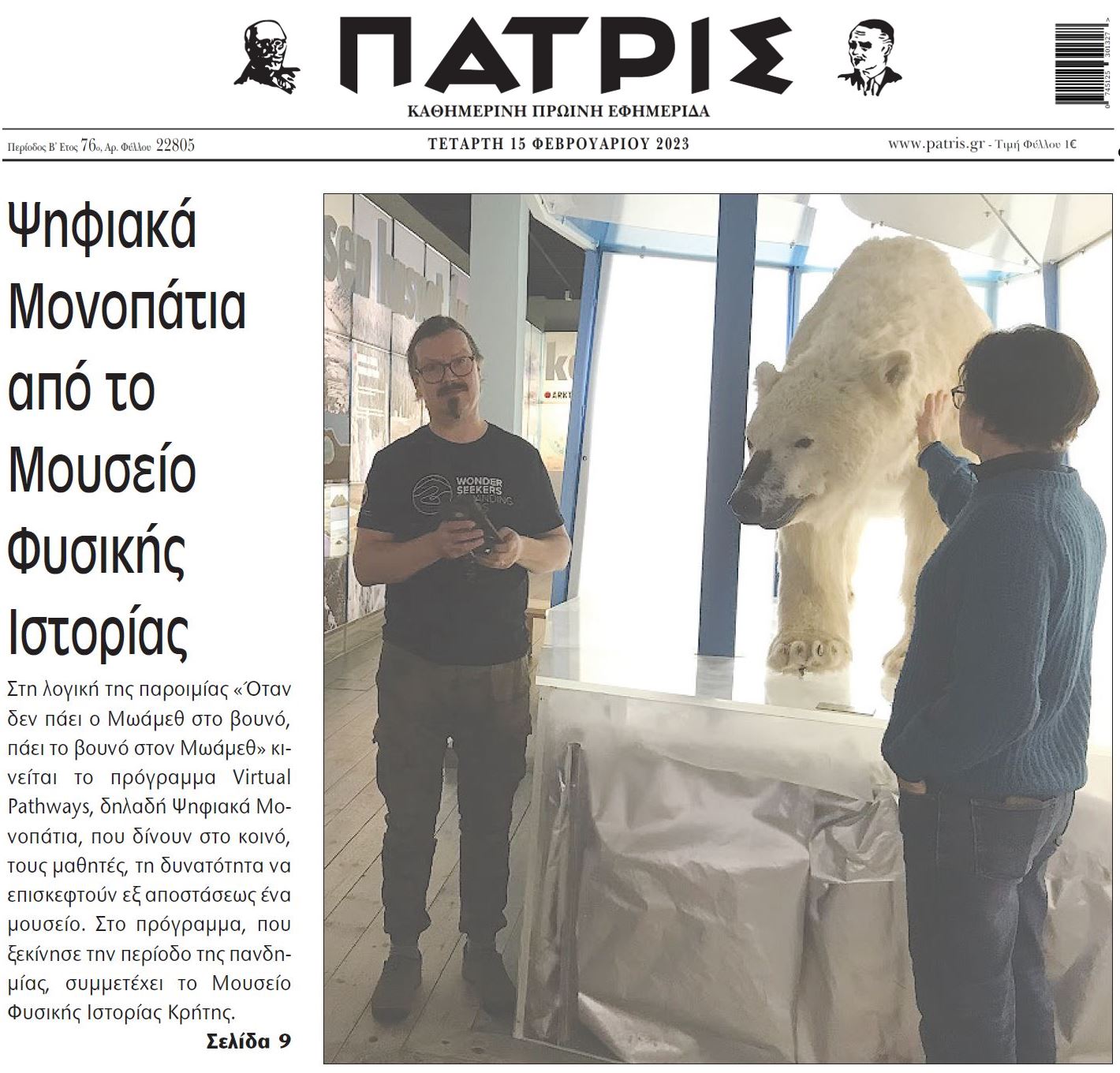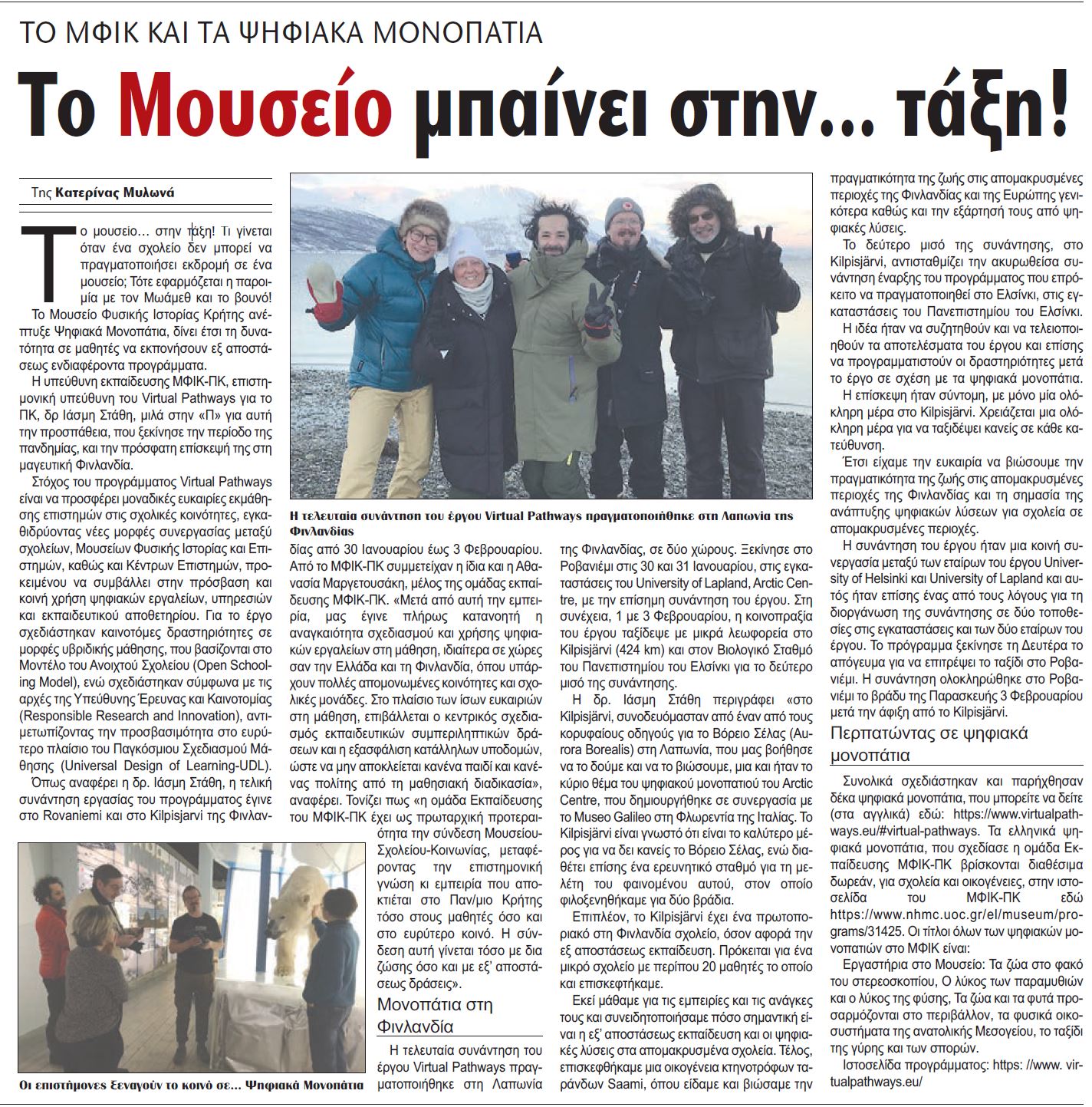
The museum… in the classroom! What happens when a school can’t take a field trip to a museum? That’s when the proverb about Muhammad and the mountain comes into play!
The Natural History Museum of Crete has developed Digital Trails, thereby enabling students to carry out interesting projects remotely. From March 13 to 17, the Natural History Museum team will visit schools on Kythira.
The project is part of the ERASMUS+ call for proposals related to the COVID-19 pandemic. It aims to provide unique science learning opportunities to school communities by establishing new forms of collaboration between schools, natural history and science museums, and science centers, in order to facilitate access to and the shared use of digital tools, services, and an educational repository. The project will include a collection of innovative activities in hybrid learning formats, based on the Open Schooling Model (Open Schooling Model), and will be designed in accordance with the principles of Responsible Research and Innovation (Responsible Research and Innovation), addressing accessibility within the broader framework of Universal Design of Learning (UDL).
VIRTUAL PATHWAYS will incorporate student-centered methodologies, such as exploration and inquiry-based learning, to improve students’ problem-solving skills while increasing their interest in STEM subjects. The project will also provide opportunities for teachers to develop their professional expertise by learning how to use and adapt design thinking, project-based teaching, inquiry-based learning (IBL), collaborative learning, and teaching techniques that incorporate interdisciplinary learning.
The educational trails to be designed will cover various thematic areas, such as the Natural History of Europe, the first Scientific Revolution with Galileo’s discoveries, the ideas behind the Nobel Prize that changed the world, and today’s challenges related to climate change and the loss of biodiversity. The project will be implemented on a pilot basis in 200 schools across four member states (Finland, Sweden, Italy, and Greece).
They will follow a «before the visit, during the visit, and after the visit» structure when visiting informal learning institutions.
The Natural History Museum of Crete—University of Crete will develop five (5) digital educational trails, in Greek and English, based on programs for school groups carried out in its exhibition space, and will coordinate deliverable IO2: Virtual Pathways.
The five (5) digital trails of the MFIK-PK in English are available here: https://www.virtualpathways.eu/
More about the museum:
https://www.nhmc.uoc.gr/el
https://www.nhmc.uoc.gr/el/museum/programs/31425