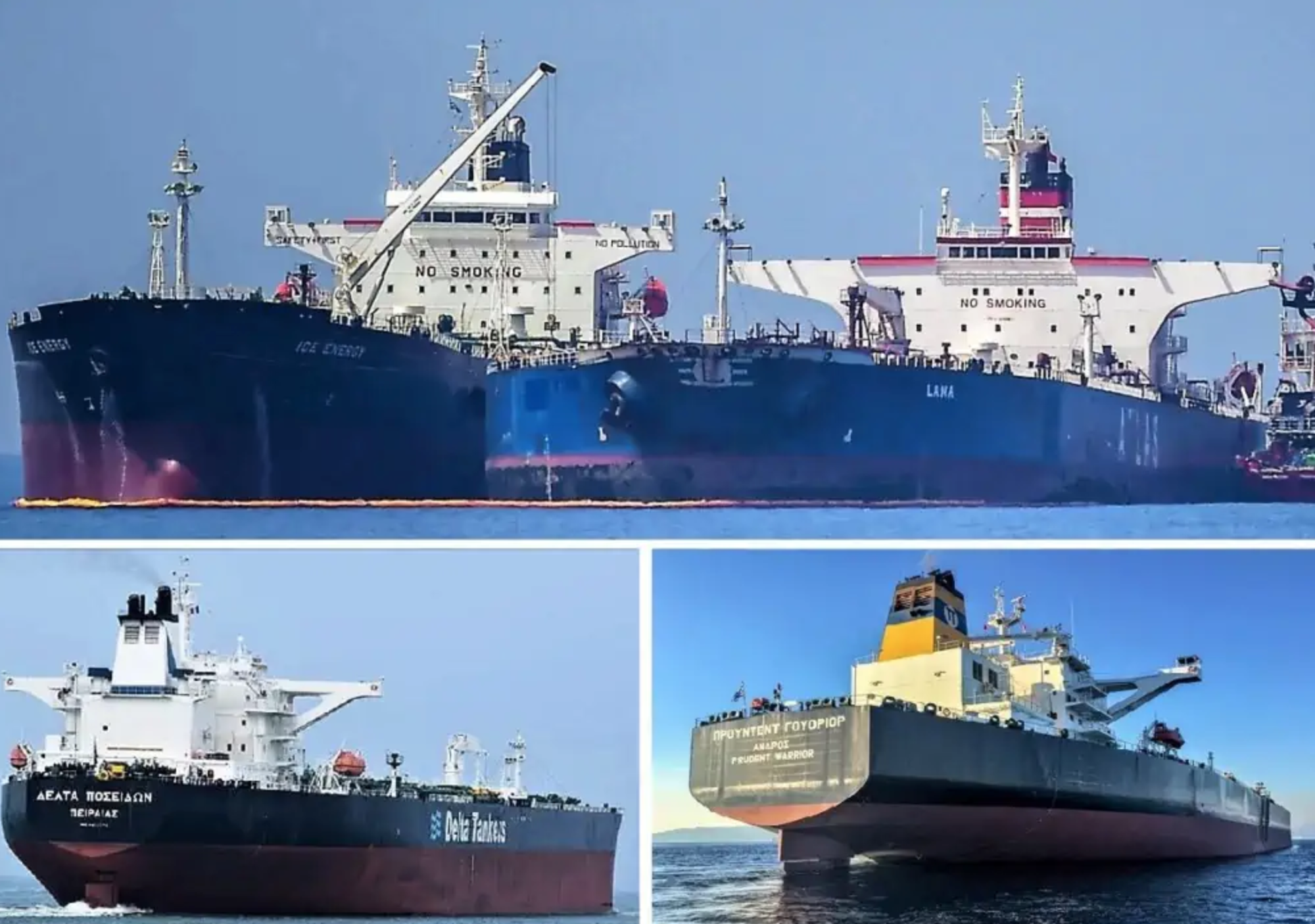
The case of the Lana’s hijacking at Washington’s behest, described in detail in *Chronicle of Humiliation*, will go down in history as a prime example of the country’s servility and self-sabotage in the service of foreign interests. The Iranian retaliatory actions against the two Greek tankers symbolize the complete collapse of Greek dignity. They also deal a blow to one of the few dynamic sectors of our economy (even though our ’patriotic« shipowners register many of their vessels in African and other flags of convenience). In fact, all these developments may not particularly trouble our Western »friends,« even as they issue hypocritical condemnations of Iran.
The truth is that our «allies» are killing several birds with one stone: First of all, a completely unreliable Greece, which is at the mercy of the Americans’ whims, will find it difficult to rebuild—if and when it ever wants to…—relationships based on trust and mutual interest with third countries, when it destroys them in such a self-destructive manner. It will be doomed to depend always and everywhere on its transatlantic overlords, with its ridiculed political class giving away land and water and simply hoping that some minimal pretense of decency will be maintained. Greece’s standing in the Middle East—and beyond—which was built over decades by maintaining certain basic balances (even though the country has always been on the «right side»), is being swept away by a political system that now has no scruples. It is willing to humiliate itself, as long as it continues to pretend that it «governs» («governed,» «will govern again») the protectorate.
Secondly, these developments are also welcome news for the Greek shipping industry’s competitors. The Greek shipping industry is being exposed and targeted, either unintentionally (due to the stance of the current government, as is the case now) or intentionally—as is also the case now, with Greek shipowners rushing to load the stolen Iranian oil onto their ships and transport it to the transatlantic pirate-in-chief, who, in any case, doesn’t get his hands dirty. The worst part is that there may be other unintended consequences due to the outrageously irresponsible and reckless (literally: they don’t think, they just carry out orders) attitude of official Greece: the conditions are piling up that will cause our country to cease being implicitly protected—with strict directives from all Middle Eastern powers, without exception—from «forceful» actions. And even worse: Greece is rapidly losing whatever support it had for its cause, both from governments and from public opinion in the Middle East—it’s obvious who stands to gain…
This is not the first time in recent years that the official Greek leadership has gone too far. To limit ourselves to the case of Iran, we recall the disgraceful manner in which Mr. Mitsotakis expressed his support for the assassination of Iranian General Soleimani: in early 2020, speaking at the «Atlantic Council,» the prime minister of the Greek neo-colony stated that «the decision was dictated by the national interest of the U.S., and we support our allies.» He showed no interest in what Greece’s national interest might be. Perhaps our country’s political leadership no longer even recognizes the concept of «national interest.» And that is why Mr. Mitsotakis chose to openly applaud an act of state terrorism rather than, at the very least, diplomatically avoid taking a position on it.
Now, however, with Lana’s far-fetched piracy case, the government has gone too far. Without the slightest legal basis or justification, it arbitrarily seized a foreign ship and its cargo. But it didn’t stop there: to cap off its arbitrariness (and self-humiliation), it is handing over the seized oil to the U.S.! No one can explain the logic behind this. Only Hatzavatis’s logic fits here. Except that, while those who pretend to govern may enjoy acting as tax collectors, the Greek people do not like it at all. This is a serious problem for those «at the top.» But it’s also a problem for the rest of us: we must find ways to understand just how dead-end and dangerous all of this is, and above all, ways to agree on a different course. A course that will restore to Greece everything it has lost, from its sovereignty to its dignity.
A Chronicle of Humiliation
- In mid-April, the oil tanker Pegas, which was sailing in international waters, was forced to enter Greek territorial waters, near Euboea, due to a technical problem and severe rough seas.
- The Greek authorities decided to seize it because, «according to reports,» it fell under the sanctions imposed by the EU on Russia, as it was owned by a Russian bank that was subject to those sanctions.
- The seizure applied only to the ship and not to its cargo, which consisted of Iranian oil (approximately 110,000 metric tons), since neither the EU nor Greece has imposed such sanctions on Iran.
- Immediately after the seizure, documents were presented proving that the tanker in question had been sold (even before February 24, the day the Russian invasion of Ukraine began) to another Russian company, which is not included on the sanctions list of either the EU or NATO.
- Consequently, the Greek authorities formally released the tanker, which had been detained in Karystos, Euboea (and had been renamed Lana by its new owners). However, they did not grant it permission to sail for 48 hours due to «bureaucratic delays.».
Change of strategy to accommodate the U.S.: Since we have no right to seize the ship, we’ll just take its cargo by force
- Lana’s 48-hour de facto detention was exactly the time the U.S. needed to ask the Greek authorities to seize—no longer the tanker, since it was not subject to any sanctions, but rather… its Iranian cargo.
- It is said that the U.S. authorities based their request on information from an NGO called the «Alliance Against a Nuclear Iran»(!), claiming that the proceeds from the sale of the Iranian cargo on the Lana would end up in the hands of the Revolutionary Guards, an elite branch of the Iranian armed forces
- Even if the «information» were true, it’s like saying that we’ll use the revenue from Greek raisin exports to Britain to buy weapons for the Greek marines… But in any case, we’ll never know if it were true, because the exact content of the U.S. «request» was never made public.
- In any case, a judge of first instance in Chalkida (…), after deliberating on his own and completely impartially, decided that the U.S. request must be granted. The fact that neither the EU nor Greece has imposed an embargo on Iranian oil was apparently considered a mere detail by the judge.
- Of course, this so-called «court ruling» was neither published nor served on the parties concerned, and it will likely be many years before anyone can examine the «reasoning» on which it was based.
- To make matters even worse for the Greek side, on May 1, the Lana was sold by the Russian shipping company to an Iranian one, while the Iranian authorities were demanding ever more insistently that their Greek counterparts put an end to the «piracy that violates all international maritime regulations,» etc.
Piracy on behalf of third parties—and in violation of every law and common sense—is acceptable as long as it satisfies Washington
- But Greece’s complete humiliation was not yet complete — and the country had not yet suffered the most severe blow to its credibility and its relations with a major regional power that had traditionally supported Greek positions.
- Apart from the illegal and unjustified seizure of the Iranian cargo (unless the domestic authorities officially admit that neither Greek nor European law applies in our protectorate, but rather U.S. «law» takes precedence), the Greek «justice system» and the Greek «government» have decided to comply with the U.S.’s other demand as well: namely, to hand over the seized Iranian oil to them!
- It was the straw that broke the camel’s back and exhausted Iran’s patience. When, in mid-May, the «Greek-owned» (and Liberian-flagged) tanker Ice Energy docked at Lana and began transferring—read, theft on behalf of third parties—of Iranian oil, Tehran decided to retaliate.
- It should be noted that domestic regulations for the protection of the marine environment do not permit the transfer of oil from ship to ship except at three specific locations within Greek territorial waters, due to the high risk of a spill.
- Of course, Karystos is not one of those three locations—yet another detail that escaped the attention of… the presiding judge (and, more generally, of the Greek authorities, who are particularly «flexible» when the Embassy sneezes, Greek authorities).
- The Greek authorities, however, proved unyielding when local residents mobilized to protest the risk of a spill and contamination of Karystos Bay.
Iran seizes two Greek tankers, while Athens pretends to be taken by surprise
- Finally, last Friday night, two of the approximately 20 Greek tankers sailing in Iranian territorial waters were «visited» by the Iranian Revolutionary Guard Corps Navy.
- The tankers Prudent Warrior and Delta Poseidon were detained by the Iranians «for violations of navigation regulations» and escorted to an Iranian port. There are 48 crew members on the two ships, including 10 Greeks and 1 Cypriot.
- According to the Iranian authorities, all the sailors are safe and in good health, are free to move about on their ships, and have had their cell phones returned to them so they can contact their families.
- Until Iran seized the two Greek tankers, the case of the piracy of the Iranian tanker Lana and the confiscation/theft of its oil by Greek authorities on behalf of the U.S. (a world first) had been relegated to the «small print» in the Greek media.
- Initially, the Greek authorities claimed that there was no connection between the two events and began to denounce Iran internationally for the seizure of the Greek tankers. The PNO (Panhellenic Seamen’s Federation) followed suit, also condemning Iran and emphasizing that «the seizure of merchant ships and the taking of crews hostage constitutes a flagrant violation of international law and represents a dangerous development for international shipping, crews, and international trade.».
- We are seeking the corresponding previous complaint filed by the PNO, which is always sensitive to seafarers’ rights, regarding the fate of the Lana’s crew, who have effectively been held by Greek authorities for nearly two months under unknown conditions, and (as we will see below) whose lives are now in danger.
- We are also looking for the corresponding earlier complaint by SYRIZA regarding the hijacking of the Iranian tanker, given that the party’s relevant sector head was quick to state, following the seizure of the two Greek tankers by the Iranians, that «this is an unacceptable act that under no circumstances can be considered retaliation for the detention of a Russian ship carrying an Iranian cargo, which was carried out by the Greek authorities.».
So, yes, they’re talking about a rope at the hanged man’s house (condemnations, counter-condemnations, and meaningful invitations—to ears that won’t listen?)
- The Greek protectorate’s furious accusations were followed by similarly harsh condemnations from all the champions of the «two-meter, two-station» approach: the U.S., of course, which was outraged by Tehran’s “unprecedented and provocative act of piracy,” as well as Britain, Germany, France, etc.
- Iran did not respond to the U.S., but rejected the German and French condemnations, calling on them «to support legal procedures based on international rules aimed at ensuring freedom of navigation and maritime security» and «to stop turning a blind eye to the illegal seizure of an Iranian-flagged tanker and the confiscation of its cargo by Greek officials, in an attempt to enforce the domestic laws of a third country beyond its own territory» (read: the U.S.).
- Tehran also called on Greece to engage in direct talks with it, without U.S. involvement, stating: «The long-standing relations between the Islamic Republic of Iran and Greece and its wonderful people have always been based on mutual respect. These relations must not be disrupted by extremely short-sighted miscalculations that result in piracy at the behest of a third party.’.
- The Greek side did not respond (or, more accurately, was not allowed to respond) to the Iranian invitation to find a mutually satisfactory solution, insisting on its «condemnation» and pretending not to understand the connection between the Lana case and that of the two Greek tankers.
Danger to the seized Iranian tanker and the surrounding area (but as far as the «authorities» are concerned, it’s none of their business)
- And while it is still unknown how and when this double drama will end, the «transfer» continues in Karystos, with increasing risks. As revealed by an «extremely urgent» message from the Karystos Port Authority, which was sent on Tuesday, May 31, to the Ministry of Shipping, the judicial authorities, and others, it received a written report from the captain of the Lana warning of the danger that the ship could be blown up or wash ashore!
- The captain points out that: 1) The particularly dangerous conditions that have arisen in the ship’s tanks due to the residues crude oil require the inert gas system must be kept in a state of constant readiness, which is impossible as long as the Lana It has not been supplied with the required fuel. 2) Due to the transfer of part of the cargo and the inability to ballast the ship because of the lack of fuel, its stability has been compromised, with the result that it is at risk of being driven ashore in the event of bad weather.
- With its «extremely urgent» notice, the Karystos Port Authority is pleading(!) with the relevant government, judicial, and state authorities to issue instructions on what it should do… It is unknown whether—and if so, what—the reaction of the «competent authorities» was. Perhaps they are waiting for instructions from the Embassy. Or are they preparing a press release in case the worst happens?;
Errikos Finalis