A child's dream is peace
A mother's dream is peace
The words of love under the trees
is peace.
Peace is the clasped hands of men
is the hot bread on the table of the world
is the smile of a mother
Nothing else is peace.
And the ploughs that make deep furrows in all the earth,
they only write one name:
Peace.
Nothing else. Peace.
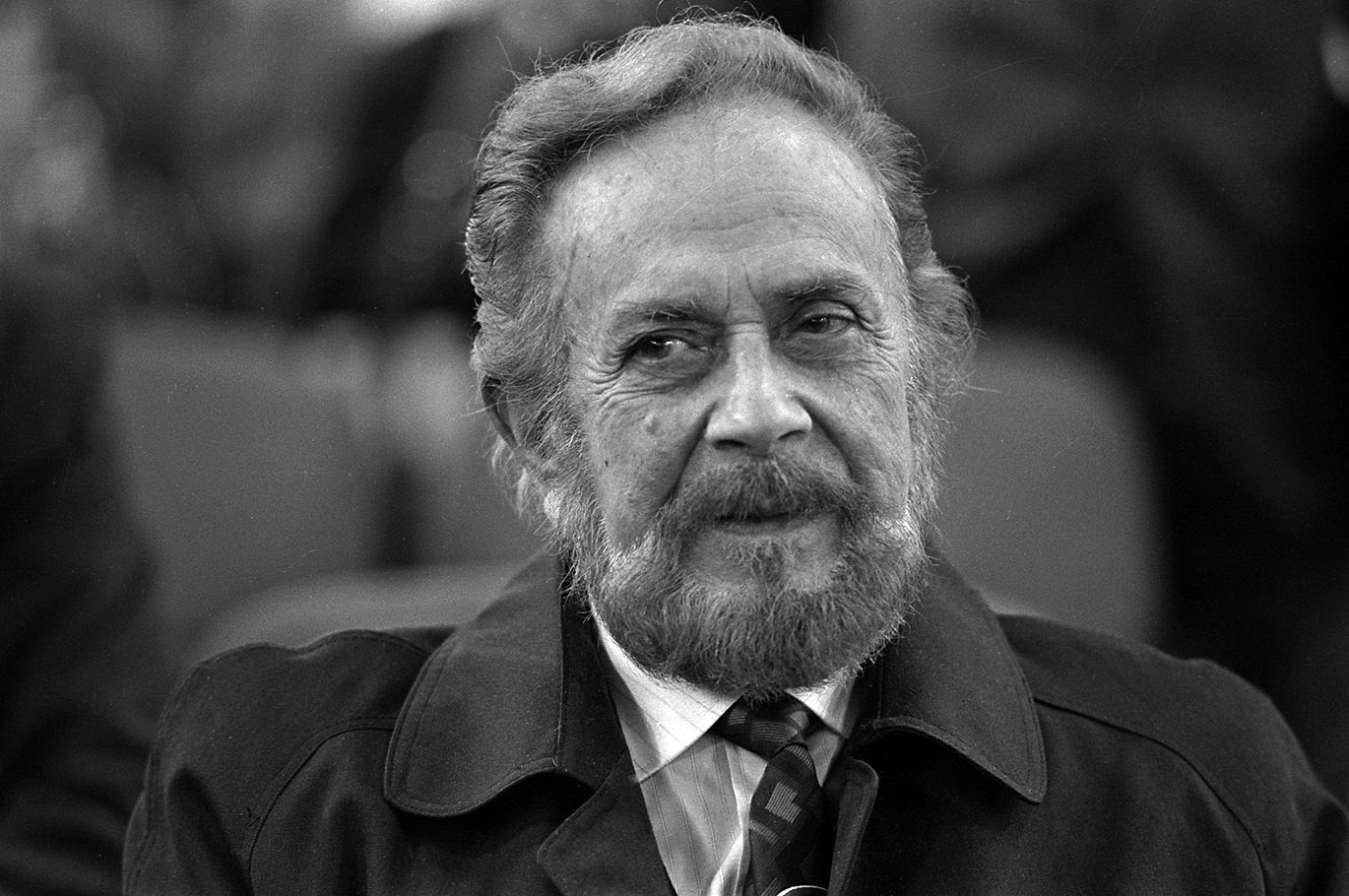
On 11/11/1990 the great poet, Yannis Ritsos, who never denied his left-wing political identity - a fact he paid for with exile and a coordinated attempt at character assassination - passed away.
A great and prolific Greek poet, with international appeal, who belongs to the so-called «generation of the ‘30s. Epitaph«, »Romiosyne« and »Sonata under the Moonlight« are three of his most famous works. In 1975 he was nominated for the Nobel Prize for Literature.
Yannis Ritsos was born in Monemvasia on May Day 1909. He was the youngest of the four children of the landowner Eleftherios Ritsos and Eleftheria Vouzounaras. His three older siblings were Nina (1898-1970), Mimis (1899-1921) and Loula (1908-1995).
In 1919 he graduated from the School of Monemvasia and in 1921 he enrolled at the Gymnasium of Gythio. In the same year his brother Mimis and his mother Eleftheria died, both of tuberculosis. In 1924 he published his first poems in the magazine «Diaplasi tis Paidon» under the pseudonym «Ideal Vision».
In 1925 he completed his secondary school studies in Gythio and left for Athens with his sister Loula. His father's financial ruin had preceded his death and the poet was forced to work for a living, first as a typist and then as a copyist at the National Bank. In 1926 he himself contracted tuberculosis and returned to Monemvasia until the autumn of the same year, when he enrolled at the Athens Law School, but was never able to attend. He continued to work as a librarian's assistant and scribe at the Athens Bar Association.
In January 1927 he was hospitalized at the Papadimitriou Clinic and the following month at the «Sotiria» sanatorium, where he stayed for three years. In «Sotiria» Ritsos met Maria Polydouris and Marxists and intellectuals of his time, while at the same time he wrote some of his poems which were published in the literary supplement of the Encyclopaedia «Pyrsos». From the autumn of 1930 and for a year he lived in Chania, initially in the fthisiatory of Kapsalonas and after his personal complaint of the miserable living conditions there in a local newspaper, he was transferred together with all the inmates to the sanatorium Agios Ioannis.
In October 1931 he returned to Athens and took over the direction of the artistic department of the Workers' Club. There he directed and participated in performances. His health gradually improved, and so did his finances with the help of his sister Lula, who had in the meantime married and left for America. The following year, his father entered the Daphne Psychiatric Hospital (where he died in 1938) and five years later he was followed by Lula, who was discharged in 1939.
In 1933 he collaborated with the left-wing magazine «Votoroi» and for four years as an actor with the companies of Zozos Dalmas, Ritsiardi, Papaioannou and Makedou. In 1934 he began writing from the columns of Rizospastis and published his first collection entitled «Tractor» under the pseudonym Sostir (an anagram of his epithet). In the same year he became a member of the KKE, to which he remained loyal until his death. In 1935 he published his second collection of poems entitled «Pyramids» and was employed as a text editor at the Govostis publishing house.
On 9 May 1936, bloody riots take place in Thessaloniki during the great tobacco workers« strike. The next day, Ritsos sees a photograph of a mother mourning her dead child in Rizospastis, which gives him an excuse to write one of his most popular poems, Epitaph, which is published in 10,000 copies. Under the Metaxas dictatorship (1936-1940), the last 250 are burned on the pillars of the Olympic Zeus.
In 1937 he was hospitalized in the sanatorium of Parnitha and in the same year, overwhelmed by the illness of his beloved sister Loula, he wrote the poetic composition «My sister's song», one of the most beautiful lyrical compositions of modern Greek poetry. Kostis Palamas, impressed by the poem, wrote the lyrics - a eulogy for Ritsos:
RAPID SLOW PEELING OF THE BLUE PLATE
SET ASIDE TO SEE.
In 1938 the «Spring Symphony» was published and he was hired at the National Theatre. Two years later, he publishes «Old mazurka to the rhythm of rain» and is hired as a dancer at the Lyric Stage.
During the Occupation, Ritsos was bedridden, yet he participated in the activities of the educational section of EAM and refused to accept money from a fundraiser when his life was threatened by hardship in 1942. After the defeat of ELAS in the «Decembriana» he followed his forces to the constriction. He passed through Lamia, where he met Aris Velouchiotis and reached Kozani, where his play «Athens in Tanks’ was staged. In 1945 he wrote »Romiosyne«, another of his popular poems, which was set to music by Mikis Theodorakis in 1966.
During the Civil War he was exiled for his leftist activities in Kontopouli in Lemnos (1948), Makronissos (1949) and Agios Efstratios (1950-1951). In 1952 he returned to Athens and became a politician in the EDA. In 1954 he married the paediatrician Filitsa Georgiadou from Samos, with whom he had a daughter, Eri (1955). In 1956 he travelled to the Soviet Union as a member of a delegation of intellectuals and journalists and in the same year he was awarded the State Poetry Prize for his «Sonata of Moonlight». When the great French poet and writer Louis Aragon (1897-1982) read it, he felt «the violent jolt of genius» and declared that its author was «the greatest of the living poets of our time».
In 1960 Mikis Theodorakis set «Epitaph» to music and marked the period of the dissemination of great poetry to the general public. In 1962 Ritsos visited Romania and met with Nazim Hikmet, whose poems he translated into Greek. He then went to the Czech Republic and Slovakia, where he completed the Anthology of Czech and Slovak Poets, Hungary and the L.W. of Germany. In 1964 he participated in the parliamentary elections with the EDA.
When the coup d'état of 21 April 1967 broke out, his friends warned him to hide, but he did not leave his house. They arrested him and locked him up in the Hippodrome of Faliro. At the end of April he was transferred to Gyaros and later to Partheni on Leros. In 1968 he was hospitalized in «Agios Savvas» and then placed under house arrest at his wife's house in Karlovassi, Samos. In 1970 he returned to Athens, but after refusing to come to terms with the Papadopoulos regime he was again exiled to Samos until the end of the year when he was admitted for surgery at the General Clinic of Athens. In 1973 he participated in the events of the Polytechnic.
After the fall of the dictatorship and the post-war period, he lived mainly in Athens, where he continued to write at a feverish pace. In 1975, he was awarded an honorary doctorate by the University of Thessaloniki and was awarded the prestigious French poetry prize «Alfred de Vini». The following year he was awarded the Lenin Prize in Moscow. In the following years, he was awarded the «Lens Prize of the Russian Academy of Sciences» at the Leningrad University in Moscow: Birmingham (1978), Karl Marx of Leipzig (1984) and the Faculty of Philosophy of the University of Athens (1987). In 1986 he was awarded the UN «Poet of International Peace» prize.
Yannis Ritsos passed away on 11 November 1990, leaving behind 50 unpublished collections of poetry. He was buried three days later in his hometown of Monemvasia.
The main body of his work consists of over 100 poetry collections, 9 prose works and 4 plays. Studies of his peers, numerous translations and chronicles, as well as other publications complete the picture of the Chalcedonian author.
See more about the poet on the page: https://www.yannisritsos.gr/