The refugees from Farasa in Cappadocia, overwhelmed by the journey and uprooting, arrived at the marshes from the lake of Giannitsa in 1924, with the compulsory exchange of populations after the Asia Minor catastrophe. People from the villages of Varassos, Afsari, Kiska, Sati, Tsouhouri, Karsandi, and Fkoshi went by boat to Piraeus or Karambournaki, to Thessaloniki and from there they scattered to other parts of the country, such as Corfu, but mainly to Macedonia. Those who found themselves in the marshes were suffering from malaria, which was rampant at that time. Some of them fled to Drama and some others were forced to settle in the wooden huts created by the state at the time. Two families lived there in each hut for about two years, when houses were built to house their new life in the new village they created, Platy, Imathia.
Now that the years have passed and the generation of the first refugees from Farasa, who took their name from Varasos, has been lost, the testimonies of those who described the events of the refugees are coming to light, since they themselves did not want to talk too much about what left wounds in their souls. The religious element is strong in their reports and descriptions, as their children and grandchildren say that they were very religious people and that this is what kept them, along with their language, the archaic Greek dialect of the Faroese, which they retained despite the pressures they were under. Their consolation and psychological support was, moreover, the grace of Saints Arsenios and Paisios, who, as the younger generations say, «it is no coincidence that they came out of Farasa».
«Before Seferberlik, the Turks were good to us...»
The testimony of her grandfather Efthymios Kirtikidis, as recorded by Aglaia Loukopoulou, is conveyed by Miranda Mourvetidou, treasurer of the Association of Cappadocians of Plataeus, who confirms that most people at that time avoided talking about what caused pain in their souls. «Before the Seferberlik (meaning military mobilisation), the Turks were good to us. Then the situation broke down. The Turks got wild and chased us. And they were asking for girls and chasing women and Chetniks were coming to the village. And people were fleeing to the mountains. We suffered a lot. Then when the exchange came out, the Turks got even more angry. And we couldn't talk at all. If we talked, we got beaten up. The Turks themselves revealed the exchange to us. This was in 1923, in the month of May, on the 10th. They told us: a committee will come and you will leave. They cursed us, they told us that we would leave. In a month, in the summer, they came and sealed the livestock. Then they took us out of our houses and locked them up. The Turks took our houses. Our things were taken out into the street. Those of us who had money rented carts and left for Vereki, a Greek village above Tsouhouri. Others went to Vereki again, but they didn't rent carts, they went on foot,» are the words of Mr. Kirtikidis.
How the village emptied - The journey by boat and the destination
On how the village was emptied, he says that this happened in four or five days and adds: «Our priests have left. We took nothing from our church, we left everything as it was. We only hid in the basement of the church some large pictures and papers. My family was one of the last to leave. We left by cart. In Vereki we stayed at St. Constantine's. Next door was a small town. We took only our mattresses and a few small things with us. We also had some money. We stayed in Vereki for two months. And we ate what was ready. A few people were working, but where could all the people find work... Then we got up from Vereki and went by wagon to Ulukisla, the next day we took the train to Genice and from there to Mersina at the port. At first we stayed at Halil Efendi's hani. We paid a peganota (i.e. a tropa) each for each day. We worked. The women cleaned cotton, the men did other jobs. But we stayed too long and we could not pay at the hani. So we went to Abraham Efendi's shop. We didn't pay there. Mersina was full of refugees. Our village was all together. Nine months passed.».
Describing the journey of the refugees by boat, he says that they all travelled on the ship «Alexandria», which accommodated more or less 3000 people from Chuhuri, Afsari, Kuruja, the region of Ak Dagh Madin of Yorqat province and other places. After four days, the ship arrived in Karambournaki and after 15 days, the refugees were transferred to Harmanchiai, a settlement in Thessaloniki. From there, the settlement sent half of them to Drama and half to Grevena. Efthimios Kirtikidis himself went to Grevena, then to Vathylakkos in Kozani and in 1934 he arrived in Platy.
«They were very religious people, that's what kept them going»
Ms Mourvetidou also referred to the element of faith, saying that the refugees from Farasa were very religious people and this is what kept them going. «They also had the language, of course, which fortunately in that area was kept and they did not accept the pressure to leave it,» she says, not failing to stress that «it is no coincidence that the last Saints, St. Paisios and St. Arsenios, came out of Varasos.».
She says that «these Saints were their consolation, their psychological support» and notes: «St. Arsenios was an old priest in Varasos. He performed miracles in life and not only to Christians. Turks would come and ask for his help and to all of them he extended his hand and God's help. They had him not only as a teacher and priest in the churches, because Varassos had so many churches and chapels. He was also used as a doctor. They went to him to read them the blessing for the lechona, the sick, the blind. He would read a blessing for any situation. St. Arsenios also baptized Paisios, who was then a baby. He said then that he himself had no children, but he would leave Paisios at his feet and gave him the name Arsenios. Paisios took this blessing and it was indeed the grace of God that went to this child and he became a Saint. Afterwards, his service was great on Mount Athos. Many people visited him - both educated and uneducated - and everyone was helped, as long as they believed.».
Monument of Honour and Memory to the founders of Plataeus
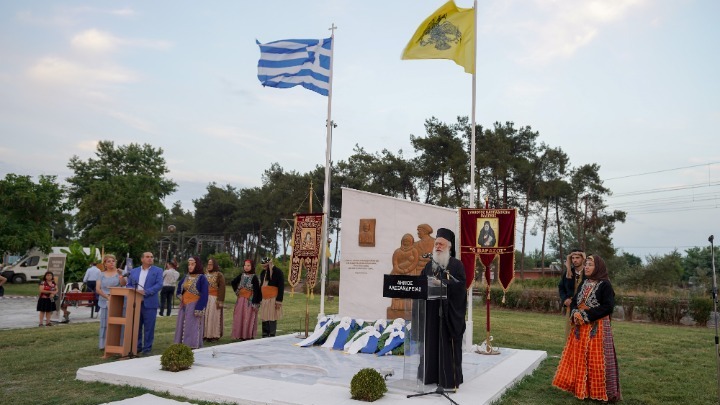
A few days ago, in Platy, Imathia, the unveiling of the Monument of Honour and Remembrance to the founders of the village, who arrived there as exchangeable refugees from the area of Farasos in Ayotiko Cappadocia, took place. The ceremony was organized by the Association of Cappadocians of Plateau after an effort that started 4-5 years ago, stopped during the pandemic period and is now completed.
«We decided on this monument because we felt it was our duty. People, our grandparents, came here naked, with almost nothing, only the bare necessities. Now God has claimed us and we have finished it. What we feel is emotion,» says Mourvetidou. Through this, she notes, the second and third generation people are trying to travel with their minds for a while to Farasa so that they can build a picture in their minds, with evidence from photographs, from testimonies and from what they have read.
«To be honest, if you don't experience something, you can't understand it in its full extent. But we understand what this means, what it means for Hellenism in Asia Minor, a Hellenism of 33 centuries, to receive the final blow in 1924 with the exchange. It was now uprooting», she notes, and with these words she closes her description.
P. Yultsi