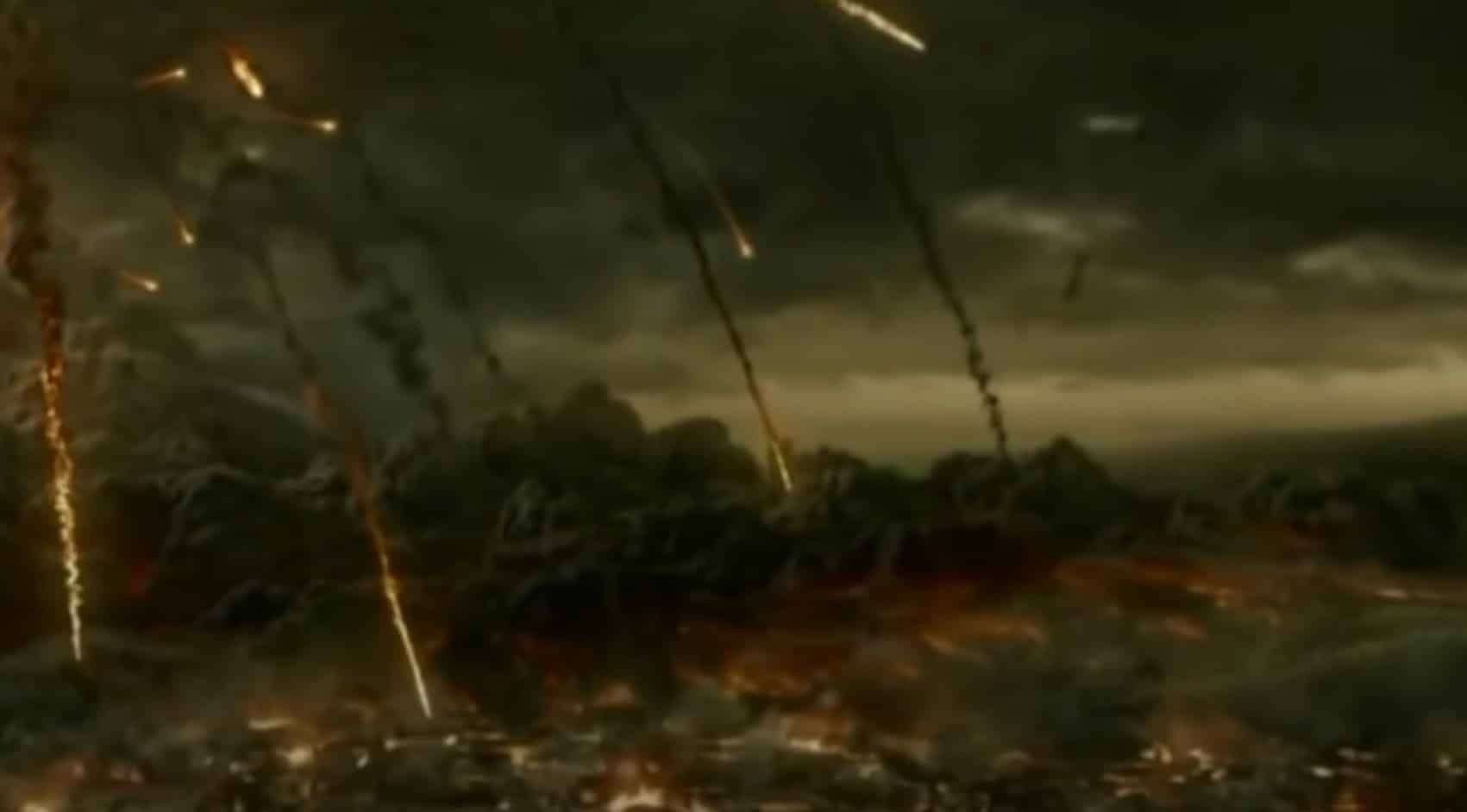
About 3,600 years ago, the 1650 BC, during the Middle Bronze Age, the city Tal el-Hamam was in its prime: Well placed in the southern Jordan Valley, northeast of the Dead Sea, it had become the largest continuously inhabited Bronze Age city in the southern Levant. At that time it was 10 times larger than Jerusalem and 5 times larger than Jericho.
«It's an incredibly important area, culturally,» says James Kennett, professor emeritus of geosciences at UC Santa Barbara. «Much of the early cultural complexity of humans developed in this area,» he adds.
In this area there are traces of civilization dating back to the beginning of the Chalcolithic, and are found in layers, as the settlement was built, destroyed and rebuilt over the centuries.
However, at some stage there is a gap, corresponding to the Middle Bronze Age, which has attracted the interest of some researchers because of its «very unusual» materials. In addition to what one would expect to find from destruction caused by war or earthquakes, pieces of pottery were found whose surfaces were melted to the point where glass had formed, mud bricks with traces of bubbles and other partially melted building materials. All this points to an event of extremely high temperatures - beyond any temperature that could be produced by the technology of the time.
«We saw traces of temperatures above 2,000 degrees Celsius» says Kennett, whose research team was at one stage gathering evidence to support a hypothesis that an even older explosion in the air, some 12,800 years ago, caused major fires, climate changes and extinctions of animal species.
The traces of the Tal el-Hamam disaster looked familiar, and a team of investigators, including Allen West, a scientist specializing in crash/fall incidents, and Kennett, worked with Philip Sylvia of Trinity Southwest University, who specialises in Bible analysis to find out exactly what happened in that city 3,650 years ago. The results were published in Nature Scientific Reports.
«There is evidence of a giant cosmic explosion in the air near this city, Tal el-Hamam,» Kennett says of it, likening it to the 1908 Tunguska explosion of 12 megatons, in which a 50-60 metre meteorite is thought to have «entered» the Earth's atmosphere over Siberia.
This explosion over Tal el-Hamam was powerful enough to level the city, destroying the palace, the walls, and mud brick buildings, according to the scientific article. As for the human remains (bones), or research has shown high degrees of dismemberment in the people who were there.
Kennett says further evidence of such an eruption was found thanks to several different soil and sediment analyses, which showed iron-rich pellets and silicon, as well as molten metals. Furthermore, the explosion scenario may explain the extremely high concentrations of salt found in the «destruction layer».
«The salt was thrown up because of the high pressures from the impact,» Kennett says of the meteorite, which probably fragmented on contact with the atmosphere. «And the impact may have partially hit the Dead Sea, which is rich in salt.».
The local Dead Sea coast is very rich in salt, so the impact may have dispersed the salt crystals over long distances - not only in Tal el-Hamam, but also in the neighbouring Tel es-Sultan, which is thought to have been the biblical Jericho, which also suffered a violent destruction during the same period, and Tal-Nimrin (which was also destroyed).
The high salt content of the soil may have been responsible for the so-called «Late Bronze Age vacuum», according to researchers, during which cities in the Jordan Valley were abandoned, with the population of the region falling from tens of thousands to a few hundred nomads. Nothing grew on those once fertile lands, which were abandoned for centuries. Traces of human resettlement in Tal el-Hamam and surrounding communities reappear in the Iron Age, some 600 years later after the sudden destruction during the Bronze Age.
Tal el-Hamam is at the centre of an ongoing debate about whether the Biblical Sodom, which, according to the Old Testament, God destroyed because the people who lived there were terrible sinners. Lot is supposedly saved by two angels who tell him not to look back. However, his wife is turned into a pillar of salt. Fire and brimstone fell from the sky, cities were destroyed, thick smoke rose in the sky, people were killed and crops were destroyed - in a description that strongly resembles an account of a cosmic crash event. In this context, although there is no scientific evidence to support that this city was indeed biblical Sodom, it is not unlikely that such an event was the inspiration for the oral tradition that may have led to the Old Testament texts in question.