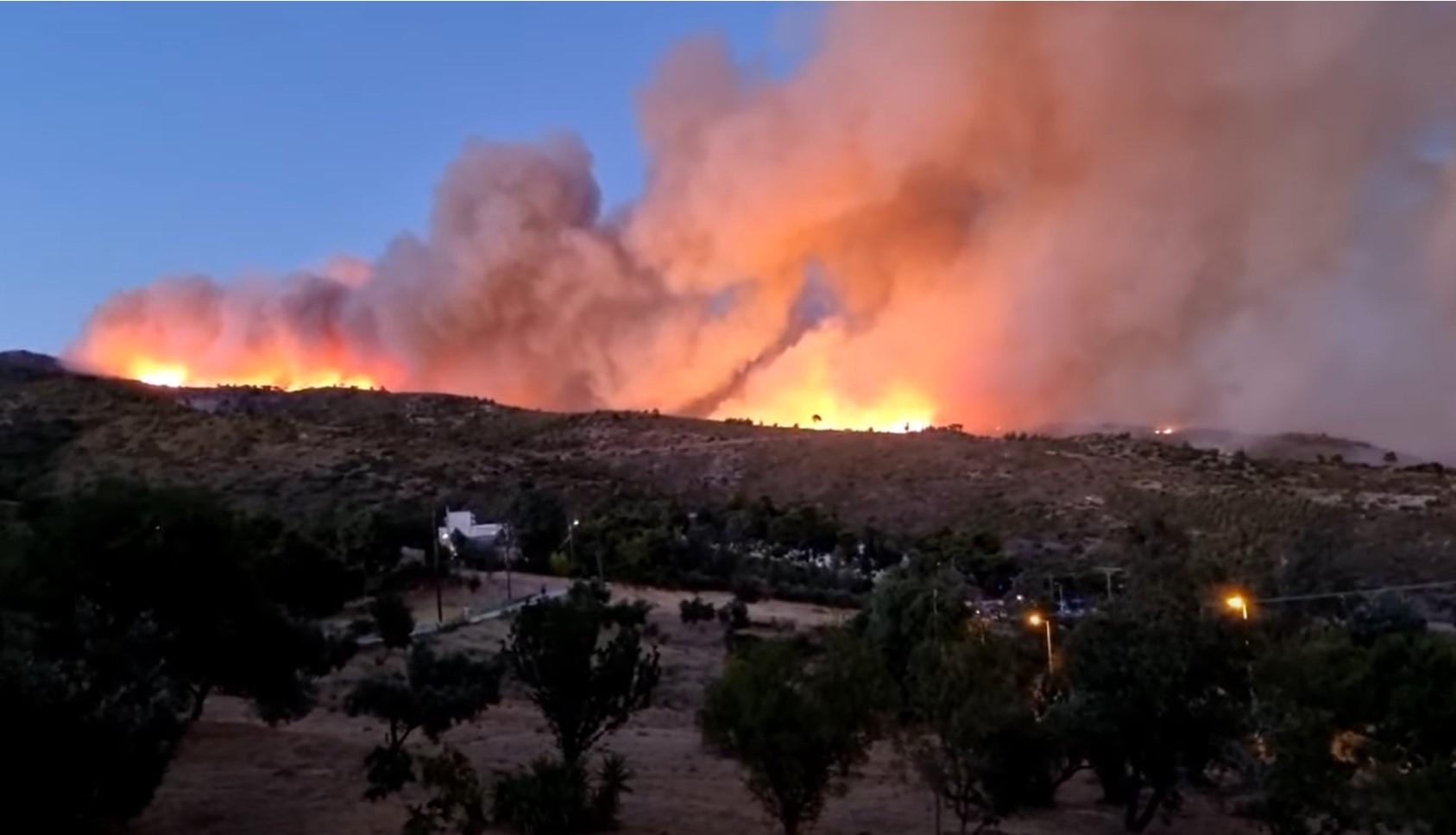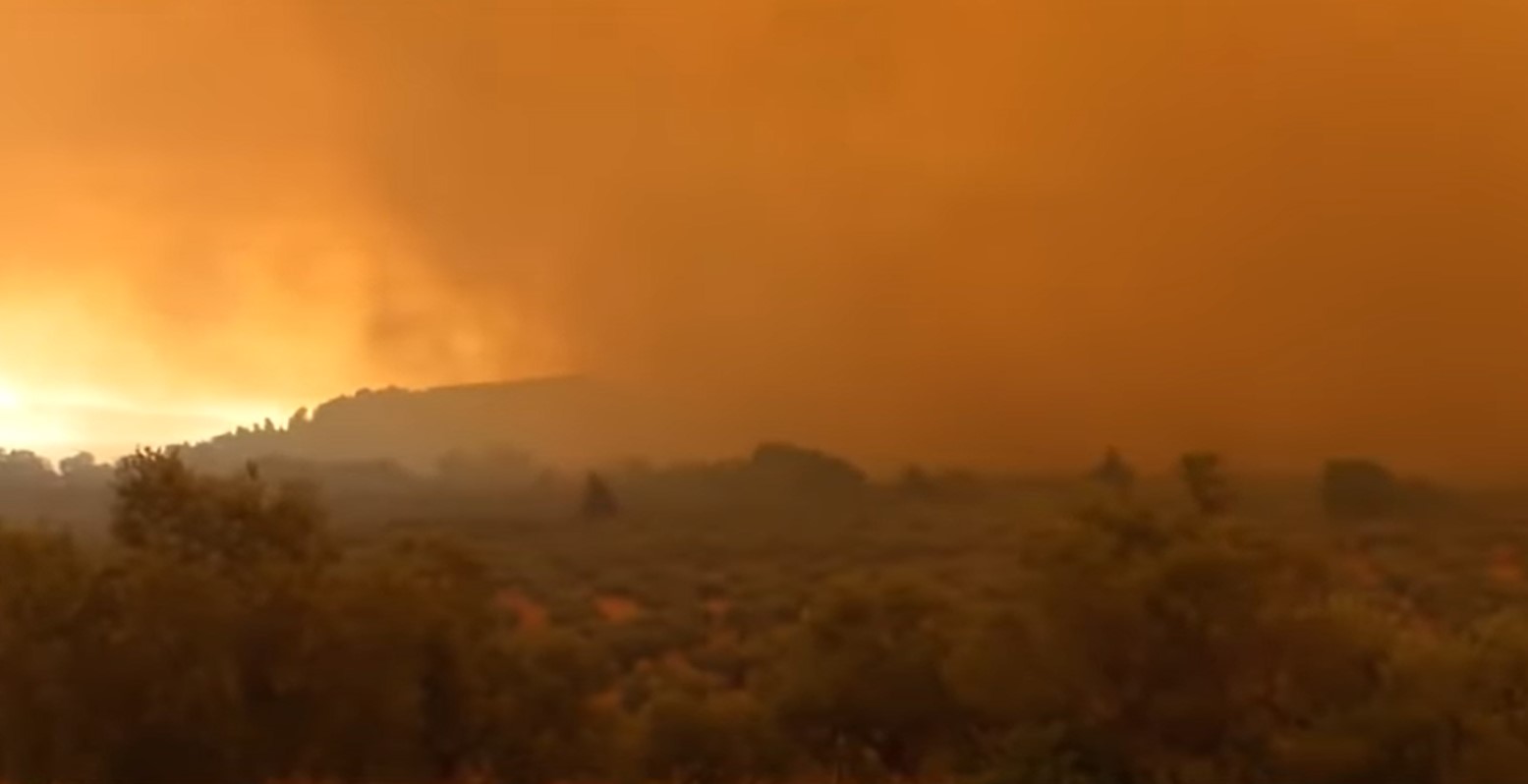
In summer, kids count the number of baths in the sea or the ice cream they eat every day. In the fire department they count fires. Every day we have an average of 30 fire outbreaks in the Greek territory. Sometimes the number of fire incidents exceeds 80. The climate crisis has made the problem even bigger. And we still have no solution.
What we have is the first in Europe in fire severity (18,522.7 burnt acres per major fire), while we are also the ones who ‘break’ the negative record of major forest fires every year (4.4 became 30)
WHY ARE WE BURNING?;
Because, it seems, we can't put the overwhelming need to acquire manners above ‘I’ or ‘it's your fault’ or the Greek's ingrained need to try whatever limit there is ‘bosco’ -given the lack of control and impunity.
The Magazine tried to find out what state we are in this year, in terms of fire protection, with this year's fire season having started on the first day of May. So, in theory, everything should have been ready on that day.
So, in view of the summer, Greece received a large allocation from the EU for vehicles, facilities etc (not staff), with reports that the government has decided to give «the most money of all time», ...so we don't have to live through what we've been through in recent years.
The country still prefers all these years to invest in fire suppression rather than fire prevention, and even at a rate of 80%-20%. This was also shown in a recent WWF report, more details of which can be found below.
For the record, information suggests that the amount allocated in 2021 for firefighting exceeded 500 million euros. The amount does not include the damage of the disaster - or other costs that the Ministry of Finance does not even know, since no reports/reports are made by the Fire Department. Nor will they be done this year -because no one asked for it.
WHAT WILL HAPPEN?;
Before we get to the facts, however, a seasonal firefighter of the Attica fire department, who wants to remain anonymous, answers the question that was discussed quite a bit last year.
What did the Romanian firefighters do better?;
«The foreign colleagues who came and helped the most last year had basic differences. Self-protection equipment for example. I have been in the fire brigade since 2019 and I have been given a single uniform, some boots that broke in the first fire, zero self-protection equipment. I am paid exactly 700 euros a month and I have been forced to buy my own uniforms, helmets, gloves, respirator, boots. Also.
The Romanians have mapped areas with modern means. They would come and work for eight hours and then rest as necessary to be able to function. My Greek colleagues and I arrived in Varybobi at 13:30 in the afternoon and stopped at 11:30 at night for half an hour to catch our breath.
We hadn't even drunk water the whole time. How long can you operate like that in a fire? Fortunately last year we were attacked at the demonstration outside the ministry because they claimed we were looking to “settle down”. I want to work all year round not sit around. To run in the mountains.
I feel Proud that I help. But the ministry doesn't have the right people to run it.»
WHERE WE ARE THIS YEAR
The European Forest Fire Information System (European Forest Fire Information System ), established in 1998 by the European Commission, informed that from the beginning of this year until 9 April, 30 forest fires broke out in our country. The average from 2008 to 2021, for the same period, was 4.4. 10.330 acres. The average from 2008 to 2021 was 375 acres.
The 2020 the fire brigade of Greece had 18,419 members, of which 11,116 were permanent, 2,603 had a five-year contract and 2,466 were seasonal. There were an additional 108 civil service members, as well as 2,155 volunteers.
The air assets were 20 Canadair and in fact 7 CL-415 (up to 6 were available), 13 CL 215 (up to 9 were available), 19 Pezetel (all were available), 2 Super Puma AS 332 L1 (both were available), 3 BK 117 CL helicopters, as many Chinooks and 1 C1-30 aircraft. We had leased 12 medium type helicopters and 9 heavy type helicopters.
They had broken out 1.060 dormitories in forest areas and 9,300 acres (8,925 forest area) were burned.
The 2021 the devastation came and in an investigation conducted by NEWS 24/7, in order to study what is needed to avoid more similar summers, the Secretary General of the Panhellenic Union of Foresters, George Paparousopoulos had stressed that «what we can do to avoid repeating the same thing is to create better conditions so that the fire doesn't escape and if it does, it does much less damage. Fight it with better conditions. In the absence of these, a spark is enough».
Fire zones are becoming very difficultα «as well as having a recommendation approved, NGOs come and tell us that we want to destroy nature or put in generators», says D. who is in a unit staff position that has the primary say in fire coordination «no matter how much we explain that these zones must have 10 to 20 meters of clearance to stop the fire, we are threatened with lawsuits. And we leave.» No, there is no competent body to decide - for the good of all - and to check that what was agreed is being done.
THE 2022 PROGRAMME
The European contribution for 2022 also includes the pre-positioning pilot project, which means that for the first time Greece will host firefighters from European countries in advance, with the European Commission providing the funding. In July and August, Greece will host firefighters from Bulgaria, France, Germany, Romania, Finland and Norway «so as not to waste valuable time in transferring forces».
THE LARGEST PILLAR IN EUROPE
This year we will have the largest fleet of aerial fire-fighting equipment in Europe, with what we own (the civilian fire brigade and the army's) and what we will hire.
According to official sources, we have requested a tender of 76 million euros for the Fire Brigade, with the submission of tenders closing on 21/2.
In fact, we asked reinforcement with 20 Air Tractor light aircraft (last year we had 6) and eight Bell helicopters (they have a built-in firefighting tank and can carry personnel - last year we had 6).
We (the fire department) decided to lease again two C-64 heavy helicopters, one ATR 42-500 personnel transport aircraft.
This year the Fire Service will have at its disposal +8 airborne fire-fighting assets, compared to 2021 (86 instead of 78).
The lease has been made through a tender process mediated by the NSPA (NATO Support and Procurement Agency). There are 20 helicopters (12 medium and 8 heavy), while, according to those in charge, the country's permanent fleet of aircraft and helicopters is also in short supply. Here it would be useful to mention what the Magazine last year.
The total number of airborne firefighting assets will increase from 78 in 2021 to 86, based on the one-year agreement with the NSPA. If it goes smoothly, a three-year one will be signed next year, with an option to extend for another two years.
There is a second contract ‘running’, with a budget 40.000.000 EUR 2 million for the lease of 2 additional heavy helicopters, 8 medium helicopters for personnel transport, 1 personnel transport aircraft and 21 amphibious aircraft. It should be clarified that the decision on what we leased (and the approval of the expenditure) was signed in early March, with the Greek government contracting with the NATO service rather than directly.
THE WRONG LOGIC
“As long as there is the logic that with the planes we will put out the fires, sooner or later we will reach the same results. If people who know how to put out the fires don't get into the forests, there will be no real change,” the Secretary General of the Panhellenic Union of Foresters tells Magazine, George Paparousopoulos. Incidentally, this was also pointed out by those others who were kind enough to devote some of their time to us.
In 2021, the forest service and fire department was given 0.04% of the state calculation. In the same year 3.57% of the state budget was given to NATO for military expenditures.
1.7 million euro was given to the forestry authorities for fire prevention projects. It was the 10% the amount requested. For forest roads, EUR 30 000 was given. The Panhellenic Union of Foresters from 1200 members had reached less than 500. Are they important? They were the first to run the forest fires until the 1998 and gave immediate and effective solutions - since they knew the spaces - and protected them all year round.
In any case, of course, overall the Forestry Service has seen a steady decline in staff and resources allocated to it since 2000. Specifically, in 2000 it counted 6,000 people in staff and today it has dropped below 3,000 with a reduction of 53%. At the same time the financial resources allocated to it over this twenty year period have decreased by 80%. From 1998 and the decision of the Simitis government until this year, the Forestry Service belonged to the Fire Brigade and what it did until then (it had the first say in forest firefighting, as the competent and knowledgeable authority in the forest) disappeared.
D. says that until 1998 (when the Simitis government decided that forest firefighting ceased to belong to the forestry services and went to the fire brigade, in one day -virtually ‘cancelling’ it) the forest firefighters were in the forest -as members of the forest firefighting service-, they knew it, they protected it and as long as they were there, it was difficult for someone to go and set 15 fires. The big fires started when the forest firefighting went to the fire department.
The government decided this year to provide 5.8 million euros - from the Ministry's regular budget - for the operation of forestry offices seven days a week during the fire season.
Until last year, foresters, forest firefighters and foresters (i.e. those who know the forests) were far from the centre of decision-making. This year that will change. Not radically. The first step has been taken, we would say. We'll see what happens next. For now, keep in mind that we remain the only country in Europe without a cadastre and one of the few on the planet without forest maps. “If you don't know how many, which and how the forests in Greece are - or who to save first, since you are not familiar with the property - how can you intervene effectively?” says D., “if the forest maps come out, there will be a picture and there will be no possibility to build - reforestation will have to be done.”.
WE'VE GOTTEN OUT OF DEBT TO NATO AND NOW WE'LL HAVE SPARE PARTS.
In 2018, it was known that the Fire Brigade of Greece owed the NSPA the amount of 8,000,000 euros. Since then, a problem began to “build” that cost us dearly (in all senses) and concerned the lease and maintenance of aerial firefighting equipment.
As long as we did not pay, the NATO service did not tender for anything related to airborne firefighting assets in Greece. Among them were spare parts - which this year we have and we packed everything so that everything was ready.
Incidentally, the Ministers of Civil Protection (who until last year were in charge of the fire brigade - now part of the Ministry of Climate Crisis and Civil Protection) approved the exit, but the debt was not settled. This year NATO's Support and Supply Agency informed us that if we did not pay, the debt would be passed on to the other members of the alliance. That is why we paid 8,457,481.64 euros, with NSPA agreeing to sign a one-year contract.
WHY ARE WE IN DEBT?;
Greece started working with NSPA in 2011. Until then, it leased (with annual or short-term contracts) aerial fire-fighting equipment for the fire season. As several cases of corruption had been uncovered, in 2011 it decided to make these leases (plus those for spare parts and maintenance services) through the NATO agency - where members of the Alliance go for tenders for supplies for the armed forces and security forces.
This made political interference in the selection of suppliers impossible (a phenomenon that had been noted), there was transparency in the process and cost control - with NATO guaranteeing the reliability of the companies and the best prices.
However, we ’managed‘ to owe 7.1 million euros from 2012 to 2014, and in 2016 another 800,000 euros were added (in 2015 we settled the debt - for some reason).
The outstanding issues had to do with disputes between the Fire Brigade and private contractors (who were awarding the provision of aerial fire-fighting equipment). What were they disagreeing about? With contract clauses.
One of the consequences of non-payment was the following: In 2015, as soon as SYRIZA came out, they changed the whole management of EAV and brought in ELVO (Hellenic Weapons Industry) which had closed it down. The big maintenance that was going on at EAV was the propellers. That's where the Canadair was a particular issue. The first thing that was stopped (in the two days after the new management took office, by the new management) was the contract for the propellers. It was reinstated last June. In the meantime many Canadairs were grounded that could not operate - because there was no contract. In the years that followed nothing changed, with the governors tendering, then contracts that were not honoured, and until the next ones that would cover any need “we had no propellers for Canadair”, among other things “and some years we had 5 active ones. So we went to leased ones.
There are some other problems. The flight times of the air assets are not controlled by anyone, according to officials. “No financial statement for this activity has ever been announced.” That is, they are not controlled even by the Minister of Finance and in fact, no one knows how much the activity of the hired means costs - there is no report and information on the actual cost for: flying an airplane plus the cost of the crew, fuel, personnel on the ground, etc. No Government has asked them to do this and so, they don't do it. They only know the money signed in the contracts - where the number of flight hours is stated. According to estimates from people who know the fire service operation, the cost for an hour of flying a hired helicopter exceeds 30.000 euro.
For the Canadair we wrote last year that the crew is two people, they never fly all together (they are in the air for up to 3 hours and then need refueling or crew change) and this year only 3 are grounded. All others are available. “Last year the money to repair major damage to 15 Canadairs was given in June. Obviously they were not ready in a day. In August we were burnt out. The question is why we had to wait until the last minute when half of Athens was burnt the year before. If the money had been given in January, we would have had another 10 available in time,” says D.
THE GIANT BERIEV THAT BURNED DOWN A HOUSE
We had Beriev on the schedule for this year and we got away with it because of Russia's war in Ukraine. Last year it had operated over 35 times, logging over 100 flight hours and in the majority of fires it “didn't put out a match” explained the people who were in the field for hours.
According to D. «the Beriev can carry 12 tons of water, but its lease shows the lack of knowledge of those who make the decisions in the Fire Department. Greece has places that are closed (gorges), low and rocky. Jet engine aircraft such as this one cannot descend low - because they can ‘pull’ everything and crash. Therefore, they drop water from 4 to 5 thousand feet. With the heatwave and the fire temperature reaching 600 degrees, there was not ... even a glass of water on the ground. It was evaporating.»
THE CREATION OF THE UNIFIED FOREST PROTECTION AGENCY
In 1992 there was a bipartisan committee conclusion on the fires. Another emerged in 2008, after the fires in the Peloponnese in 2007, from the Parliamentary Committee on Environmental Protection, whose chairman was the current Prime Minister. After Mati, the Commission headed by Professor Johann Goldammer, Professor of Fire Ecology at the University of Freiburg, came up with its findings.
In all three cases, the need for a single forest protection body was stressed.
It is well established that the lack of communication and consultation (with many people in charge, but without a clear hierarchy and way of ‘connecting’ and intervening) has cost dearly - in lives, habitats and property. Until last year everything was the responsibility of the Fire Brigade -which includes the Air Force with its resources and people, in the fire season.
The forest firefighting was nowhere to be found, which according to the sources of the Magazine was a crime, as the Athens firefighter is most likely to be pulling people out of elevators before being sent into a forest - where he has never rested - to put out a fire. What if there was training? No, because there wasn't time (we explain below). From this year, all Forest Service departments (as well as forest firefighting) will be part of the Ministry of the Environment, which will work with the Ministry of Climate Change and Civil Protection “after 24 years,” according to the government's press release. “The approximately 3,000 employees from the Forest Service will be utilized in patrols, assistance in suppression work and staffing of the ESKEDIC (Unified Coordination Centre for Operations and Crisis Management). Everything now belongs there and that is where the decisions will come from.
HOW UNIFIED IS THE CARRIER?;
Essentially the body created this year is not 100% single. The Forest Service has been added to the decision-making center, but as Mr. Paparousopoulos says, the role in the first phase is very specific.
It is envisaged that when there is an incident and when a person is called by the forestry department, his role will be to inform the person in charge of extinguishing the fire, the terrain, the composition of the fuel, the roads that exist. His role begins and ends with providing information.
According to the plan, 5,800,000 euros will be allocated from the Ministry’s regular budget to ensure that forest districts operate seven days a week during the wildfire season. «Money isn’t the only issue. There are limitations due to staff shortages across all departments—by law, we can work up to 20 hours per month in addition to our regular duties. The real issue is the hiring of permanent staff. For the record, we’re currently operating seven days a week—we’re on standby,» D. tells us.
But why are we still the only country without forest maps? O Mr. Paparousopoulos explains to us that “after 1998 and the change in circumstances, the number of foresters, forestry technicians, and forest rangers was reduced by nearly 50%. A forest district office may have only two people to handle everything. The list also includes the verification of forest maps, a task that is unlikely to ever be completed (the volume is simply too great), and even if it were completed, there’s a high probability they’ll be a mess, since they can’t verify everything that needs to be verified. There have been no large-scale hiring drives for nearly two decades. There is a willingness to do this as well, but for it to happen, the process of transferring the Forest Service to the Ministry of the Environment must be completed. That way, we’ll be able to coordinate with one another and implement forestry policy without any alterations.‘.
What had been announced by the [name] last year was still pending Prime Minister and it was that «we would move to a vertical organizational structure for the forestry service and come under the Ministry of the Environment. The process began in September, but obstacles kept cropping up» until, just a few days ago, the ministerial decision on the transition was signed. Mr. Paparousopoulos emphasizes that «it was a very difficult decision—first and foremost a political one, since we are up against a much larger body in terms of personnel, —and second, an economic one—funds will be needed to invest in computerization, personnel, and other resources so that the forestry offices can actively participate in firefighting and return to how they used to operate. Now that the relevant decision has been signed, there is no longer any reason why things shouldn’t be done the way they should be.’ Not this year. Starting next year—once the pending hires are finalized and the Forest Service returns to the state it was in prior to 1998.
THE GOVERNMENT WENT ALL IN ON MONEY
According to announcements regarding the fire prevention season that began on May 1, 2022 (even though not everything is ready—alas), the largest amount in history will be spent during this fire prevention season. Notably, it was reported that the ANTINERO (a preventive clearing program) worth 50,000,000 euros (from the EU Recovery Fund) is the largest such program ever developed and implemented by the Ministry of Environment and Energy (according to a statement by Deputy Minister of the Environment Giorgos Amiras). Through this program, “approximately 40,000 stremmata of forest land will be cleared, over a three-month period, nearly 11,000 kilometers of forest roads will be maintained, and 1,625 kilometers of firebreaks will be cleared.”.
A common conclusion emerging from all research efforts is that the allocation of resources for fire prevention and suppression has historically been carried out through a system that lacks both documentation and accountability. In addition to the News 24/7 investigation, this is also evident from the report by the WWF in collaboration with the MIIR (Mediterranean Institute for Investigative Journalism), which was published last week and covers the five-year period from 2016 to 2020.
It is interesting to note that, of the available funds from the «NSRF 2014–2020» for fire prevention—according to the report—Greece has managed to absorb only 53.2%, with the result that the remainder remains unutilized.
We won’t know the exact figure for this year unless everything goes well. Then it will be announced. The same sources report that those in charge are very eager to reveal how far they’ve come, so they can do what they consider best, but they fear it will backfire if we face new chaos. If everything goes well, we’ll hear the amount.
At this time, it has been reported that, in addition to aircraft leases (76,000,000 euros, plus another 40 million) and the 5,800,000 euros for the forestry agencies, another 5,000,000 will be allocated from the public investment program for clearing forest roads. To this will be added another 2,000,000 through the Green Fund “for projects to be designated by the forestry services,” plus 1,000,000 euros for Mount Athos.
Fifty (50) million euros will be provided by the Recovery Fund, in collaboration with the Ministry of Environment and Energy, for the cleanup of very large areas of forest and forest management—in cooperation with forestry services, firefighters, and through studies.
The invitations have been sent out. They haven't been finalized yet. And yes, the fire season has begun.
The 30 million euros will be allocated for the Implementation interventions (for studies already approved by forestry offices), up to 12,000,000 will be allocated for construction studies in areas where no studies exist, and the 8,500,000 euros will go to fire protection studies of the ‘most dangerous’ areas.
THERE IS NO AUDIT OF THE FUNDS
Cleanups aren't taking place everywhere—since there isn't yet a monitoring mechanism in place
Municipalities allocate funds for fire protection (last year the amount was 17.6 million euros—of which 1.7 million went to firefighting), but in far too many cases, these funds are allocated to things that are neither essential nor significant (e.g., hiring without competitive bidding). One solution is oversight. Which isn’t happening.
For example, in a municipality that faced massive wildfires last year, 70,000 has been allocated this year for wildfire prevention projects. We asked the person in charge of civil protection for the municipality how these funds have been used: “We’ve cleared roads and fields, and we’re cutting back vegetation. The money are not enough ”Not even in the slightest, of course. Let’s not kid ourselves.“ We also asked him if anyone from the central government had audited him to see whether he had carried out the necessary work with the money he received: ”The system is still the same as last year’s. They give us the money, they don’t check what we’ve done, and only if the area burns do they come and ask whether the fire prevention projects had been completed before the fire season. As a result, there are municipalities that don’t even carry out the required work.”.
The president of the Central Union of Municipalities of Greece, Dimitris Papastergiou, explains in Magazine: “It’s true that no one from the central government monitors how municipalities use their fire protection funds. But in my opinion, that’s not the issue. The issue is that the funds being allocated are both laughable and lack proper criteria. For example, in Trikala, 50,000 euros were allocated for an area of 610 square kilometers. That’s barely enough to pay five people to clear four or five large tracts of land. Furthermore, there is no formula, and the funds are not distributed based on forest cover, forest type, or the municipality’s area. The municipality of Kalambaka covers 1,700 square kilometers and receives the same amount of funding as the municipality of Filothei, which covers just 4 square kilometers. It’s ridiculous.”.
The section on municipalities, which are the key elements that must be in place to tackle a fire early on, remains a sore spot. Often, the heads of civil protection offices are people with only a high school education. This means they clearly lack the knowledge to draw up a fire response plan by gathering data and plotting it on a map. However, it is the municipalities that must have detailed knowledge of the area’s topography and road network so that they can provide instructions to firefighters and volunteers so they do not become trapped while trying to help.
Forest clearing is also a huge problem. For years, it has been a ticking time bomb. They divide the forests into sections and distribute them to people so they can clear them, cut down trees (etc.), in exchange for harvesting and selling the resin. All that happens is that they take the resin, which drips onto whatever is below, creating the most dangerous conditions imaginable.
As for the studies, the list also includes fire hydrants, which are missing everywhere. In the Parnitha Where a fire broke out last year, there were only two. As a result, fire trucks lined up there to refuel.
Another typical example is the Hippocrates Community, where you can’t get a permit for a fire hydrant because it’s a forest area (Natura), but you can get a permit to build a house.
REPAIR AND MAINTENANCE OF OLD VEHICLES
Greece followed, in the fire department, an organizational chart that had been drawn up in 1977 up until last year. This did not provide for the replacement of retiring firefighters. In 1998, the fire department also took over basic emergency response (until then, it had not handled forest fires—those were the responsibility of the forestry service, “which no longer even has equipment”), but nothing changed to meet these new needs, “not to mention that things were different back then in urban areas.”.
It's different this year.
However, there are 4,000 vacancies. As the outgoing Chief of the Fire Department, Stefanos Kolokouris—who retired on his own initiative in January 2022—had said, «Each patrol unit needs three to four people, as the demands have increased.» How many does it have? «The existing problems are evident even in the winter, when urban patrol units do not have enough personnel. There are two: a driver and an officer who needs assistance to intervene, so the driver cannot leave the vehicle or stop monitoring the pump. I also know of a station near an oil refinery that has a ladder truck (a specialized vehicle), but no driver with the required license. This means that if something happens, the vehicle is there, but it can’t get to the scene because there’s no one to drive it there.».
In any case, the difference from last year is the addition of 500 ‘forest commandos’ (EMODE), which is ‘offset’ by the departure of 680 permanent firefighters. So the 2,500 seasonal firefighters, along with the volunteers, will be called upon again to provide solutions. “We’re the kind of people who don’t think twice about what we’ll face, and no matter how difficult the fires are, we go in and do whatever it takes,” he explains to Magazine Pavlos Andreou, a member of the Board of Directors of the Seasonal Firefighters Association.
But the number of firefighters hasn't changed. If one thing became crystal clear—and it did—last year, it’s that if it weren’t for the seasonal firefighters and volunteers, the fires might have reached Syntagma Square. Or Omonia. The Magazine had also covered the seasonal. Not only to highlight ‘vulnerabilities’ (e.g., the average age of firefighters is close to 50, and there have been no new hires since 2012), but also in the hope that something will change by this summer.
Has it changed? No.
With the implementation of the bailout agreements, the ‘seven-to-one’ rule took effect in the fire department: seven leave, one stays. According to his sources, Magazine: “It ended up being 27 to 1, after the pay scales were changed and everyone rushed to leave to avoid the pay cuts. As a result, the force was depleted, and based on the existing organizational chart, the state was not obligated to fill the vacancies. They had also ‘cut off’ the hiring of graduates from the school, even though no official circular had been issued. That’s how the solution of hiring seasonal workers came about.
«At first, they had no experience, and not only were they unable to be effective, but there was also the risk that they themselves would get burned—we suffered casualties.".
Since then, it has become clear that the gaps are not just a number. It's experience and so much more
»Ten years later, they have the experience and everything else they need to become permanent employees." But they don't.
«The funding provided by the EU covers everything except personnel, which is where we have the biggest problem,» says the Pavlos Andreou.
Note: Seasonal workers are hired on contracts that last for the duration of the wildfire season. «In 2019, when we started hiring, we had forestry duties. In 2020, we were assigned duties similar to those of permanent staff. In other words, we’ll be working in traffic control and everywhere else.».
Mr. Andreou adds that «the general approach is to hire police officers and/or wait for this wildfire season to pass and then announce that they will be hiring. They said the same thing last year—they had mentioned 4,000 new hires that never happened, perhaps because the Ministry and the Minister changed. But now, elections are coming up…”
The Ministry of the Interior has informed us that it will announce the vacancies in each ministry in September, to be filled in 2023. If there is no progress on our issue, we will take to the streets again, and this time, our protests will be ongoing. This is what we decided at the general assembly we convened.
At the same time, the Hellenic Police is 4,458 positions over its authorized strength, based on recruitment data from 2019 to 2021.
Every year, 100 people graduate from the school, many of whom go on to work at the Ministry. Obviously, this is far too few, given that the number of permanent staff is steadily declining each year, with the average age currently standing at 48.5 years. The average age of seasonal workers is 31 years.‘.
It is also important to note that the Fire Department is not purchasing new vehicles, even as the Greek Police has moved forward with a radical renewal of its fleet.
The board member of the seasonal firefighters“ association concludes: ’According to Law 3938 of ’11, they can hire us directly for five-year terms, without a competitive recruitment process. But this is something the current government doesn’t want to hear every time we bring it up. In other words, four firefighting seasons haven’t been enough to prove my competence. I have to apply through a competitive exam and complete the required physical tests to prove whether I deserve a position. The government wants to hire people through the 7 years , ”, as was the case with the new force, but this also applies to the special guards.‘ He is referring to the Special Forest Operations Units (EMODA), whose members are known as ’forest commandos.”.
FOREST MANAGEMENT
Mr. Andreou described the hiring of 500 ‘forest rangers’ as a ‘flash in the pan’ (440 of whom are seasonal workers and 60 are scientific staff—that is, foresters and forestry technicians), especially since 680 people retired from the force this year.” In other words, we’re short-staffed again. Furthermore, according to an announcement by the Panhellenic Federation of Fire Department Employees’ Unions, there is a need to strengthen the force by filling more than 4,000 permanent positions —unofficially, the vacancies number 9,000.
He also added that the ‘forest commandos’ cannot do what they were ‘advertised’ to do when the unit’s creation was announced. In other words, they cannot jump out of helicopters into the fires. Indeed, according to information obtained by the Magazine, the training of these individuals is currently underway. In fact, the same sources report that on the second day of the new unit’s training (its members signed their contracts on Monday, May 9), they were trained for an urban incident rather than a forest fire.
TOTAL NUMBER OF FIREFIGHTERS
In 14.616 The firefighters cited by the government include 9,189 permanent firefighters and 2,427 firefighters on five-year contracts, plus 2,500 seasonal firefighters, plus the 500 ‘forest commandos.’ It is noted that the number of volunteer firefighters has doubled (to approximately 4,000), ‘whose training and certification have been completed.’.
It is not specified how many hundreds of people are employed at Fraport and Hochtief airports who are unable to leave their posts —even if a fire has broken out right outside the airport.
Source: Magazine He provided more details about the firefighters who appear on paper but are not included in the evaluations.
«There is a power plant in Oinofyta that serves Greece’s largest industrial zone. An area stretching from Avlona to nearly Thebes, filled with factories (and thus flammable materials), plus the forest, plus everyday life. At least one factory fire breaks out every day. How many members does the station have?;
Let's say there are 85 firefighters registered in the area. Thirty-five of them are on duty. The other 50 volunteer firefighters are stuck in Tanagra and cannot leave the airport. A similar situation applies to Eleusis, which has a station at the airport—where there are 100 flights a day, so they have to monitor every landing and takeoff—and another at the refineries.
That’s not their job. They’re firefighters, not rescue firefighters—who are a separate unit and, in essence, fall under a different ministry. Elefsina is a military base with tons of explosives. You can’t risk an explosion, because it would wipe out a part of the country.».
For these reasons, those who are left to handle incidents outside the airport do not even have the luxury of receiving training more than once a year.
The current situation remains unchanged, since the contract we were discussing is still in effect. One person (Loverdos) tried to change it, and in the end, he was the one who changed—he was replaced.
FIRE TRUCKS
So, the fire department has 3,596 vehicles. The 35% models are very old and worn out (20 years old or older). In the Transparency If you look hard enough, you'll find that a great many vehicles have been repaired and maintained (for example, a from the many relevant contracts ), as well as a contract for the provision of vehicle rental services for the needs of the General Secretariat for Civil Protection, in the amount of 33,881.76 euros. It is vehicles BMW brand.
«Many of the vehicles are in very poor condition. For example, I’ll mention one that I drove—you could see the road through it because the bottom had been punctured,” says the man Andreou, who adds, “While there is a problem with the condition and number of fire department vehicles, the Greek Police has 1,972 more.».
WHAT HAS STAYED THE SAME
Ο European Civil Protection Mechanism ,which you may know as rescEU, will continue to be at our disposal once we activate it, so that we can get as much as possible help we could.
Let's see what it offered last year:
Austria: 43 firefighters and 11 vehicles
France: 3 Canadair firefighting aircraft, 250 firefighters and 38 fire trucks (they donated 4 water-carrying fire trucks and one utility jeep to the fire department)
Germany: 221 firefighters and 46 vehicles
Spain: 1 aircraft
Croatia: 1 aircraft
Cyprus: 40 firefighters, 2 aircraft
Poland: 143 firefighters and 46 vehicles
Romania: 108 firefighters and 21 vehicles
Slovakia: 75 firefighters and 30 vehicles
Sweden: 2 Ericsson-type aircraft
Czech Republic: 13 vehicles and 34 firefighters
Incidentally, other countries outside the EU also sent us aid, such as Egypt (2 Chinook helicopters), the U.S. (1 aircraft monitoring the firefighting efforts), the United Kingdom (21 firefighters), Israel (16 firefighters and 2 Air Tractor aircraft), Serbia (55 firefighters, 13 vehicles, 3 helicopters), Ukraine (100 firefighters), Russia (6 aircraft—including Berievs), and Turkey (2 aircraft). Obviously, they didn’t send them for free. The same will happen this year, if necessary.
Note: rescEU, which Minister Christos Stylianidis recently mentioned, stating that he is working to «to utilize a 4-million-euro allocation available through the European RescEU mechanism to lease additional aerial firefighting resources,” is a mechanism that creates a “new European reserve (RescEU reserve) that includes a fleet of firefighting planes and helicopters, medical evacuation aircraft, as well as a stockpile of medical supplies and field hospitals that can respond to health emergencies.».
When the scale of an emergency exceeds a country’s ability to respond on its own, that country may request assistance through the EU Civil Protection Mechanism. Once activated, the EU channels offers of assistance from Member States and participating countries through the Emergency Response Coordination Center.
IN LIEU OF A CONCLUSION
«No matter how many resources you have, no matter how many people you have, if you have 100 fires a day, it won't be enough.".
In recent years, a trio of challenges has emerged—almost constantly—that cannot be overcome even if you’re perfect in every way. Almost simultaneously, fires break out somewhere in Attica, somewhere in Euboea or Boeotia, and somewhere in the Peloponnese…
»…Inevitably, resources and personnel are spread thin, and in essence, they don’t know where to go first. Fires break out in areas with dense vegetation and high risk.”, ", says D., who will once again be serving in a command position at his unit during this fire season, coordinating firefighting efforts and thus demonstrating the need for surveillance.
A need that has not been anticipated.
RESEARCH - TEXT: Niki Bakouli and Manos Fragioudakis