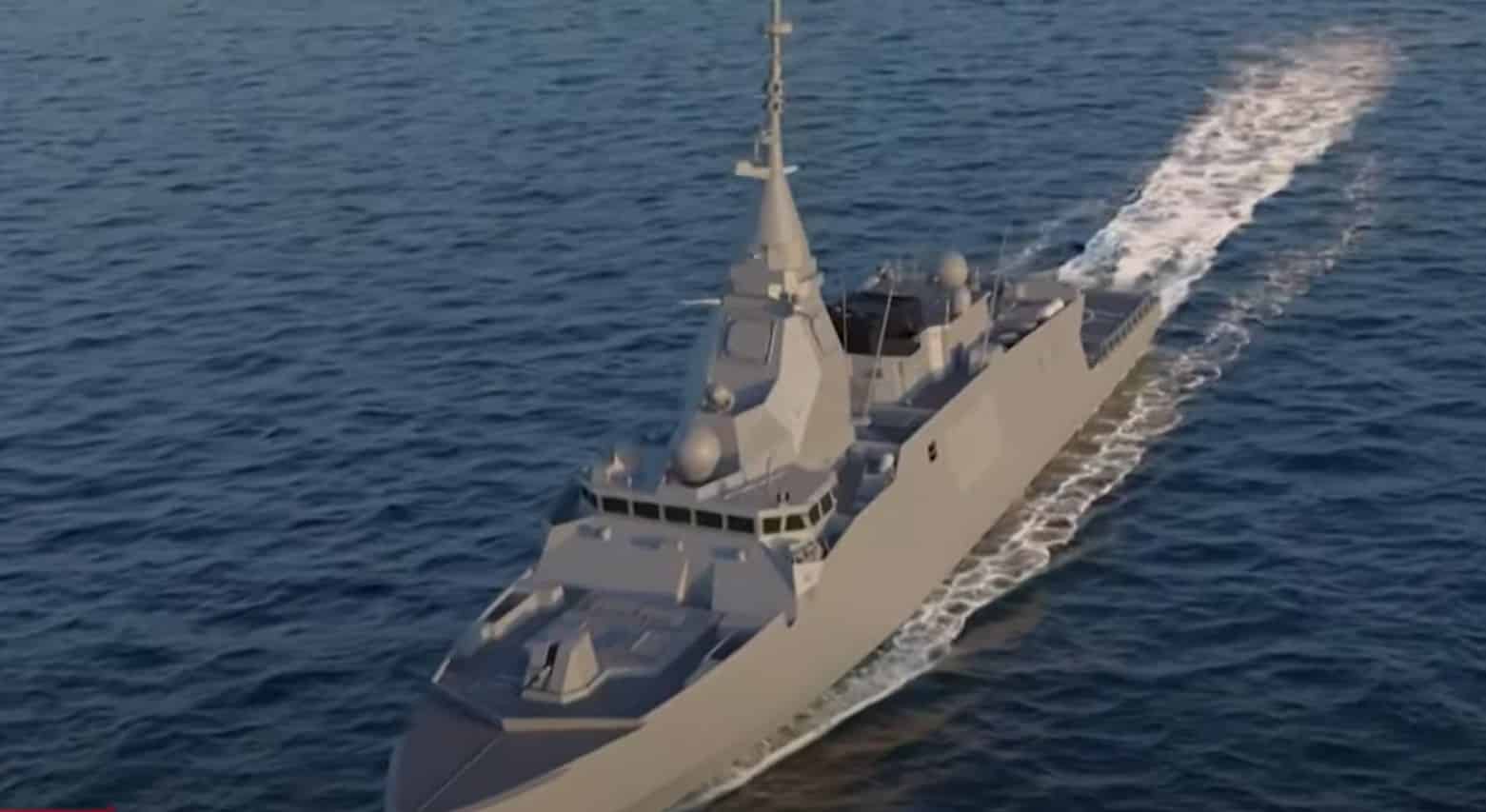
The Greece-France agreement for the operational upgrading of the Greek Navy, through the procurement of 3+1 “Belharra” frigates and the forthcoming construction in Greece of 3+1 “GoWind” corvettes, was welcomed by almost all the scholars of these issues. And rightly so. However, it would be extremely comforting if this unanimity and sympathy were found in time and when the «ball was burning», to use a sporting term...
When the Oruc Rice sailed in the Aegean and Eastern Mediterranean, with Turkey boasting through a propaganda video: «45,000 hours of sailing in 82 days». When the USA were exerting suffocating pressure on our country to accept their proposal and it was presented in the domestic media as «cosmogony at a reasonable cost». Or even recently, when the France seemed «isolated» because of the agreement CLOSURE, which demonstrated for some analysts that «whenever a Western ally had to choose between Paris and Washington, it always chose and always will choose [sic] Washington».
Now that France is trading with the US and «overcomes a major blow to its prestige and credibility internationally» [sic], I wonder who has the right to celebrate? Since Washington immediately welcomed the agreement as soon as it was signed, then everyone can feel redeemed and free to say how much they too... «have always loved France». But is it so?;
A simple internet search shows that the said agreement, including a defensive assistance clause, had been envisaged and proposed by the now retired Professor of the N.C.P.A. Yannis Mazis, with his proposal being based on the rationally re-examined geopolitical data of the Greater Middle East and beyond. When the «ball was rolling» and the loneliness was deafening...
Over the last thirty years, Mazis has recommended the methodological tool of Systemic Geopolitical Analysis, which is invoked to decode the power distribution, challenges, stakes and opportunities of the actors involved. This scientific - and therefore impartial - tool is the ultimate in geostrategic synthesis, which is carried out on behalf of someone and is therefore militant. However, in order to be serious and successful, it must be based on the scientific acquis of the preceding Systemic Geopolitical Analysis.
This orthodox line of thinking may be incomprehensible to those who have learned to make aphorisms of the level of «Francophile» (as far as Yannis Mazis is concerned... Francophile yes, Francophile yes, Francophile not necessarily at least as far as geopolitics is concerned and never with blinders on) or to seek some kind of «expediency» in a conclusion beyond the usual. But it is a reasonable conclusion for a scientist who has deep faith in the methodological tools he uses, because he has tested them and verified their potential through dozens of publications in Greece and abroad.
The commitment to the geostrategic proposal to strengthen our close cooperation with France lies in the de facto strategic alignment between Greece and France, and this may also answer the fear that Paris would honour the defence assistance agreement in case of emergency. Obviously, allied relations are also characterised by uncertainty, with partners having to constantly reaffirm their ally's strategic commitment. Undoubtedly, an indifferent and inactive Greece will fail to mobilise France in case of an emergency.
But the starting point is clear. In the present historical phase of Turkey's neo-Ottoman behaviour and its quest for a hegemonic role in the Maghreb, the Middle East and beyond, France wants to contain Ankara at all costs and recognises that a central geostrategic barrier in this direction is Greece and in particular its naval presence. Consequently, the strategic exhaustion of our country is an unacceptable scenario for Paris, not because the French admire Socrates or like the sliding scale, but because it would mean the aggrandizement of Turkey and the curtailment of French interests in the most geopolitically critical part of the world for them.
Does this endanger Greece's foreign relations?;
The geostrategy of the Greece-France partnership covers this problematic and this was pointed out by Mazis long before the side-effects of the AUKUS agreement. Greece, because of its position on the map, must always take into account the dominant naval power and therefore cannot disregard the priorities and sensitivities of the Anglo-Saxon factor.
And that is why the strengthening of the strategic relationship with France is the right choice! Not with an actor directly competing with NATO interests, but with a major European nuclear power belonging to the Western security system, but with a clearly distinguishable strategic behaviour. With a powerful actor that has every interest in balancing Turkey, without being interested in finding a placeholder for its interests in the region, as it has the will and ability to project power without intermediaries.
Is the choice of “Belhara” operationally optimal?; This has been confirmed by many retired officers, but also by Yannis Mazis himself, as well as by Kostas Grivas, who is an expert in weapons systems. Despite the current absence of the “Scalp Naval” sub-strategic weapon, these ships seem to be an added value for the Greek Armed Forces, given their compatibility with the 24 “Rafale” fighter aircraft under acquisition.”. But let me insist that the crucial aspect of the agreement is the political dimension, which, I repeat, needs to be preserved and constantly cultivated.
The crucial stakes now are the establishment of institutions, a mechanism for making proposals and overseeing national security issues, as would be the case through a National Security Council., which has also been proposed by Professor Mazis. This would make a decisive contribution to our timely and correct alignment with the ever-changing reality of international politics, as well as to the shaping of our arms diplomacy on the basis of our own timetables and not as a result of developments on the other side of the planet.