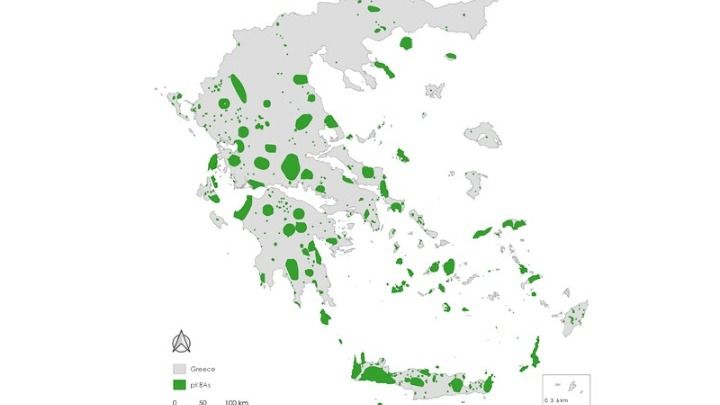
«Greece is leading the way in the promotion of Key Biodiversity Areas, using them as a key tool for the expansion of the network of Protected Areas». This was stated by the Secretary General of Natural Environment and Water of the Ministry of Environment and Energy, Petros Varelidis, speaking to RES-MPA. In particular, our country is one of the leaders at the European level in the effort to effectively protect biodiversity, as it recognizes the Key Biodiversity Areas by law 5037/2023.
In fact, as he made known, the Natural Environment and Climate Change Agency (OFYPEKA) will be responsible for the collection and management of data, while the Nature 2000 Committee assumes the role of the National Committee of these areas, with the main objective of ensuring the conservation and proper management of the Key Biodiversity Areas of Greece.
According to Mr Varelidis: «The Key Biodiversity Areas offer for the first time the possibility to identify important areas using multiple groups of organisms and a common methodology. These areas have been identified since 2016 using quantitative criteria published by the International Union for Conservation of Nature (IUCN), but were designated after an extensive 12-year process involving multiple scientists, stakeholder groups and the public.».
As Kostas Triantis, Professor of Biology at the University of Athens and Managing Director of OFYPEKA, explained to APE-MPA, «Key Biodiversity Areas represent the most important places on the planet for the conservation of global biodiversity. There are more than 16,000 sites in the world, the protection of which is a priority for achieving the global goal of addressing the rapid loss of biodiversity.».
For her part, Konstantina Spiliopoulou, PhD from the University of Athens, says: «According to the database of Key Biodiversity Areas, Greece has 204 areas that are recognized by the Hellenic Ornithological Society as bird areas. With data we have from multiple groups of organisations, the role of many of the Key Biodiversity Areas recognised on the basis of birds seems to be significantly enhanced, while at the same time new areas are being identified, mainly in the Peloponnese and Central Greece. It is important to stress that for the first time invertebrates and plants are emerging as the most important organisms for the identification of Key Biodiversity Areas in our country».
As Mr Triantis concluded: «According to the European Commission's technical report on the criteria and guidelines for the identification of new protected areas, Key Biodiversity Areas are recognised as a key scientific tool for the expansion of the existing network of protected areas.».
It is noted that according to the EU Biodiversity Strategy 2030, Member States should expand the existing network of protected areas to cover 30% of their land and 30% of their marine area.
Elias Palialexis
*Photo: The proposed Key Biodiversity Areas in Greece; Source: Spiliopoulou 2022-Doctoral Dissertation, EKPA