«Which Greece do we live in? Which Greece do we want to live in? How do we get there?»: Around these three central questions revolved the event, under the title, «For Greece ’21»", held on Wednesday evening at Benaki Museum. An event organized, together with the months of research that preceded it, by the GSEE Labour Institute and in the context of which three scientifically innovative researches by Nikos Panagiotopoulos, Professor of Sociology at the National and Kapodistrian University of Athens, and scientific collaborator of the Institute, were presented.
Γ. Gerapetritis: Equal and fair distribution of wealth
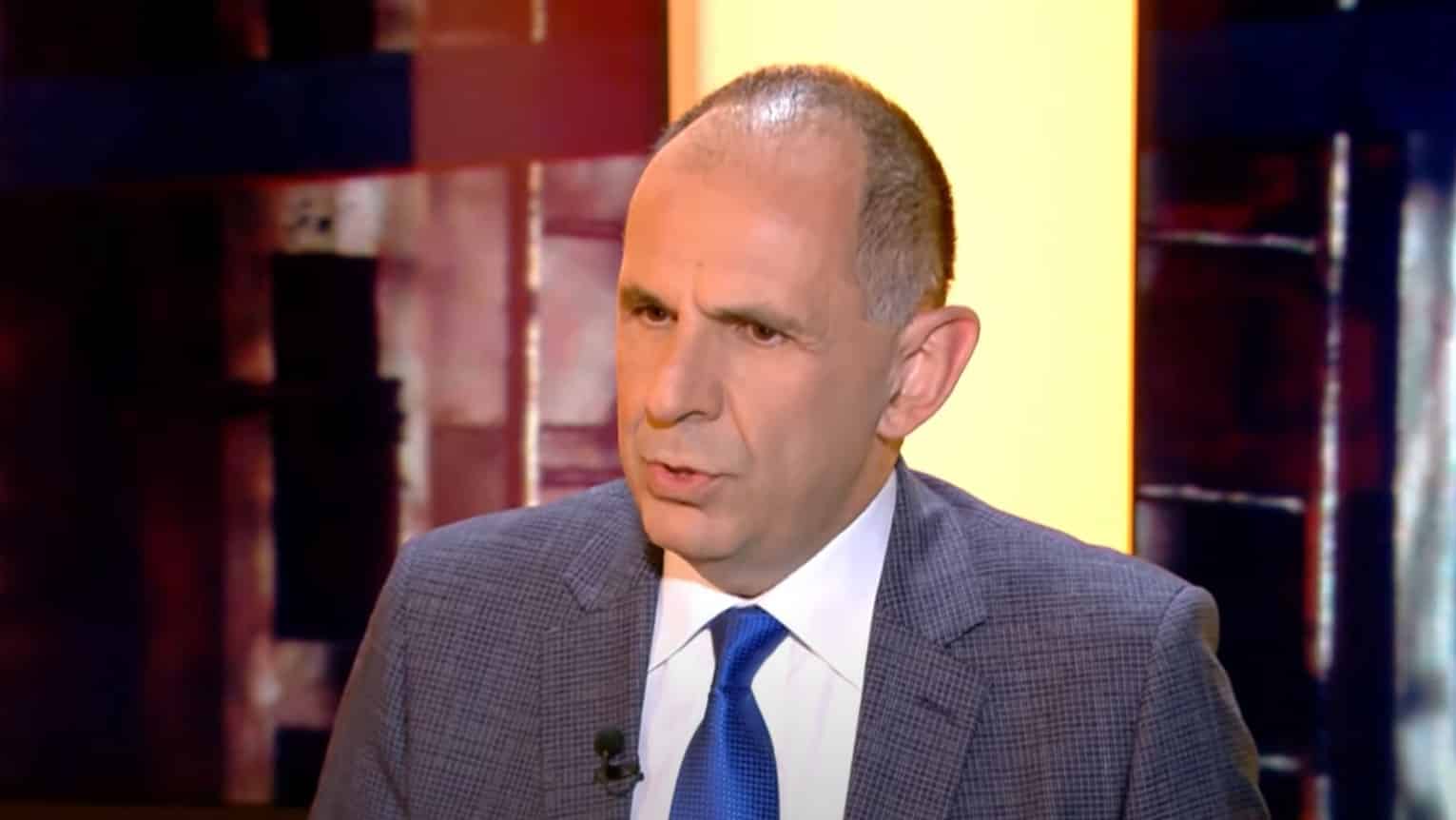
Mr Panagiotopoulos together with the President of the GSEE, Yannis Panagopoulos were the two main speakers of the evening. But starting from the speeches that followed, the Minister of State George Gerapetritis noted that internationally but mainly in Greece there was a big drop in the happiness index during the years of the crisis and «we remain quite low by the standards of the western world», he acknowledged, but added that «in March 2019 the report on the global happiness index ranked us in 82nd place among 156 countries to reach in March 2020 in 77th place and in March 2021 in 51st place, (Greece is) the country with the biggest jump in terms of happiness index».
Recognizing, at the same time, the distrust of citizens for the state, society and institutions, the aim, according to the Minister of State, is for there to be equal and fair distribution of wealth, removing the inequalities that always widen in times of crisis. The minister and academic, stressed at the same time the importance of Education, while referring finally to the great steps taken, as he said, to break the client state and the foci of corruption.
Ι. Stournaras: Conditions for optimism
In his videotaped interview, the Governor of the Bank of Greece, Yannis Stournaras stressed that the results of the surveys of Nikos Panagiotopoulos show that «citizens want to overcome the two dominant ways of exercising politics, namely both of the strict technocratic that claims to work for the happiness of the people without them, and of the demagogic - populist indifference. The political system should take these conclusions seriously,’ Stournaras suggested.
And he continued: «The economic and social policies pursued in the euro area during the pandemic, provides evidence of optimism and differentiates the current approach from that taken during the Greek crisis of 2010: cooperation in science and public health, joint action in the areas of fiscal policy - see the European Recovery Fund - and monetary policy, with the European Central Bank buying the bonds of all countries without exception, are laying the foundations for a new, more collective European joint effort in the areas of public health, the economy and society in.
Asked by the journalist of the radio station «Athens 9.84», Eleonora Orphanidou (who also moderated the event) about how the Greek pessimism can be reversed, the Governor of the Bank of Greece stressed that «in the coming years and with the help of the European Recovery Fund, of European Central Bank but especially with our own efforts and structural changes, we can have a decade of relatively high economic growth rates. If these rates are spread throughout the economy and society, I believe that this problem expressed, perhaps justifiably, by citizens will be overcome.» After the Stournaras interview, a video was also shown of the approach of a frontline teacher, the substitute - hourly teacher at a second chance school, Pavlos Liaropoulos.
The opposition's approach
On behalf of the opposition, MP, George Katrougalos He criticised the government for the removal of sociology from the compulsory subjects, with reference to the sociological research of Mr Panagiotopoulos, while at the core of his speech he invoked the well-known story of the multimillionaire G. Buffett, who revealed that he pays less tax than his secretary. «It is not only that the wealth that has been generated over the last 40 years is actually being reaped by 1% of the population, it is that at the same time the institutions of redistribution and support for the welfare state are undermined, which was the result of the post-war historical compromise», noted G. Katrougalos, who, at another point in his speech, said that the improvement of the country's position from 2019 is not unrelated to the policies implemented during the four-year period 2015-19, while. the index of social inequalities declined at the end of SYRIZA's term of government.
In the political «for all intents and purposes» of the opposition MP, «people gain power when they organize and assert themselves through trade unionism, political parties and mass organizations», thus overcoming the existing problems in trade unionism and collective representation.
Different, of course, is the position of the MP of the Movement for Change, George Kamini, who after speaking about the fake prosperity of the 1980s, 1990s and 2000s, since it was based on borrowing and indebtedness, as he said, pointed out: ’The sudden collapse of the living standards of many people caused social anger expressed in the squares of the indignant, led to the rapid electoral rise of SYRIZA and the assumption of government power together with the ANEL party. The electorate believed in SYRIZA's promise that it would tear up the memoranda, but the expectations invested in it evaporated after only six months, until the referendum. The Syriza - ANEL coalition signed its own memorandum, which it managed until 2019.’.
Critical of the current government, G. Kaminis, who focused on the areas he is responsible for on behalf of his party: «in the areas of policing, civil protection and prisons, I have not seen any serious reform at all». In particular, «in prisons we are experiencing anti-reform», he argued, and continued: «the resignation of Michael Chrysochoidis is bound to frustrate the implementation of all the measures announced by the Ministry to curb police arbitrariness». Finally, in the field of civil protection, after the summer fires, «we saw with the first floods that the preventive measures that the State should have taken had not been taken».
Voice to the silent citizens
This was preceded, as noted above, by the contributions of Messrs. Two of them were carried out by the Professor of Sociology and his research team, and were published in equal volumes («The Unseen: Sociology of the popular classes in Greece» and «Citizens talk about Greece») under the general title, «For Greece in 21’ - »Field« publications, while the third one was carried out and published within the framework of the INE (»Greece ten years later«). According to N. Panagiotopoulos, the »invisible« are none other than the people of everyday life, the ordinary people who toil for today and tomorrow, their own and their families».
GDP growth alone cannot make the citizen happy, the President of the GSEE pointed out, in order to underline that «all three surveys are characterised by the concern to analyse and publicise the real experiences of so-called everyday people, to give them space in the public debate, to make them known and understandable. In reality, individuals, and especially the most needy of them, remain »mute', but they are given a voice through the three inquiries. Finally, speaking about the economy of happiness and the economy of evolution, I. Panagopoulos acknowledged that these issues are something that trade unions have to put on the public agenda.
For his part, Professor N. Panagiotopoulos, after first of all referring to a pioneering research, which is, after all, still in progress, stressed that in the last 10 years it has been observed in our country «a rapid, extremely violent collective degradation and at the same time a subjective deterioration of life. A very intense deterioration in the world of work, unemployment, job insecurity, reduction and instability of wages and incomes, impoverishment of the most vulnerable social categories, first of all, of course, the unemployed, impoverishment of the most precarious and poor workers, with the result that economic and social inequalities are reinforced.».
And, at the same time, «we had a public health crisis, a deconstruction of the value of people's educational investments, since we considered that degrees were no longer useful, and a serious deconstruction of trust in institutions and in Others‘ (p.The professor of Sociology also said, deploring, on another point, the structural violence of the financial markets, which, he said, has as its price suicides, delinquency, drugs, alcoholism and violence. He called for both »dangerous populism« and »authoritarian technocracy« to be renounced.
Indeed, N. Panagiotopoulos recorded, through the research, the feeling that the unsung feel that they are not supported by official politics, that politics is a microcosm closed in on itself. One of the resulting issues, he observed, is to redefine the social image of the role of politicians; ultimately there needs to be «a huge shift in the role and image of politicians for what they do».
The research of INE/GSEE and N. Panagiotopoulos, through the personal interviews conducted by the research team, was finally presented on stage at the Benaki Museum, through the short documentary film, directed by Angelos Kovotsos, the theatrical analogue with the actors Manolis Mavromatakis and Filareti Komninos, as well as the one-act play, directed by Dimos Avdeliodis, while the visual banners were based on the painting by George Rorris.