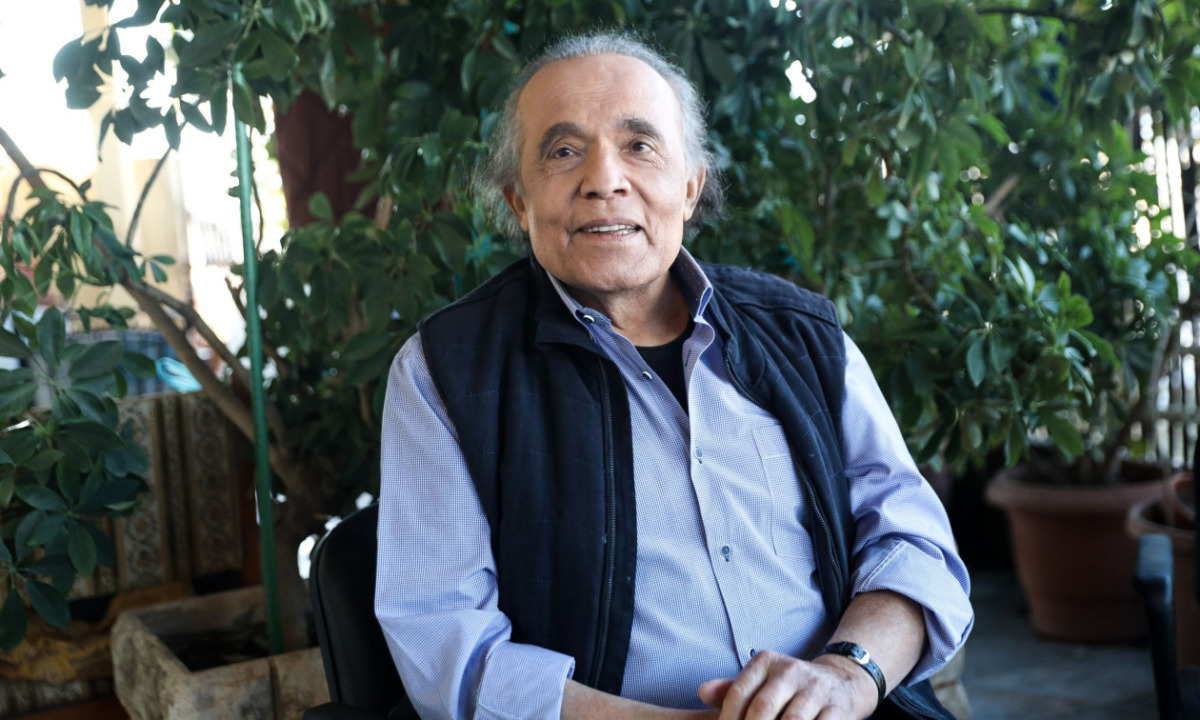
The tendency to confuse folk tradition with quaintness is a common phenomenon in our country. We consider «tradition» to be anything that smells of tsikna, the clarinet of misfortune, and a fustanella made in the People’s Republic of China. But true folk tradition is not a museum exhibit, nor is it a plaster ornament for our national anniversaries. It is a living, rebellious organism that breathes ceaselessly. And if you want to know what this organism sounds like when it breathes without the artificial filters of art dealers, all you have to do is let yourself be carried away by the voice of Lakis Chalkias.
Chalkias wasn’t simply born into a musical family. He was born into the very mythology of the Greek sound, the son of the unsurpassed Tassos Chalkias, raised in an environment where music was not a profession, but a way of engaging with death and life. Except that, much to the disappointment of the commercial music scene, Lakis refused to become just another «entertainer» on the keyboard. He realized early on that his legacy was not a marketable commodity, but a heavy, unyielding responsibility.
Lakis Chalkias’s voice wasn’t meant to accompany your meal at some trendy tavern in Plaka, amid cheap retsina and tourist illusions. It is a Doric voice, rough, carved in stone, carrying within it the dampness of the mountains of Epirus, the unbearable pain of emigration, and the heavy, silver silence of its rivers. When she sings, she doesn’t try to impress you with girlish frills, artificial enthusiasm, or cheap vocal acrobatics. She hurls the notes at your face like stones freshly pulled from the frozen river. Stones smoothed by time, yet capable of shattering your complacent consciousness.
Lakis Chalkias’s great genius—and I use the word in its authentic, aristocratic sense, not in its marginal one—was that he grasped the obvious in time. Folk song is not an innocent, bucolic depiction. It is the mother of political song in this country. It is the raw material from which collective memory, resistance, the lament of the common people, and the dignity of the wronged sprang forth.
When Yannis Markopoulos composed «The Thessalian Cycle» in 1974, with lyrics by Kostas Virvos, he didn’t simply create yet another «art-rock» album of the Metapolitefsi era to be consumed in concert halls. He created a comprehensive, unflinching sociological treatise on Greek agrarian capitalism. The Thessalian plain is not presented there as an idyllic, pastoral landscape with bucolic, love-struck shepherdesses, but as a battlefield of bloody class conflict.
From the invisible exploitation of the peasant and the feudal structure of the countryside, to the Kileler uprising and the violent, uprooting of the peasant into the city’s factories, this work captures the historical journey of an entire class that toiled the land so that others might reap its fruits. In this landscape, Chalkias does not «interpret» in the cantadoric, bourgeois, or melodramatic sense of the term. He becomes the plain itself. He becomes the parched soil thirsting for justice, the sweat of the plowman dripping into the furrow, the whisper of the wind through the cornstalks. The way his voice is delivered leaves no room for facile sentimentality. His voice is crushed by the weight of centuries of injustice; he does not ask you to pity him, but demands that you understand, remember, and reflect.
We live in an age of cheap production and even cheaper consumption, where music is produced on computers, mass-produced, and consumed like chewing gum that loses its flavor in five minutes. Amid this digital wasteland, Lakis Chalkias stands like those old stone bridges of Epirus. They don’t care if the muddy waters of current events flow beneath them or if air-conditioned cruise ships and tie-wearing nouveau riche sail past them. They stand there, silent and immovable, because they are built from materials that withstand the test of time, bound together by the mortar of history and the blood of the master builders.
The «Thessalian Circle» and Chalkias’s entire career remain a landmark because they achieved what is unthinkable by today’s standards in the commercialized music industry. They blended high artistry with class consciousness, without descending into dry party propaganda or wooden rhetoric. They transformed the social struggle into high poetry and the folk melody into a contemporary existential manifesto.
Chalkias is one of the last greats who remind us that song in Greece was never «entertainment»—in the sense of nourishing the soul with utter nothingness—but rather an existential, political, and deeply redemptive act. It was the way for a person to stand tall in the face of authority, time, and death itself.
So, all you believers, come and listen. The rest of you, go on lulling yourselves to sleep with the songs from your TV screens and the sounds of your manufactured oblivion.