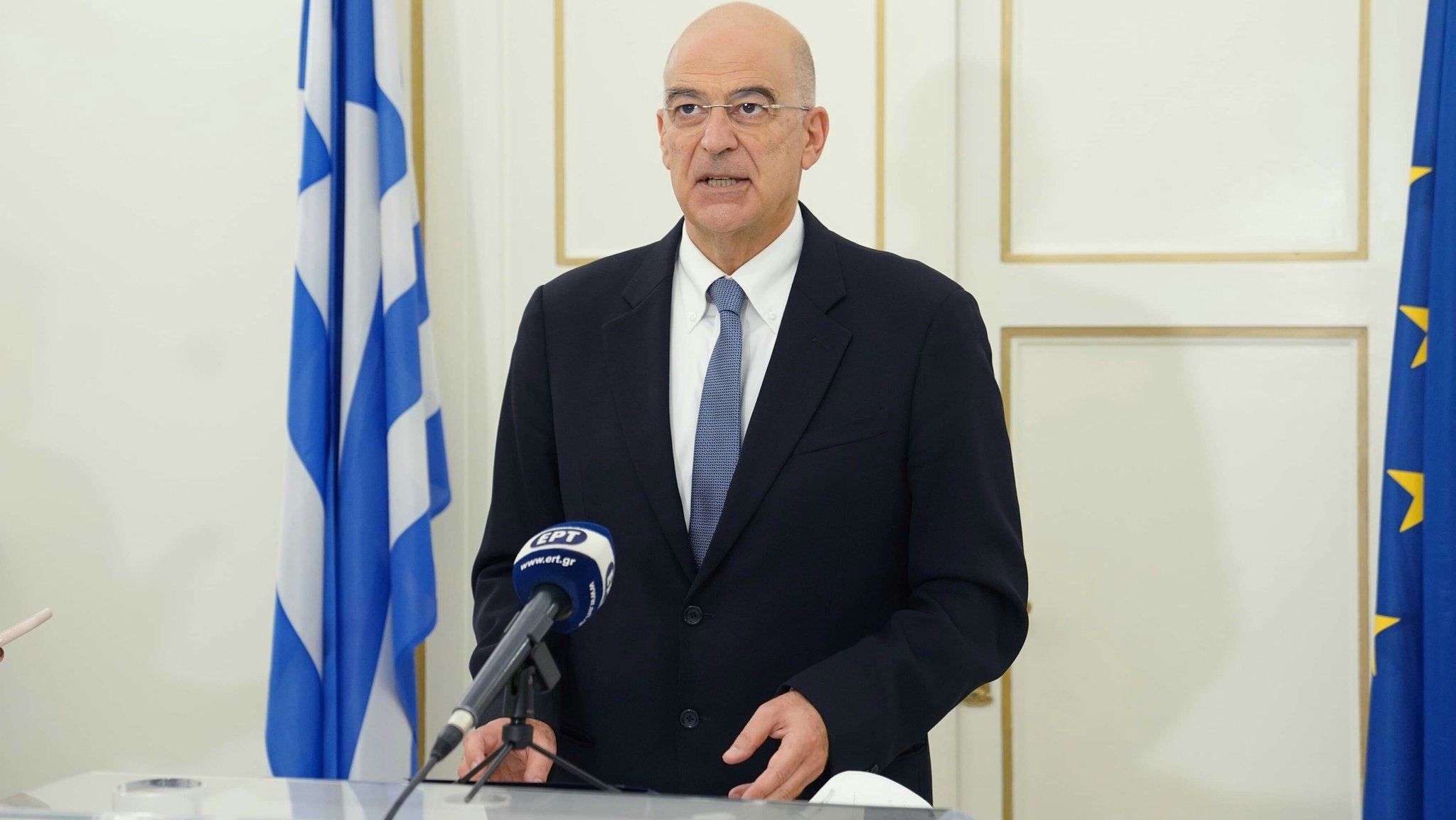
“The transformation of the anniversary of the Asia Minor Catastrophe into a celebration of hatred and war cries from the other side of the Aegean, causes only sadness”, underlines Foreign Minister Nikos Dendias, in an article in the newspaper “Democracy” on the tribute to the 100th anniversary of the Asia Minor Catastrophe.
As Mr.Dendias stresses, “Greece, with all its occasional failures, managed to turn the Asia Minor disaster into a factor of national creation. And gradually over the years, it has managed to become a member of a strong European group of states, today's European Union”.
“Greece has developed into a society of values and principles, with full respect for the law, including, of course, international law,” he says: “But today's Turkey, as it sadly turns out, has learned nothing from the destruction of the Ottoman Empire, which it utterly and irrationally yearns for. And it is using it as an excuse to revive a nationalist spirit, which is a clear challenge and proof that it is looking to the Ottoman past and not to a European future, which, fortunately, is still envisioned by a significant part of its society.
The Foreign Minister notes that the Asia Minor Catastrophe “remains 100 years later a traumatic event for our collective memory and our modern history, but also an occasion for drawing conclusions at the level of national self-awareness”, while he characterizes the uprooting of hundreds of thousands of Greeks from their ancestral homes for millennia as “a «wound» that has not healed in our national consciousness and will not heal in the foreseeable future”.
“The unforgettable homelands, the persecution, the hundreds of victims, the human pain, the refugees, the families that were separated and lost, but also the integration into a stagnant Greek society, are experiences that are «alive» today. Experiences that are constituent elements of the country's current identity. After 1922, nothing is the same for Hellenism anymore”, he stresses.
At the same time, he adds, “it became a starting point for the enrichment of Greek society from the rich and particular cultural elements that the survivors of the Asia Minor Catastrophe brought with them from the other side of the Aegean. Smyrna, Ephesus, Philadelphia, Anchialos, Nikaia, Adana, Vourla, Phocaea and so many other place names are not just memories or names of today's regions and streets. They are the geographical context of experiences, which links the past with the present.The refugee populations that took root in many parts of the country became the occasion for a real renaissance of these areas‘.
“Their integration into the society of metropolitan Greece was ultimately a feat for a country trying to recover from years of war. Their dynamism and ingenuity allowed them to excel in all fields within a few decades,” he points out, citing the poetry of diplomat George Seferis, the literature of Elias Venezis and Dido Sotiriou, the entrepreneurship of Aristotle Onassis and the directorial eye of Karolos Koun.
“But the Asia Minor Catastrophe is also a trigger to reflect on the consequences of the National Schism that preceded it and of which it is essentially the result in one way or another. In a debate, which remains politically and ideologically charged even a century later, about the causes, I would not wish to take a position on the «it's their fault», nor do I claim laurels as a historian.”.
“The Asia Minor Catastrophe continues to be the most obvious proof that whenever Hellenism was divided over a foreign policy issue, the results were disastrous. This conclusion can only serve as a guide to the need to preserve national unity as the apple of the eye, at least as far as the main choices concerning the country's international relations are concerned. It goes without saying that individual differences are legitimate, just as the right to criticise is unquestionable. In a critical period, however, such as the present one, it would be unwise to allow a new Schism to bring about the disastrous results of the past,” he stresses.
“Everyone should bear in mind, inside and outside the country, that the two most traumatic events for Hellenism in the last 100 years, the Asia Minor Catastrophe and the Turkish occupation of Cyprus (despite their significant individual differences), occurred only after Greece had been divided on principle on both these issues.” Dendias said that “the Mitsotakis government has succeeded, fortunately, in ensuring that foreign policy in general is not a field of fierce partisan confrontation. With the contribution of the opposition parties, I hope and hope that in a critical juncture such as the one we are going through, this will continue and that the quasi-election period will not put the need to preserve national unity on the back burner”.
“The best way to pay tribute to the memory of the victims of the Asia Minor Catastrophe, but also of those who came from the other side of the Aegean and contributed to the reconstruction of the country, is precisely to preserve the national unity to which I mentioned above”, he stresses and concludes: “Greece cannot act as an isolated country from global developments. It must understand the messages of the times and, relying on its alliances, seek maximum benefit when conditions allow. Only in this way can it have a voice and a role in developments in its region.